









Review: Hotone Freqlux
Freqlux has a deep pitch-based bag of tricks set to provide some seriously unusual and inspiring deviations.

By Brad Watts
7 May 2026
Hot off the heels of this year’s NAMM show, Hotone has added a second member to what would appear to be the beginning of a series of specialty ‘NeonGlow’ pedals, rather than the company’s usual fare of multi-effects and amp simulations. Almost a year ago, AT’s Andrew Bencina reviewed the Hotone Verbera, a dual convolution/algorithmic reverb pedal. Following in the same form factor is the Hotone Freqlux – a pitch-based bag of tricks set to provide some seriously unusual and inspiring pitch deviations. There’s a lot going on with the Freqlux. It’s far from your typical harmoniser or pitch-shifter.
THE NEW NORMAL
I’d contend pedal design has evolved a newer, more practical format – the mid-sized pedal. Strymon seems to have settled on a standard for its middle-range pedals, as has Walrus, Wampler, even JHS to a degree. Pedals that are just that bit larger than the typical Boss/Ibanez/MXR form factor we’ve become accustomed to since, gosh, 1977-ish(?), along with the ingenious revelation that input and output jacks are best positioned at the top side of the pedal rather than the sides like yesteryear’s designs (JHS not so much). Consequently, there’s a little more room to squeeze pedals onto your board without patch cables absorbing precious real-estate. As long as you’re not wearing clown shoes you’re fine. Also making a noticeable disappearance is the option to run pedals with a 9V battery. Who needs batteries when your board is permanently powered with an isolated mains supply? Besides which, most contemporary digital pedals would churn through a 9V battery before your first set.
CHIC LE FREQY
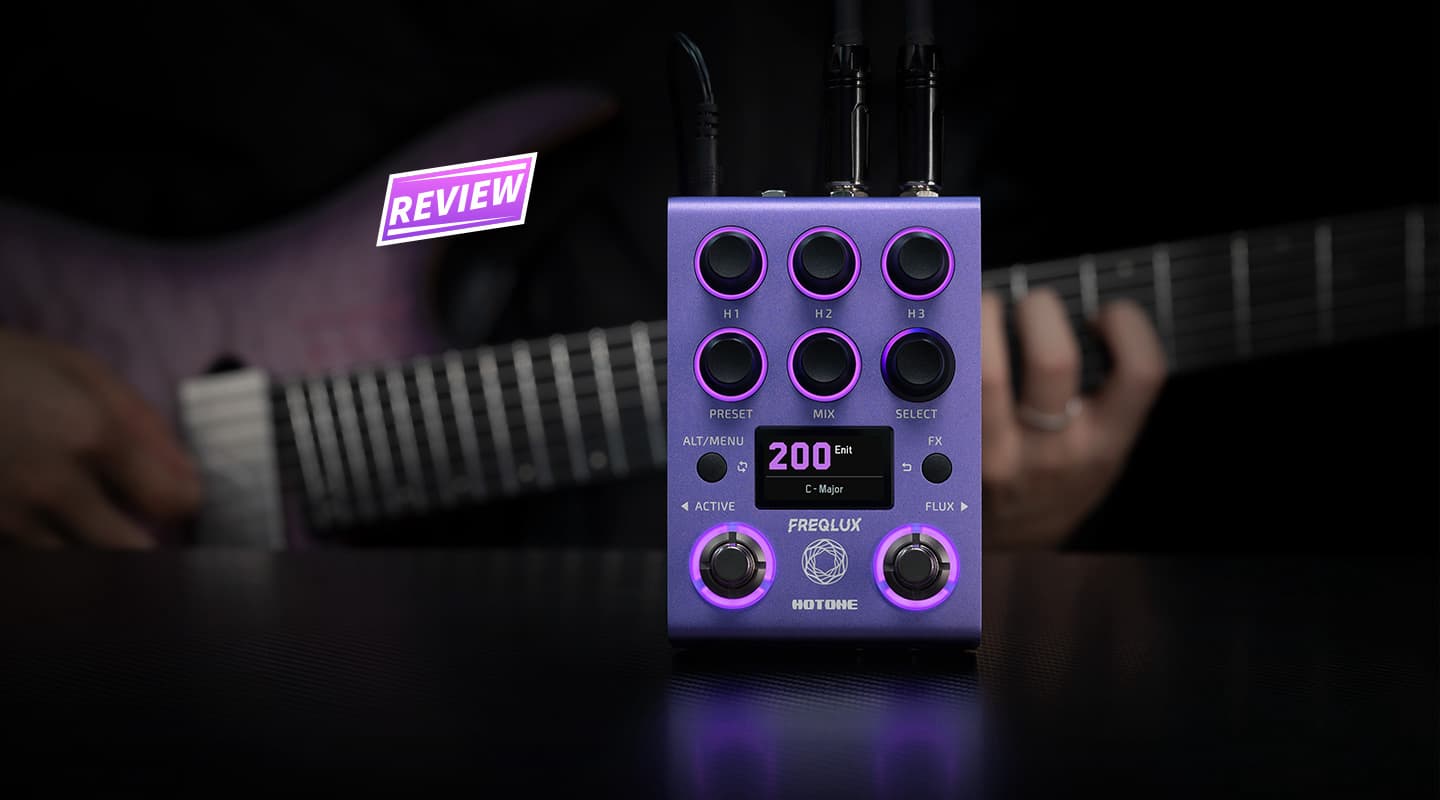
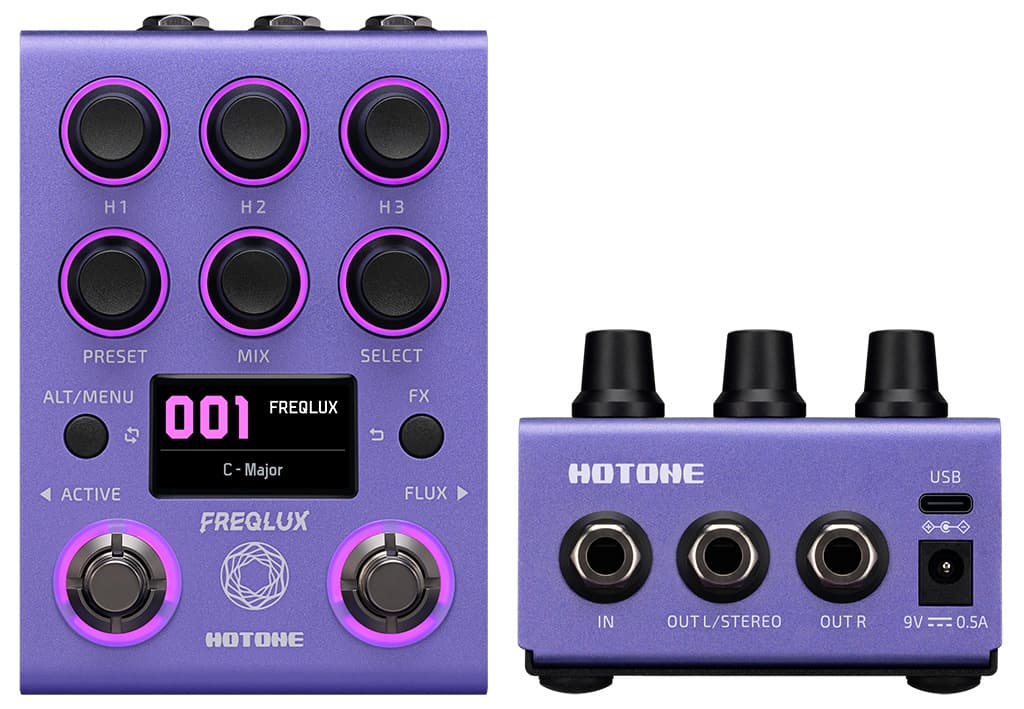
Which brings us back to the Hotone Freqlux. Stereo analogue audio I/O at the top of the pedal, along with a 9V/0.5A input, and a USB-C port. Contrary to my preference for jack inputs at the rear of a pedal, the Freqlux sports two 3.5mm jacks at the front of the unit. One doubles as a MIDI in or expression pedal input, the other for MIDI thru. By space necessity you’d employ 90° connectors for these, otherwise they’re going to get stomped on and broken, potentially leaving a jack plug permanently inserted into either input. Hotone graciously include a 9V power adaptor with an overly generous 2m cable, so prepare to rewire it if you’re incorporating the pedal into a dedicated board. It’s a lot of cable to be coiling up and tying into RF submission, or make certain your board’s power supply can handle the 0.5A draw. The unit can be powered via the USB-C 2.0 port, but that requires a greedy 2A. USB also provides connectivity to the soon-to-be-released editing software, ‘Neon Collector’. According to the manufacturer, this software will cater to all pedals in its NeonGlow series, which thus far includes the Verbera convolution reverb, and now the Freqlux. I’m led to believe there are more to follow in the series. MIDI can also be communicated via the USB port. Build quality is what should be expected in a stomp-box – steel housing and 2mm plate aluminium – solid.
NEED TO KNOW
Hotone Freqlux
Pitch-Based Guitar Effects Pedal
Top-side of the pedal you’ll find a small display with parameter/menu select buttons either side. Moving up, there are six continuous rotary encoders for parameter adjustment, two of which are detented and also provide push-button capability. Surrounding each of the encoders is some suave purple-ish glowing LED to signify where the pot is set. The front-and-centre pot is hardwired permanently to global mix between effect and dry signal, so that’s a no-brainer for quick adjustment. For the upper pots you need to rely on where each pot’s LED surround is ‘glowing’ for broad adjustment, or stoop down to read the parameter setting with more precision via the screen. It’s a necessary evil with multi-effect-style units. Inevitably there’s too much information to peruse with anything other than a display. If you’re a super-tweaker you’ll appreciate the depth. If you’re a ‘set the knob where it sounds good’ player you may find the display too complex. Either way, Hotone has struck a happy medium between screen adjustment and broader settings assessment via the LED surrounds of each pot.
Of course, being a digital processor there are program slots, with about 100 presets out of the box, and room for another 100 user programs. Oddly, the manual reports some obscure MIDI controller numbers for program/patch changes. MIDI CC #14 (which is typically undefined in the MIDI spec) as bank select between the two 100-program groups, then followed by a program change command. It seems a little over engineered, so if you’re driving MIDI data from an external switcher or controller, make sure it has the smarts to cope. Else-wise, every single other parameter of the Freqlux can be addressed via MIDI – and there are a lot of parameters.
The two footswitches cover multiple uses: up/down through programs, bypass, tap-tempo along with a ‘flux’ mode allowing you to dynamically alter parameters according to the time the footswitch is held down. Unusually, the program change and bypass functions instigate when the footswitch is released, not on immediate down-press. I’d much prefer making these changes with a down-beat press, not when lifting my foot.
If you’re not frightened by complex menu operations and a steeper-than-usual learning curve, then I’d say the Freqlux is a worthy pedal for going where no guitarist has gone before
THE PITCH
Don’t be misled by the Freqlux name – this isn’t a frequency modulation or filtering device. Freqlux deals with pitch (ok, ‘frequency’) shenanigans. It’s a pitch shifter on steroids, and then some, with some incredibly unique effects possible.
The effects engine comprises three harmonising modules which can each alter pitch up or down to three octaves – according to key or not, detune for finer pitch adjustment for modulation effects such as chorusing and tremolo, pan position of each module, level, tone, modulation speed and depth. You can even set delay times for pitch-altered repeats and feedback, and set those to MIDI clock and bar divisions, or save a tempo to each program. You could effectively use the Freqlux as a delay unit alone. As mentioned, all these parameters can be altered via MIDI controller messages.
THE ROAD
But is the Freqlux a must-have? It’s a loaded proposition. If you’re not frightened by complex menu operations and a steeper-than-usual learning curve, then I’d say the Freqlux is a worthy pedal for going where no guitarist has gone before – not to say you can’t shunt any instrument you like through it. Synthesists (is that even a word these days?) will find the Freqlux inspiring also. If you’re mimicking bass, string sections, or Hammond organs in a covers act, you may well find the unit essential. Equally so if you’re just after maximum experimentation. If menu-diving ain’t your thing, be warned, you may find the Freqlux daunting. In short, give it a go and see what you think. I guarantee you’ll hear effects you’ve not experienced before.






RESPONSES