

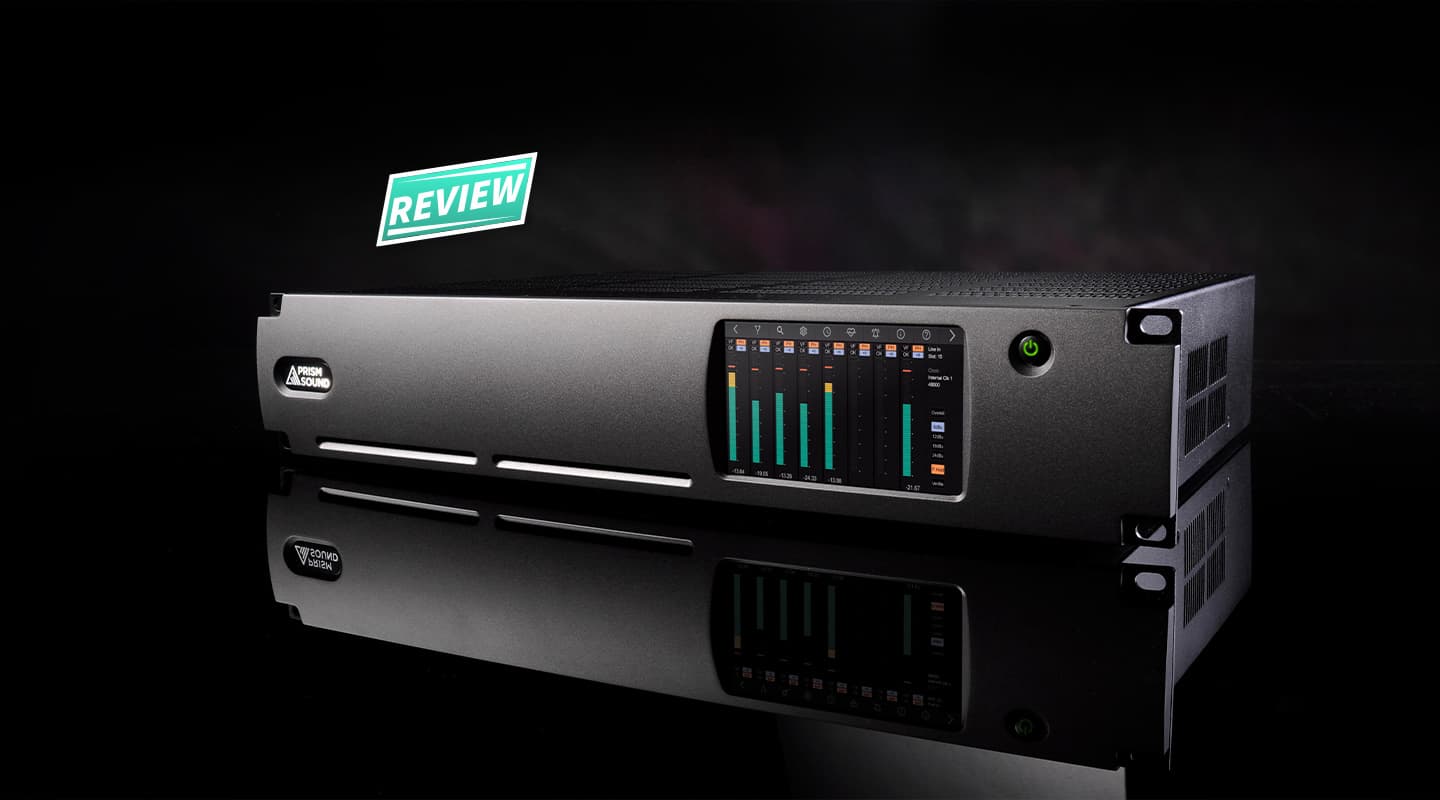
Review: Prism Sound Dream-ADA
Dream-ADA is a no-holds-barred, modular converter for facilities with high channel-count requirements and high expectations.

3 July 2026
Review: Ben Feggans
Prism Sound has long been a highly respected name in professional audio. Founded as a consulting firm in 1987, the company worked on precision analogue-to-digital conversion, with an emphasis on dynamic range and low-level distortion. In 1993, the Prism Dream AD-1 became a benchmark A/D (analogue-to-digital) converter, followed by the Dream AD-2 A/D and DA-2 D/A converters, used in many high-profile mastering studios in Europe, the United States and here at Studios 301 Sydney. These products paired a no-nonsense, almost laboratory-like, interface with exceptionally precise sound. The ‘Prism sound’ is widely regarded as transparent but not sterile – still retaining a musical quality that has made the brand popular for mastering and audio restoration. Prism later moved into multichannel tracking with the ADA-8 modular A/D and D/A converter in 2001, subsequently upgraded for 192kHz operation. After releasing a range of professional USB audio interfaces, Prism has now revived its highest ‘Dream’ designation with the Dream-ADA, which is in the studio for review.
ALL FACETS
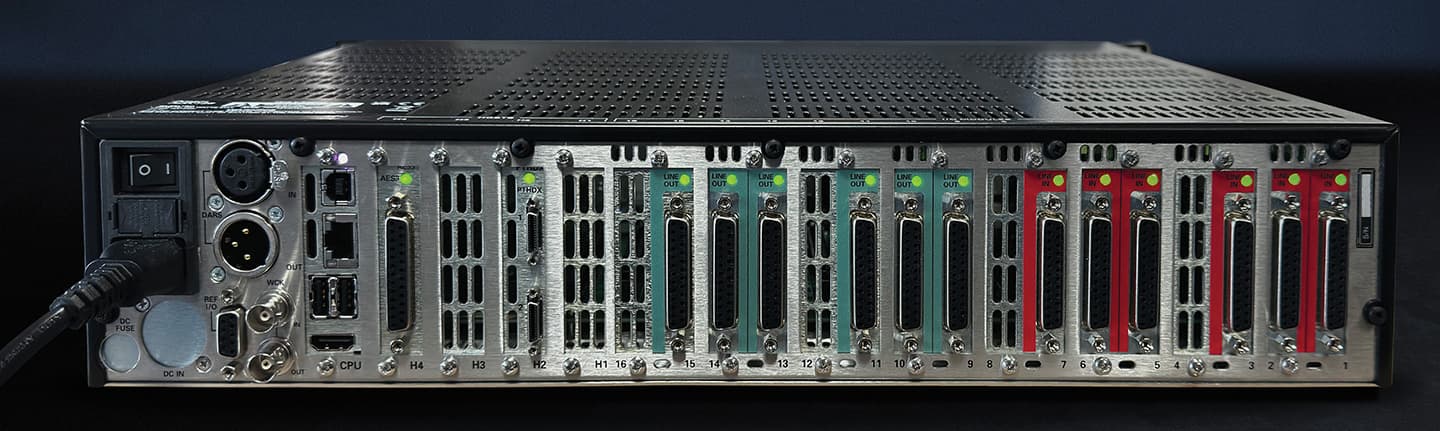
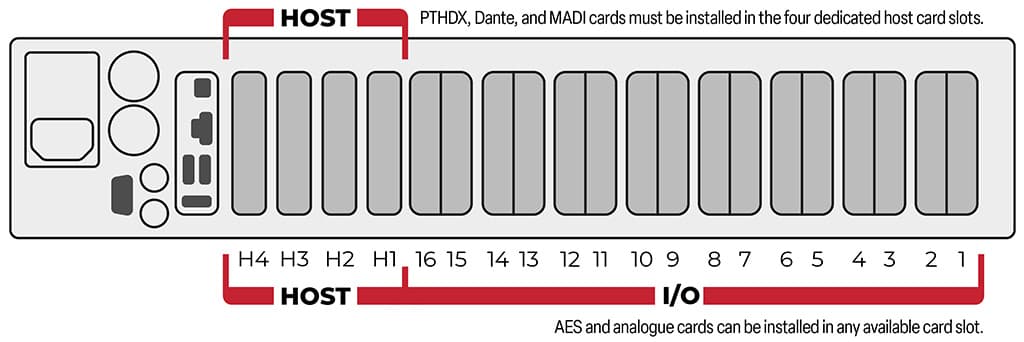
The Dream-ADA is a modular 2U chassis that builds on the legacy of the Dream ADA-8XR. As you would expect from Prism Sound, the build quality is excellent. The chassis can accommodate up to 20 plug-in modules, enabling a Dolby Atmos-ready 128-channel system. Modules come in two formats: I/O and Host, and the Dream-ADA can accommodate up to 16 I/O modules and four Host modules. I/O module options include 32-bit, eight-channel line-level A/D conversion; eight-channel line-level D/A conversion; a new eight-channel mic/line A/D interface with premium mic preamps; and a 24-bit eight-channel AES3 interface. These I/O modules use Tascam DB-25F connectors, so you will need breakout looms. Current Host module options include Pro Tools HDX, Dante and MADI, each offering 64 channels of 24-bit/192kHz bidirectional audio. Prism Sound says additional Host modules will be released in future.
Configuration can be handled from the five-inch TFT front-panel touchscreen, or via the RJ45 network interface over IP. There is currently no USB-C or Thunderbolt option. The CPU control module includes USB-A, USB-B and HDMI sockets designated for ‘future use’. Unlike the Dream ADA-8XR (which offered FireWire), the Dream-ADA cannot currently operate as a standalone USB or Thunderbolt audio interface, as this interface is aimed at facilities already with professional audio over IP networks. In practical terms, you need a Host module (such as Dante or Pro Tools) to integrate it with a DAW, or an AES3-capable interface if you have the AES3 I/O module installed. Another key difference from the ADA-8XR is the omission of the monitoring module and headphone output, so you will need your own monitoring controller (hardware or software) and a headphone amplifier. For additional monitoring control, Prism Sound has collaborated with Ginger Audio Sphere immersive speaker management (license included).
The Dream-ADA contains four independent clock generators, each able to run at different sample rates up to 192kHz and with different module sync sources. Host and I/O modules can be dynamically assigned to these clock domains, allowing multiple workflows (for example, separate project studios or ingest stations) to share the resources of a single Dream-ADA simultaneously. The CPU card also provides DARS I/O on XLR, plus main wordclock I/O; additional wordclock I/O is available on a nine-pin connector. Only a single IEC mains inlet is fitted, although the on-screen interface suggests a future dual power-supply option.
DSP PROCESSING
DSP on the mic/line and line inputs includes level calibration and trim, mid-side processing, and a selectable high-pass filter. The line inputs also feature the legendary Prism ‘Overkiller’ limiters, designed to allow clipping without the usual distortion. At the heart of the Dream-ADA is ADRA (Advanced Digital Routing Architecture), controlled by a dedicated master routing DSP module installed in every system. ADRA creates and manages internal signal paths between the I/O and Host modules according to the user’s requirements. Routing in the Prism interface is performed in groups of eight via drag-and-drop; more granular routing can be handled in the Dante Controller application.
NEED TO KNOW
DREAM-ADA WAKES UP
If you have read this far, you are probably wondering, ‘So, how does it sound?’, which was also my first question on opening the box. Before assessing sound quality, the unit needed to be connected to a DAW and integrated into a mastering chain. Amber Technology (which has taken on the distribution in this part of the world) supplied DB-25F-to-XLR looms for analogue and digital I/O. For the first listening tests, the Dream-ADA was connected to an RME Hammerfall AES interface using a PC DAW running Sequoia 16, with the web interface accessed via RJ45. The browser-based control is intuitive, and routing is far simpler than on the previous ADA-8XR with its small ‘screen and button’ navigation. Metering and routing pages are clear and well laid out, and the front-panel touchscreen can mirror the same settings as the web GUI. A Settings page allows entire system configurations to be saved, recalled, renamed or deleted. One practical suggestion: a touchscreen lock would be useful for rack-room installations.
To properly assess the Dream-ADA, I ran a series of controlled tests and documented the results. In the studio, I used a Prism Lyra 2 for comparison, and an older Benchmark DAC-1 as a reference for a thicker, less refined presentation (many engineers use a Burl D/A for a similar effect). I am very familiar with the Prism range, having used a Dream AD-2 for over 15 years, and prior to that an ADA-8XR. I recorded several passes by running audio from the DAW to the Dream-ADA via AES, through analogue mastering hardware fed from the Dream-ADA line outputs, and back into the DAW via the Dream-ADA line inputs. I then performed the same loop tests using the Lyra 2, and then the Benchmark DAC-1 feeding the analogue chain with capture via the Lyra 2. For programme material I used one rock mix and one electronic music mix. The resulting sequences were labelled A, B and C for blind listening, then sent to two mastering engineers and two recording engineers.
The recorded 24-bit/48 kHz test loops were:
- A – Prism Dream-ADA D/A, through a mastering chain, into the Dream-ADA A/D
- B – Prism Lyra 2 D/A, through a mastering chain, into the Prism Lyra 2 A/D
- C – Benchmark DAC-1 D/A, through a mastering chain, into the Prism Lyra 2 A/D
After completing the AES-based recordings, I connected the unit via the Dante Host module. Setup was straightforward and, unusually for audio-over-IP, it even worked over DHCP instead of a static IP address. The more time consuming part was obtaining a Dante Virtual Soundcard trial licence from Audinate. After several rounds of verification steps, I secured a 30-day trial. Dante Virtual Soundcard behaves much like an ASIO interface between the DAW and the Host module. Dante Controller then provides the more detailed routing matrix, along with device latency settings and bandwidth monitoring. If you want both Dante audio and the Prism remote-control GUI on the same network, you will need a network switch. For large studio complexes or broadcast facilities, dual redundant Dante is clearly a strong fit.
To properly assess the Dream-ADA, I ran a series of controlled tests and documented the results
SUBJECTIVE SOUND QUALITY
So, how does the Dream-ADA sound? I am delighted to report that Prism Sound has once again raised the bar in terms of sound quality. The first thing I noticed was the extraordinary amount of top-end detail. Although the unit measures flat in frequency response, it subjectively presents as having more ‘air’ than some earlier Prism converters. Stereo imaging, midrange articulation and the solidity of the low end were outstanding: transparent, yet still engaging. Compared with the Lyra 2, I was able to identify the Dream-ADA consistently in blind listening – though the Lyra 2 still sounded excellent, we are talking small fractions of percentages of differences here. Using the Benchmark DAC-1 as the D/A source gave the chain a thicker character that was less finely detailed than the Prism D/A, but still musically pleasing.
The blind-test feedback was interesting. Of the two mastering engineers, one preferred the Dream-ADA loop (Test A) and the other preferred the Lyra 2 loop (Test B), with Test C last. Of the two mix engineers, one overwhelmingly preferred Test A, while the other preferred Test B. In other words, it was a 50/50 split between Dream-ADA and Lyra 2 in this small sample. Personally, I preferred the DAC-1 as a D/A source for the rock mix into the Lyra 2 (Test C), and the Prism Dream-ADA loop for the electronic mix (Test A).
One engineer noted that the Dream-ADA was the most consistent performer across both genres, which aligns with my own impression. It is also worth noting that these comparisons were based on just two channels of conversion – in a 64-channel recording scenario, small differences can compound and become more apparent.
DREAM TIME?
Prism Sound remains at the top of the game when it comes to conversion quality, and the Dream-ADA reinforces that position. As you would expect, performance at this level comes at a price. In comparison, there are more affordable, smaller-scale alternatives from respected manufacturers such as Merging and Digital Audio Denmark (DAD). The closest like-for-like competitor is arguably Avid’s modular MTRX II. For studios and post facilities, the Dream-ADA’s clear strengths are its A/D and D/A quality, plus extremely high I/O density in a 2RU frame.
Overall, while the Dream-ADA is more capable than the ADA-8XR it replaces, the modular (and potentially powerful), roll-your-own approach means it’s not immediately a drop-in day-to-day studio interface. For example, leaving a Thunderbolt or USB audio connectivity to a future update doesn’t make sense to me, as does the absence of an onboard headphone/monitoring module. Depending on your workflow, third-party software installation and licensing may also be required (for example, Dante Virtual Soundcard, while the Ginger Audio Sphere plug-in is a generous inclusion). That said, one thing is clear – Prism Sound has again pushed converter technology forward. For large studios and post-production facilities, the Dream-ADA is an upgrade well worth auditioning.
Ben Feggans is a mastering engineer at Studios 301.





RESPONSES