






Review: SSL Super 9000 Channel Strip
SSL backs up the release of the superb Revival 4000 with the Super 9000 that brings the best of its J and K Series into a channel strip format.

By Greg Walker
11 December 2025
I’d barely got my feet back under the desk after last month’s very positive review of the SSL Revival 4000 channel strip when another SSL unit arrived on my studio doorstep. Perhaps it’s no surprise that, after bringing to market what was effectively a ‘greatest hits’ strip of B and E Series console goodness in the Revival unit, SSL’s attention would inevitably turn to the big kahuna of the pack, the mighty 9000 Series.
9000 REASONS TO BE HAPPY
Anyone who’s mixed on an J or K 9000 Series large format console knows these monsters incorporated all of SSL’s learnings from the preceding series about designing and building premium mix architecture. With each iteration the company refined its channel designs, signal processing work flows and ergonomics, and the 9000 Series consoles really were the zenith of that process. Their ‘SuperAnalogue’ transformer-less design offered peerless sonic control married to ease of operation and a sweet, powerful sound that birthed many a mega hit from the early ’90s onwards. Often three or four metres in length and drawing enough power to run a city block, the 9000 Series were also the last of the ‘classic’ SSL mega consoles.
Demand started to dwindle as studio needs changed, digital technology made greater inroads and label budgets dried up. SSL read the room and moved quickly to diversify its console offerings while still drawing heavily on the 9000 Series architecture. The company has proved itself to be very adept at moving with the times and adopting the latest technological innovations while keeping the best aspects of its heritage front and centre. Its latest offering, the Super 9000 channel strip, is yet another great example of this philosophy.
BLUE NOTES
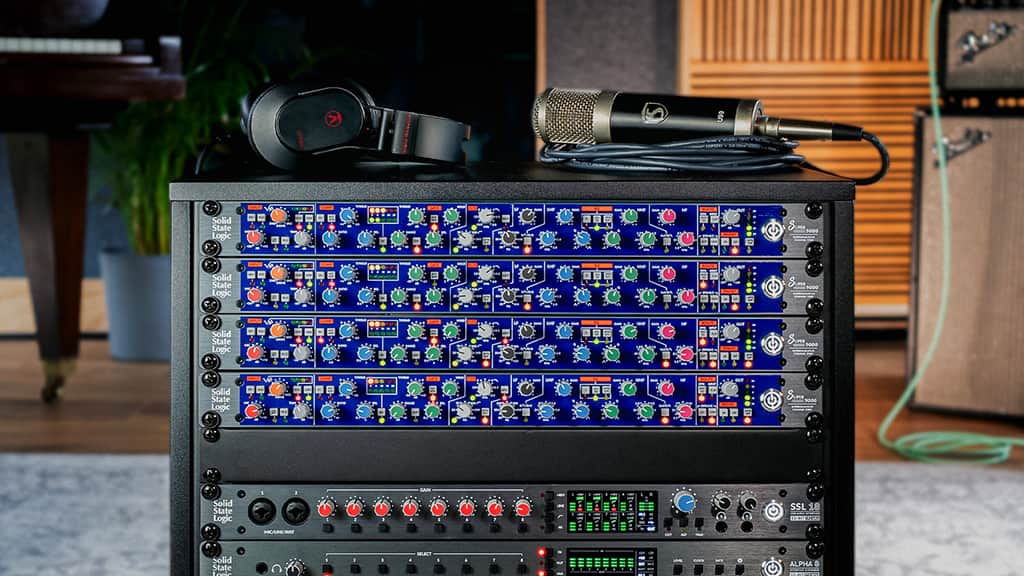
Straight out of the box the Super 9000 stakes a claim to its lineage with a striking blue faceplate (the blue livery is a homage to the original background colour of the main computer screen on the SSL 9000-K Series Console). Another little wink at its heritage comes with the pink high frequency band EQ controls, given that the default EQ mode here is the legendary pink G Series 292 with its point-of-difference proportional Q design.
In terms of layout this unit shares a lot of DNA with its sibling, the Revival 4000. Preamplification sits far left and is followed by dynamics, filters, four-band EQ and routing with output control and metering at the far right. Where the 4000 unit’s black buttons tended to blend into the black faceplate a little, the Super 9000’s grey buttons pop a lot more against the deep blue, as do the orange processing section labels. There’s been quite a few grumbles online about these bold colour choices but I applaud the ‘dare to be different’ mentality on show here, and the unit sits in a rack next to more aesthetically subdued gear quite happily.
Despite the visual similarities there are in fact a lot of significant differences between the Revival 4000 and the Super 9000, none more so than the 9000’s preamp section. Incorporated here are both a SuperAnalogue ultra-clean front end and a switchable VHD circuit for adding either 2nd or 3rd order harmonic colouration (or a blend of the two depending on where you have the Drive knob dialled in). With the VHD circuit switched out, the pre is one of the cleanest low-noise designs out there. Once the VHD circuit gets involved you can drive it gently for a tickle of character or harder by upping the mic input gain and trimming back the preamp output for thicker, more saturated tones. Essentially you’ve got the choice of a pristine classic 9000 Series pre or the coloured drive circuit out of SSL’s current Duality console. They’re a wonderful pair of options to have and deliver real flexibility when deciding how to track and/or process sounds.
One last feature of the preamp section is a Hi-Z button which, somewhat disappointingly, doesn’t activate a DI input but instead raises the microphone input impedance from 1.3kΩ to 11kΩ. This may have a very subtle or more profound effect on your condenser microphones depending on their design.
NEED TO KNOW

FLUID MECHANICS
After the preamp stage comes an extremely musical dynamics section. Where the 4000 unit featured a wonderfully smooth de-esser alongside it’s period-correct compressor, the 9000 opts instead for a more fully-featured gate with a dedicated Hold knob. This might seem a small thing but it’s actually a major point of difference between the two units. Varying the amount of time the gate stays open before closing really does allow for more creative applications and, in tandem with the 9000-Series channel compressor that offers a choice between soft-knee or peak sensing modes, the gate and expander can really help shape things like drum dynamics in a very pleasing way. I’ve never been a heavy gate user but the Super 9000’s version of this tool is incredibly musical and strangely addictive to tinker with. The smoothness of the gate’s behaviour and the way that, alongside the expander circuit, it can bring forward or push back certain elements, makes it a very powerful weapon indeed and one that warrants close attention when working with the Super 9000. When you start to experiment with the interplay of compressor, gate, expander and preamp gain it’s easy to dial in a huge variety of very useable dynamic treatments ranging from subtle to over the top.
PLEASING PROPORTIONS
Following on from the dynamics are a pair of great-sounding high- and low-pass filters and then another standout feature of the Super 9000, the four-band EQ. Two types of EQ circuit are offered here. The first is a 9000-Series ‘Pink Knob’ 292 circuit that offers proportional EQ on the mid bands. This means that as you increase the depth of a boost or cut the slope of the bell curve becomes steeper. At extreme settings the boosts and cuts become very narrow and surgical indeed. In use this is an effective approach as harder boosts and cuts will almost always be used for corrective purposes and require a tighter Q to identify and isolate problem frequencies. For more gentle tone-shaping a gentler, wider bell curve is most commonly preferred. An additional pair of buttons divide the low/mid band frequency by three and multiply the hi/mid band by three. This allows users to apply both proportional bell EQ boosts/cuts and shelf EQ bands in these same areas. The resulting complex overlapping EQ curves in the low and high frequency ranges sculpt sounds in a way that standard parametric EQs simply can’t hope to emulate.
The second EQ option is the classic E-Series ‘Black Knob’ 242 circuit, engaged by pushing the ‘E’ button. This EQ was developed by SSL in collaboration with Beatle’s producer George Martin for the famous Air Studios console and operates in a more familiar parametric fashion. The 242 iteration of the SSL console EQ has long been a favourite of SSL aficionados, with non-E-Series console owners often shoehorning a section of Black Knobs into their boards to obtain that ‘special something’ these circuits deliver. When in E mode the above-mentioned extra buttons do not operate on the mid bands, but rather switch the high and low frequency bands between bell and shelf behaviours. The filter and EQ sections can also be inserted into the side-chain circuit of the dynamics processor for tuning the compressor to concentrate on particular areas of the frequency spectrum. The difference between the Pink and Black EQ tonalities is quite pronounced. The Pink sound is very refined and has a silky top end while the Black sound has more grunt to it and is particularly good for adding more aggressive midrange tonal colouration.
ROUTING THE SYSTEM
In true SSL style there are a lot of clever buttons on this unit that greatly expand its flexibility above and beyond what is already a very comprehensive set of controls. Among the most significant extra features is the ability to change the order of the dynamics section to place it post EQ. A ‘Flip’ button also places the VHD circuit into the line input signal path, opening up harmonically-driven sonic possibilities in post production and mix scenarios. An external side chain input can also be switched into the dynamics circuit while a link button takes care of multiple-unit side chaining where the control voltages of both units are summed to ensure smooth stereo operation. A switchable insert send and return is accompanied by another button that relocates the insert point from just after the preamp to just before the final output gain stage. Metering can also be switched from input to output monitoring. These additions mean the unit is extremely well endowed when it comes to tailoring its processing chains and interfacing with other equipment.
I’d try flipping the order of the processing, switching from Pink to Black EQ modes, engaging or disengaging the expander or changing compressor knee behaviour only to find a whole new avenue of sonic enhancement to explore
SOUND & COLOUR
So what’s the Super 9000 like to work with in the real world of great, good and indifferent tracking sources and source material? In a word: excellent. While I had the review unit I tracked a wide variety of sources using both dynamic and condenser mics in both clean and VHD modes. I also spent a lot of time processing previously recorded tracks through the line input. As a front end it’s a great sounding and very versatile unit that can give you everything from pristine capture to driven harmonic colour and everything in between. When required, the VHD sound is a very pleasing one that can impart weight and zest to anything from soft female vocals to glassy synths to kicks and snares. By tweaking the input gain and trim knobs as well as engaging the pad, a huge amount of nuanced gain control is available, while if you find yourself wanting to record with maximum clarity and detail the SuperAnalogue signal path will take you all the way there.
Once you start working with the other processing sections the world is very much your oyster. It’s striking how quickly and comprehensively you can sculpt and control sounds by applying the dynamics, filters and EQ. There’s really a lot of sonic possibilities to explore! Many times, just when I thought I’d got things dialled in pretty well, I’d try flipping the order of the processing, switching from Pink to Black EQ modes, engaging or disengaging the expander or changing compressor knee behaviour only to find a whole new avenue of sonic enhancement to explore.
Like it’s sibling, the Revival 4000, the Super 9000 revels in being heavily tweaked and the results almost always bring a new level of character and ‘mixed-ness’ to the source material. Even at more extreme settings this unit delivers totally valid results that somehow retain a smooth and aesthetically pleasing sonic signature. Sounds processed through the unit very often sit in their own pocket in the mix in a very satisfying way. I’ve got to say, it’s hard to find fault with a box that can do so many things with such sonic panache. Drums are punchy and well defined, vocals can be placed effortlessly and guitars, strings and pianos all benefit greatly from the sonic resources on tap here. While digital signal processing has come an incredibly long way, there are sonic delights here that simply cannot be had via plug-ins. The analogue SSL sound is a very special one and this unit delivers it in spades.
SUPER SPREADER
While the Super 9000 can elevate great vocal or instrumental takes to the next level, it is also a very powerful tool when it comes to rescuing poorly recorded material or imperfect instruments. Digging out detail in a muffled acoustic guitar, taming a shrill vocalist, or lending weight and life to a limp drum performance is all in a day’s work for the Super 9000. Once you start working with this channel strip you’re going to want two of them! As I mentioned when reviewing its sibling, you’ll want to keep the Super 9000 close at hand in your studio set up so that reading the status of its many controls and repeatedly tweaking them is an easy and ergonomically enjoyable process.
The Super 9000 encompasses everything that is great about the SSL brand, currently. It’s compact and very cleverly designed, insanely feature-rich and delivers wonderful-sounding ultra low-noise preamplification, dynamics and EQ to die for, with a flexible architecture that maximises every bit of sonic potential. The individual processing sections speak to each other wonderfully well and it’s this interplay that makes both the new SSL channel strips such powerful tools and so much fun to work with. The Super 9000 is every bit the equal of the Revival 4000 in that regard while bringing its own distinct character and strengths to the table and both units should be right at the top of your list if you’re looking for a modern channel strip solution that can handle front end and post production roles equally well.






RESPONSES