







Meyer Sound TIGRA Launch
Meyer Sound debuts a versatile new mid-sized line array that bridges the gap between install refinement and touring muscle, complete with a companion sub that refines what ‘musical’ means in the low end.

19 May 2026
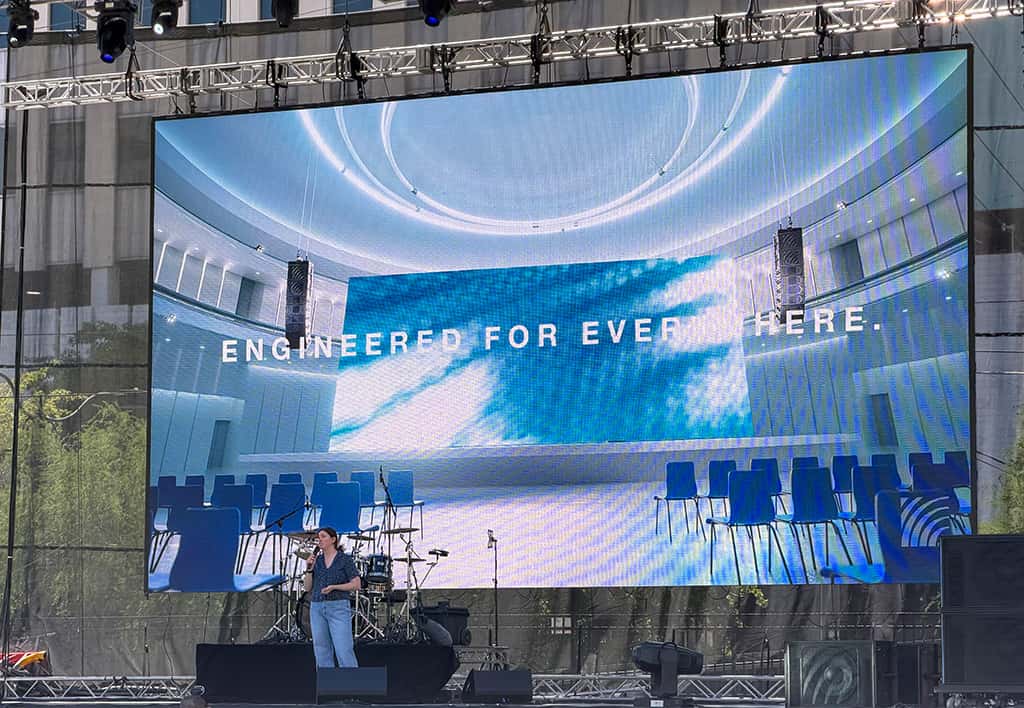
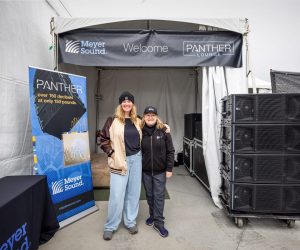
I don’t know if you’d call it ‘deja vu all over again’ but returning to the Las Vegas Downtown Events Center four years on (almost to the day) definitely was a moment. Back in 2022 it was the launch of Panther, Meyer Sound’s miracle, promising (and delivering) 150dB in a 150lb enclosure. This time, in 2026, it’s Tigra’s turn.
In an increasingly corporatised audio industry Meyer Sound continues to make its own rules. Panther has proven to be outrageously successful and perhaps launching a mid-sized member of the post-Panther ‘cat’ family might have come sooner but the engineering department has been too busy innovating. They’ve been experimenting with exotic space-age/F1 materials for Tigra’s four-inch compression driver, a version of which first went into the Ultra-X80 last year.
Regardless, it’s Tigra’s time. It’s a mid-sized line array that will slot straight into a Panther-led rig, team up with the new 1800-LFC to form a kick-arse standalone system, or be a versatile installation solution for theatres and the like.
PANTHER’S LITTLE BRO
Casting my mind back to the Panther launch in the same field, I recall car alarms going off in adjacent multi-storey carparks as the demo heated up – Panther + 2100-LFC is a monstrous system that can match just about anything in the market when it comes to brute force. Tigra’s debut was a little more polite but no less impactful. The next-level pattern control was very evident, the evenness of Tigra’s tone even at its outer limits is quite striking, and sure, its output is very impressive, even if it’s not shaking those carparks with apocalyptic low end.
One thing’s for sure, Tigra is not simply a shrunken Panther. It’s a new member of the family, designed from the ground up with a different brief, a brief that Katharine Murphy-Khulusi, Senior Engineering Director, explains this way: “We wanted to be very conscious of making it a really great standalone product that could do a large stage, maybe even a large festival stage, but also was a little bit toned down, a little more refined for install.”
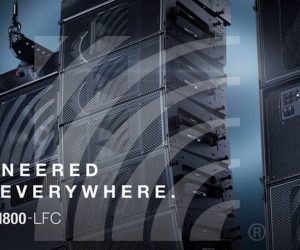
That balance between brute force and finesse is the thread running through every conversation at the launch. Meyer Sound has historically been a concert touring company at heart – Leo, Lyon, Leopard, Panther – but the install market has always been there, absorbing product and occasionally wishing the boxes were a bit smaller, a bit lighter, a bit less overkill for a 1500-seat theatre. Meyer Sound listens to its customers and understands this. In fact, Tigra’s snappy catch phrase is ‘Engineered for Everywhere’.
WHAT’S IN THE BOX
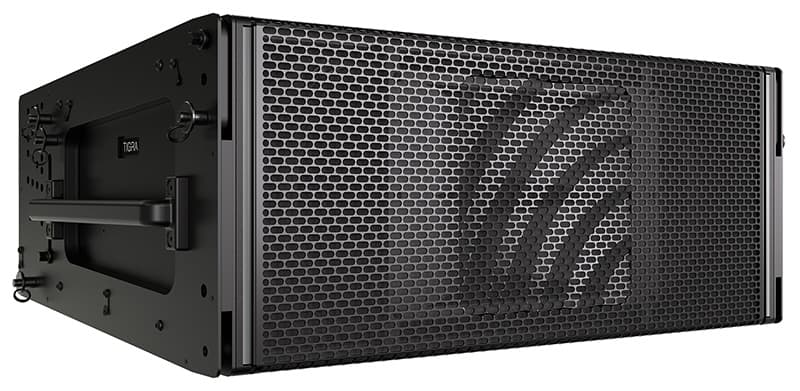
Tigra’s vital stats read like a greatest hits of Meyer Sound’s recent driver development. Two 10-inch low-frequency transducers, designed in-house and evolved from the Leopard platform, sit alongside that single four-inch compression driver I mentioned earlier, which shares DNA with the recently launched Ultra-X80 point source box.
Pablo Espinosa, the company’s Senior Director of Amplifier & Transducer Technology, and a veteran of nearly every significant Meyer Sound loudspeaker of the last 25 years, walks me through the details with the enthusiasm of someone who’s spent years obsessing over voice coil diameters and phase plug geometries.
“The 10-inch driver can compete with most of the 12-inch counterparts out there,” he says matter-of-factly. “It has a much bigger motor structure, bigger voice coil, more travel, more power handling than the Leopard driver it’s based on.”
On the high-frequency side, Espinosa is particularly animated about the compression driver’s throat length – or lack thereof.
“Over the years we’ve been making it shorter and shorter. In Tigra, we went a step further, where we coreed out the plate. So the horn is basically connected almost directly to the phase plug.”
The result, he explains, is reduced distortion and improved pattern control. It’s the kind of incremental, obsessive refinement that rarely makes headlines but adds up to a box that simply sounds right.
“We always try to make better things. Every time we launch a product, we try to raise the bar.”
Tigra is really a chance for us to explore. These speakers can do more things than we ever had anything do before—but in a controlled way.
— John Meyer, Founder
THE VOICING CHALLENGE
Here’s the challenge: Tigra needs to sound like an extension of Panther, because the two systems are designed to work together. Transition frames allow Tigra boxes to hang beneath Panther arrays as downfills or outfills. But Panther uses two three-inch compression drivers; Tigra uses one four-inch unit. Different transducers, different horn geometries, different everything. So how do you make them sing from the same hymn sheet?
Espinosa breaks it down into three layers: the inherent response of the drivers themselves, the behaviour of the horn and its interaction with the driver, and finally the DSP alignment – the filters, EQ, and delay that tie everything together.
“With Tigra, we needed to make sure that it sounded good as a system on its own, works well with Panther as a downfill and outfill, plays with the 2100-LFC, and also plays well with the 1800-LFC,” he says. “We put a lot of effort not just on designing one loudspeaker, but the system that integrates well with the rest.”
It’s a philosophy that permeates Meyer Sound’s approach. Individual products are never designed in isolation; they’re conceived as nodes in a larger ecosystem. The new 1800-LFC subwoofer, for instance, was tested throughout its development alongside Panther, Tigra, the existing 2100-LFC, and even the Ultra-X80.
Katharine Murphy-Khulusi, who oversees the engineering team, puts it simply: “It is easier to design subs that are matched to a specific line array element when they are designed together. We’re lucky to have all of the acoustic engineering team and mechanical engineering team all based in Berkeley – they’re all in meetings together, and they’re all testing things together.”
1800-LFC: COMPANION SUB
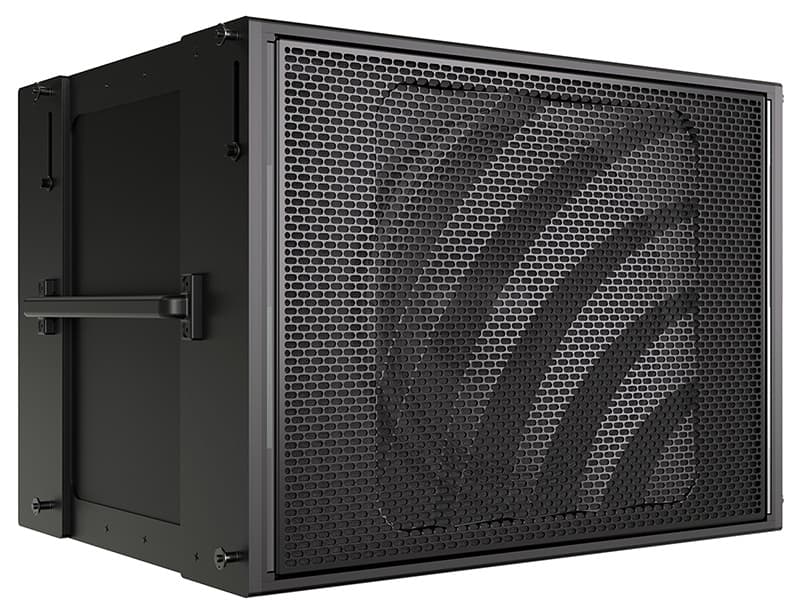
Speaking of the 1800-LFC, it deserves more than a footnote. Meyer Sound’s subwoofers have long had a reputation for being ‘musical’, a word that gets thrown around a lot but essentially means they accurately reproduce bass notes rather than just pressurising a room with undefined low-frequency energy.
The 1800-LFC takes this a step further. A single 18-inch driver, evolved from the (single 18) 900-LFC (launched 2015), sits in a cabinet that’s been engineered as a complete system: enclosure tuning, port design, bracing, amplifier topology, and DSP all optimised together.
Pablo is particularly proud of the amplifier’s voltage swing, which he sees as critical to reproducing musical transients. “Music at low frequencies can exhibit 12dB of dynamic range, so average power is often not as important as peak power to reproduce those peaks. The musicality comes from two aspects: the ability to reproduce the frequency response flat, the phase response without time smearing, and at the same time be able to reproduce those peaks and that impact.”
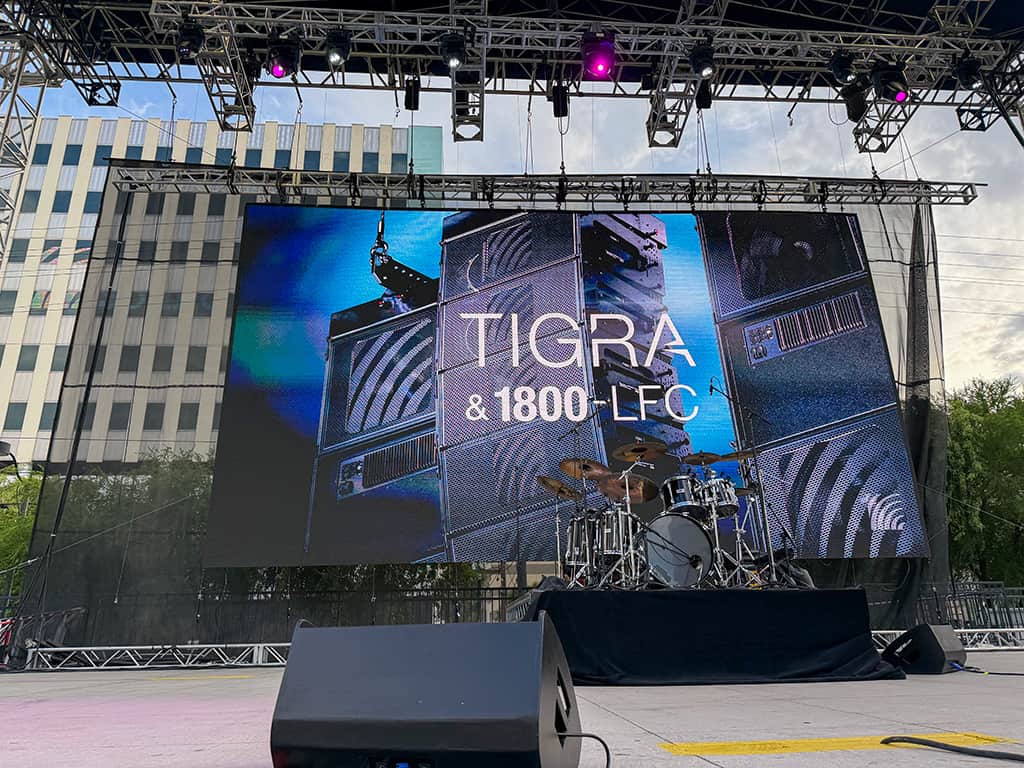
At the demo, the 1800-LFC felt like a natural extension of the Tigra hang – tight, defined, and utterly unflappable even when the system was pushed hard. An acoustic drum kit, a Meyer Sound staple at these events, provided the perfect torture test. Kick drum transients were immediate and visceral without any of the woolly overhang that plagues lesser subs.
GEN-1 ARRIVES: PROCESSING ON BOARD
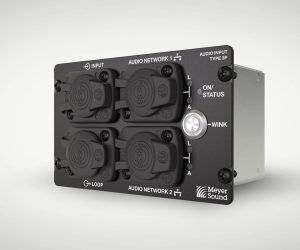
One of the more significant technological shifts with Tigra is the debut of Meyer Sound’s GEN-1 processing module in a PA product. GEN-1 moves all the DSP – crossovers, EQ, limiting, alignment – directly into the loudspeaker itself. It’s a fundamental rethink of signal flow that has implications for everything from system deployment to creative possibilities.
Andy Davies, Senior Director of Product Management, has been deeply involved in shaping GEN-1’s integration. He sees it as a response to the way customers have embraced Milan networking since Panther’s launch.
“When we launched Panther, it was the first product with Milan straight to the box in that size, in that scale. And it was a big jump for our customers,” he recalls. “We weren’t 100% sure how fast that uptake would be. And the answer was really fast.”
The first major Panther deployment – Ed Sheeran’s stadium tour with 212 boxes – went full Milan after just five shows. The message was clear: the industry was ready to cut the analogue umbilical cord.
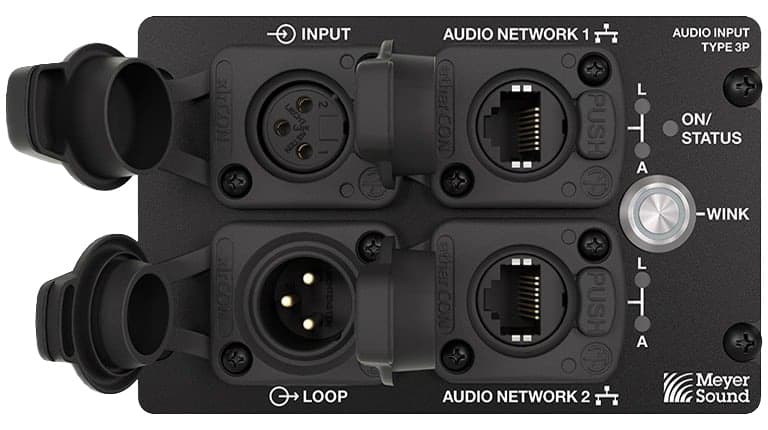
GEN-1 takes this further. A small Tigra system with 1800-LFC subs can receive an analogue feed from a console, process everything internally, and operate without a Galaxy – Meyer Sound’s mainstay outboard processor that has been the brains of the operation for some time now.
“A small system of Tigra and 1800-LFC ground-stacked can receive an analogue feed from a console. It’s got all the DSP in it to play with as a PA. You don’t need a Galaxy. Nothing in the way,” notes Andy Davies.
For rental companies, this is significant. With the deployment of GEN-1, the Galaxies in their inventory becomes available for something else, improving fleet utilisation. For system integrators, GEN-1 removes a piece of Meyer Sound-specific rack gear from the signal chain, allowing loudspeakers to receive signals from third-party DSPs and show control systems.
“In a bigger systems integration world, we could see the value in having loudspeakers calibrated to the room, receiving signals from something else that might not say ‘Meyer Sound’ on it,” Davies acknowledges. “And that’s okay.”
MODES, MOVIES, & JOHN MEYER’S VISION
John Meyer, characteristically, is already thinking several steps ahead. For him, GEN-1 isn’t just about convenience, it’s about unlocking capabilities that were previously impractical.
One example: switching between PA mode and cinema mode. A venue that hosts live performances and film screenings typically needs two completely different delay and alignment structures. PA systems are optimised for minimal latency to avoid echoes; cinema systems prioritise time-correction and can tolerate a tenth of a second of delay.
“You can have a button on your keyboard somewhere to go from PA mode to Movie mode,” Meyer explains. “We can now start to explore that kind of thing.”
NEBRA & THE UNIFIED WORKFLOW
Tigra doesn’t exist in isolation. It’s part of an ecosystem that includes Milan networking, Nebra software, GEN-1 processing, and the Spacemap Go spatial audio platform. Andy Davies is keen to emphasise how these pieces fit together.
Nebra, launched alongside Panther, was Meyer Sound’s acknowledgement that its venerable Compass software couldn’t evolve into the networked world. But from the outset, Nebra was conceived as more than a network management tool.
“What we sketched out five years ago when we started thinking about Nebra was an ecosystem – how we bring these different tools together,” Davies explains. “Audio pros want to be on site moving in a straight line as fast as they can and not jumping between audio tools and networking tools.”
The result is a platform that combines connectivity, monitoring, and processing in a single workflow. Network configuration is no longer a separate task performed in a different piece of software; it’s integrated into the deployment process.
“It’s not networking over here in a separate package. That’s just how we connect things together, as part of deployment.”
We live and breathe the spatial world daily. But we believe in versatility – loudspeakers that people can practically use day after day.
— Andy Davies
JOHN MEYER PHILOSOPHY
Spend any time with John Meyer and you’ll notice a recurring theme: a deep suspicion of complexity for its own sake. In an industry that has a knack for over-emphasising feature lists and software updates, John Meyer stays on message… with ‘consistency’ and ‘reliability’ being right up the top of his company’s priorities.
“I’ll go back to a software programme and it’s completely different because of an update to the new version. Nothing’s in the same place,” he says. “I don’t think that’s a great way of creating new technology.”
His benchmark is simpler: can someone who hasn’t used a system in four or five months walk in and know how to operate it? If not, the design has failed.
“In a live concert, you can’t struggle. Everything has to be clear. They need to have access to information and how it’s working.”
This philosophy extends to the data sheet wars that plague the loudspeaker industry. Meyer has long campaigned for more meaningful specifications, and Tigra continues that tradition. During the demo, it was striking how little time was spent discussing peak SPL figures.
“People are already saying, ‘You say it’s less powerful than Panther, but it almost seems like it’s as powerful’,” Meyer observes. “With music, it’s going to. We shouldn’t even put power specs on the datasheet, but we have to.”
WHAT’S NEXT
Tigra represents the first step in what Meyer Sound describes as a new phase of development, one that leverages the processing power now available on board to explore capabilities that were previously impossible or impractical.
Katharine Murphy-Khulusi summarises the ambition neatly: “We set a new standard with Panther. We set a new benchmark both for what we thought the industry was ready for, but also for ourselves. And when we made the decision to do a new product that was essentially in the Panther family but a little bit smaller, a little more versatile, we knew we had to get the place in the market right and we knew we had to get the performance right.”
Based on the reactions at the Las Vegas launch, Meyer Sound has succeeded on both counts. Tigra is neither a compromise nor a consolation prize for those who can’t afford or accommodate Panther. It’s a distinct product with its own personality – refined enough for theatres and performing arts centres, powerful enough for mid-sized touring rigs, and versatile enough to slot into sports arenas and corporate venues.
The 1800-LFC, meanwhile, is a worthy successor to the 900-LFC. A single-18 sub with the tightness and musicality Meyer Sound is known for, designed from day one to work seamlessly with both Panther and Tigra (and, indeed, the Ultra family).
For Meyer Sound, Tigra is more than a product launch. It’s a statement about where the company sees the industry heading: towards systems that are powerful yet refined, flexible yet foolproof, networked yet reliable. The self-powered, self-processing loudspeaker isn’t a new concept, but Meyer Sound’s execution – and the ecosystem surrounding it – suggests its playing a longer game than most.
The car alarms of downtown Las Vegas can rest easy. Tigra doesn’t need to make noise to make a point.







RESPONSES