









Review: Valeton GP-180 & GP-150
Accurate DSP emulation for guitarists in a portable, battery power-able, app-controllable unit.

By Brad Watts
26 March 2026
During the last decade there’s been a skirmish going on in the guitar world. That contest is the battle between traditional analogue effects processors, like standalone dedicated effects pedals combined with valve amplifiers, and the move to DSP-based emulation of analogue processing. Many professionals have moved completely to DSP for its logistical ease and reduced maintenance requirements, while as many others remain firmly in the traditional camp. Some, like myself, utilise a combination of both. There’s advantages on all sides of the trenches, but there’s one thing we can all agree on: just how accurate the DSP emulation has become.
A significant player in the DSP evolution is Valeton, which has a decade or more of experience creating cost-effective amplification and effects processing for guitar and bass players. The company’s GP series offers multi-effects to fit all space requirements and budgets – from the diminutive GP-5 through to the flagship GP-200 range.
GP MOTORING
Recently announced at this year’s NAMM show are two additions to the GP series: the GP-150 and GP-180. Both are compact multi-effects and offer a plethora of connectivity and DSP trickery.
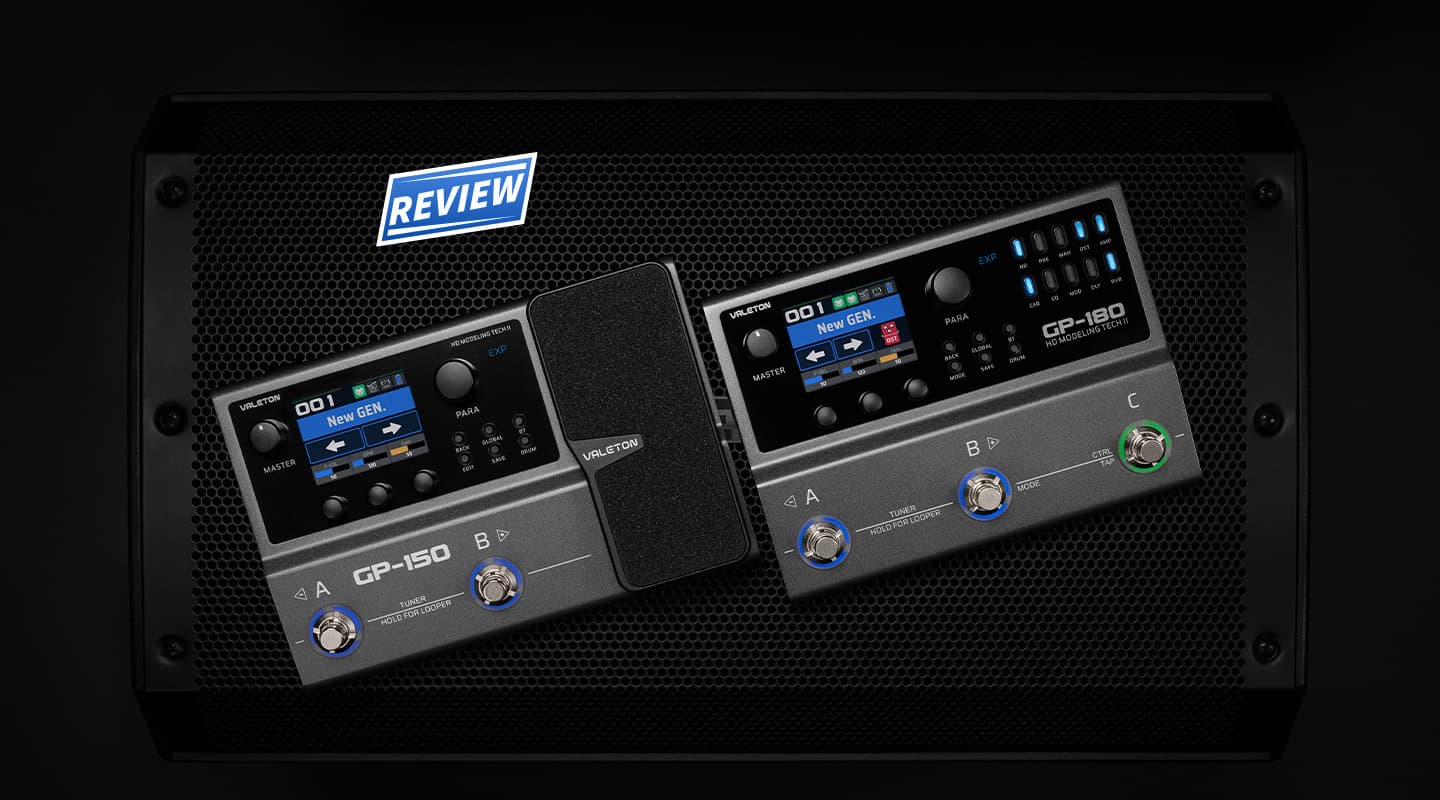
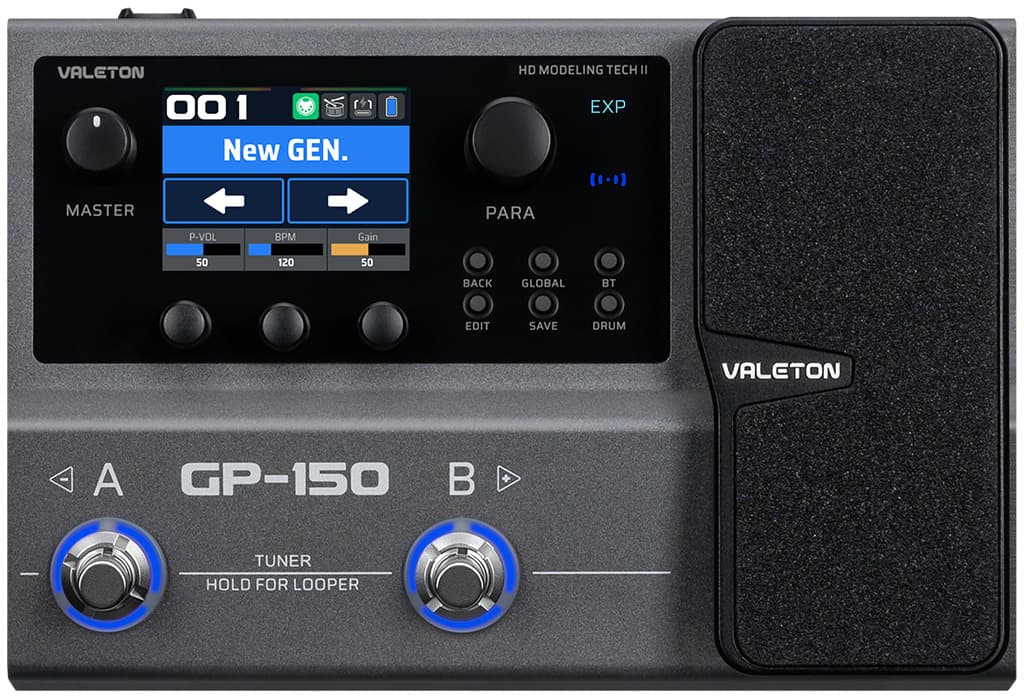
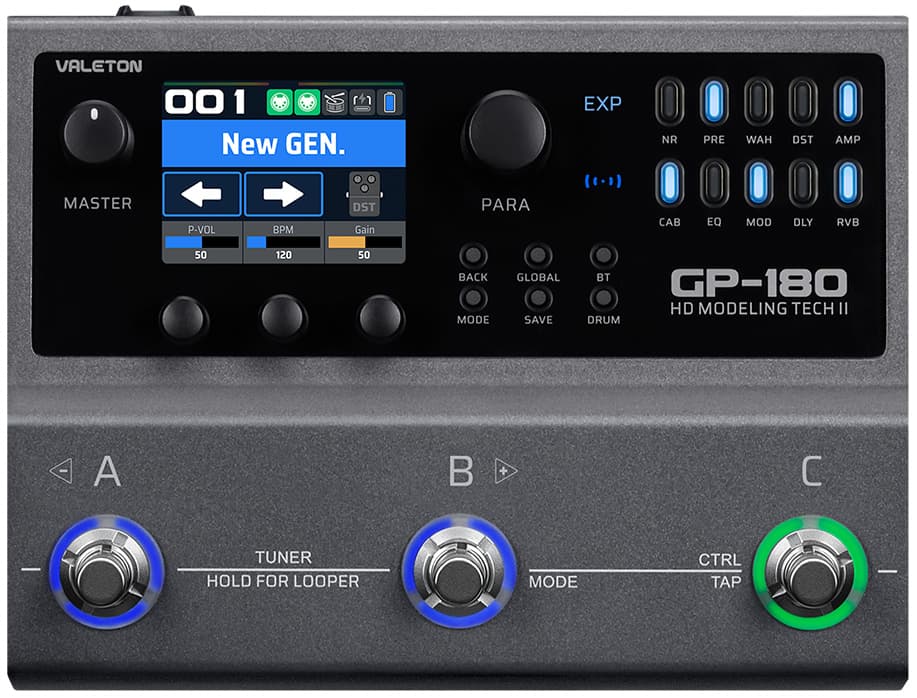
The GP-150 and 180 provide the same number and choice of DSP effects. The primary difference is the GP-150 includes an onboard expression pedal and loses the dedicated Control/Tap footswitch and 10 individual dedicated effect bypass buttons found on the GP-180. If expression is required on the GP-180 you can connect an external expression pedal. Apart from these physical differences all DSP facility and operation is identical.
ALL IN ONE
Processing in the new Valeton GP units covers everything you’d expect for a guitarist’s arsenal. Preamp (which includes boosts and compression), wah, distortion and overdrive, amplifier and cabinet simulations (with the option to import up to 20 IR cabinet responses), EQ in various formats, modulation, delay, and reverb. Selecting these virtual ‘pedals’ is reasonably intuitive, via a rotary/pushbutton encoder, with adjustment of parameters via three pots below the bright 2.4-inch colour LCD display. DSP resources are allocated on a percentage basis. Adding a particular process will result in an incremental load until, obviously, you hit 100%. Amps and cabinets tend to take the most processing, at around 14 and 22% respectively. If using the GP units straight into a traditional amplifier you can of course switch these processes off and buy back more than ample processing for the remaining modelling pedals – ideal if you’re integrating the GP-150/180 into a traditional pedalboard system. With that in mind, there’s also an extremely clear tuning function and a 180-second looper thrown in.
In a recording situation, or if you’re running a full-range/flat response amplifier, simply reinstigate the amp/cab sims for a vast range of emulations. There’s plenty to choose from, with all the usual suspects surreptitiously named but easily identified. Cabinet choice can be globally set to match the amplifier simulation, or switch that option off to mix and match amps and cabinets.
NEED TO KNOW
Valeton GP-180 & GP-150
Modelling Guitar Effects
DIFFERENT FACE
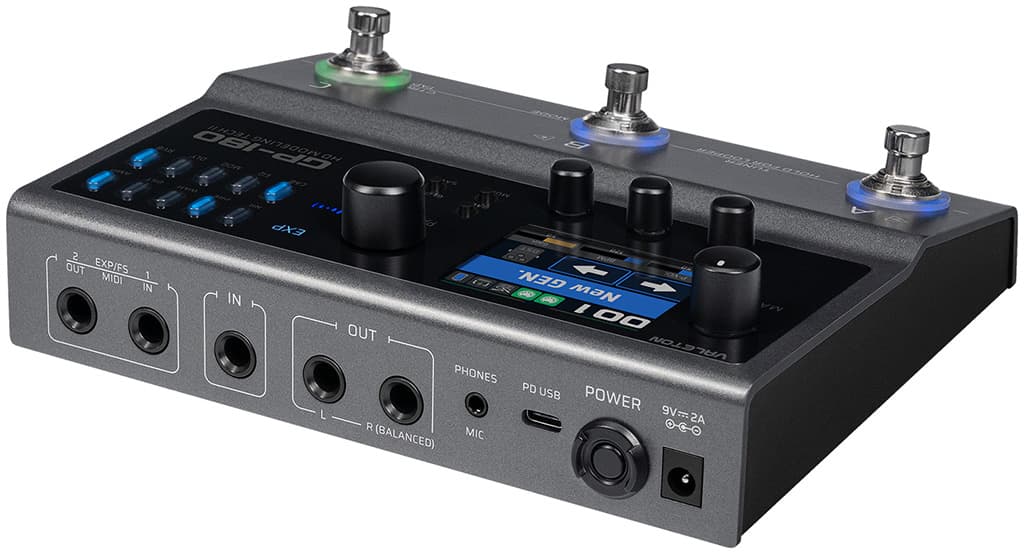
Speaking of recording, the GP-150/180 will function as an audio interface. The rear USB-C port will connect the unit directly to your DAW at 24-bit/48k and provides bus power. But wait, there’s more to this USB port than you think. The GP-150/180 units are equipped with a rechargeable battery, with up to six hours of run time. Plus, you can power other USB devices from that same USB-C port. Perfect for the busking musician – especially considering the 100 drum patterns the GP-150/180 can spit out. If bus power isn’t available for some reason, the units can be powered via a standard 9V supply (just make sure the power pack can deliver 2A).
If you’re running these devices via your DAW or full-range/flat response amplification, you won’t be disappointed
PATCHED UP
MIDI data such as patch changes can also be sent into the USB port, or via TRS, or Bluetooth… Or via all three. Equally as versatile, MIDI clock info can be sent and received via any mixture of the three. Bluetooth also comes into play for editing the units via your iOS or Android device, which is also where you can import cabinet impulse responses to the units from. The Bluetooth connection with the pre-release beta apps was easy and straightforward. One aspect of the operating system could probably do with some attention: turning the parameter knob continuously ‘carousels’ through all the options, as opposed to stopping at the end of the options. It just means you don’t get any efficiency gains as you become more familiar with the UI – you’re forced to confirm parameter knob selections by eyeballing them each and every time.
IN ACTION
So how does it sound? Overall it sounds great. The amp and cabinet simulations are exceptionally good, and respond in an extremely amp-like fashion – as promised on the box. If you’re running these devices via your DAW or full-range/flat response amplification, you won’t be disappointed. And don’t forget you can roll in your favourite cabinet IRs if required. Distortion and drive processing is also very convincing, with the usual references and emulations – choose ‘Green OD’ or ‘Blues OD’ at your whim, among others. Delays and reverbs are perfectly usable, while my favourite, ‘Tube Spring’ pressed all the right buttons but is heavy on the juice (22% of DSP).
There’s a ton of functionality and a plethora of uses for the GP-150/180. Whether it’s for your mainstay effects, as an adjunct to your existing board, or your get-out-of-jail card if your real amp blows up mid gig, you’ll be hard pressed to find anything close for the money. Sensational value.







How do the effects and overall sound compare to the NUX MG300 MK2?
I know Valeton wins on metal chassis, better documentation, proper L/R outputs, midi/2nd pedal support,
more effects amps etc.. Nux seems to sound better its not easy to find a true side by side comparison