







Review: Waldorf Protein Wavetable Synth
Waldorf release its most cost-effective means of getting into wavetable hardware. Corey Hague is nuts about Protein.

16 January 2026
Review: Corey Hague
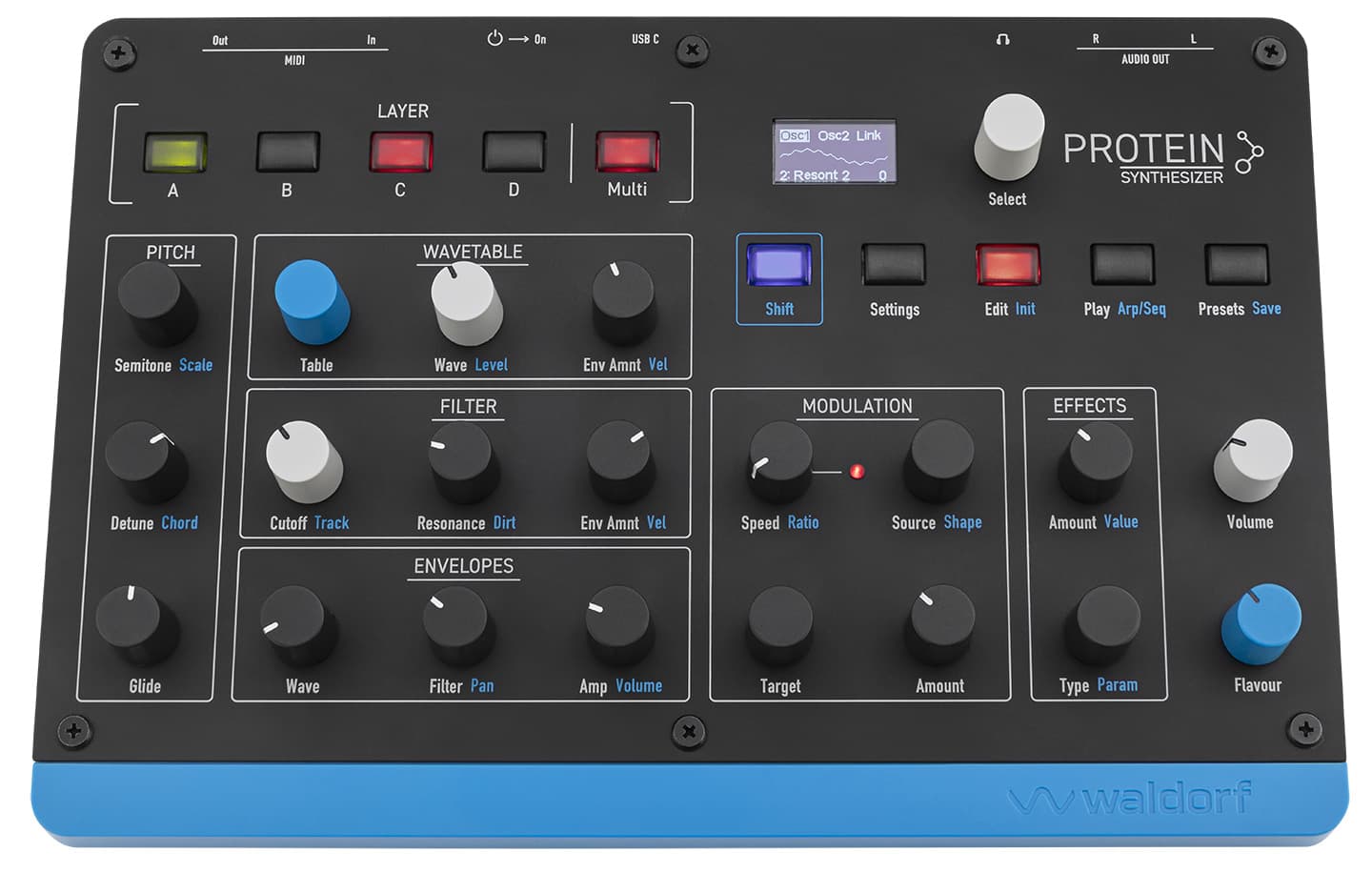
Waldorf has been in the synthesiser business for a long time, having started life back in 1988 with the release of the Microwave 1. Despite its long history of synthesiser production, there’s always been an element of the exotic when compared to larger brands like Roland, Korg, or even Moog. While Waldorf creates high-quality instruments, they’re not the kind you can easily find on Facebook Marketplace. Thankfully, Waldorf has introduced a way for more people to experience the Waldorf sound: the Protein. Despite its name, it has nothing to do with muscle powder; it’s a desktop synth that the company touts as “…the accessible entry point into the Waldorf wavetable world.”
DON’T SKIP SYNTH DAY
Small, lightweight, and streamlined, the Protein is an eight-voice polyphonic synth clearly built to a price point, yet it doesn’t feel cheap, thanks to its mix of plastic casing and metal face. Perhaps the most evident concession to its budget is the tiny screen, but at least it’s bright, clear, and free from visual clutter. Around the back, you’ll find 3.5mm MIDI in and out, a USB-C port, a 3.5mm stereo headphone output, and TRS jacks. The package includes two 3.5mm MIDI DIN adapters as well as a USB conditioner/filter, which is a valuable addition since USB-powered devices can sometimes introduce high-frequency noise. In the case of the Protein, there’s a slight spike around 20kHz, but the filter does its job effectively.
SPACE FOR SYNTH GAINS
It’s not always easy to find space for a new synth, but the Protein is so petite that it will fit comfortably in all but the most jam-packed studios. I set it up on a generic iPad stand on my desk, and it happily resided there, never feeling wobbly or at risk of toppling. At just under one kilogram, it has enough heft to remain stable during adjustments, making it suitable for nearly any setup.
Firing it up is quick and easy; my PC detected it without any drama or drivers to install, allowing me to dive right into sound creation. And what a sound it is!
PACKED WITH PROTEIN
Scrolling through the 150 included presets (with space for 250), the Protein faithfully captures the Waldorf Microwave sound—a dark, fizzy character rarely stationary. Artists such as Trent Reznor, Vince Clarke, and Kraftwerk have employed the Microwave, which speaks volumes about the instrument’s legacy. I was never fortunate enough to handle an original Microwave, but after pursuing every available software recreation, it was fantastic to hear that iconic sound leap from the Protein. Despite being digital, it somehow feels more present and intuitive than using plugins or apps. The Protein doesn’t give the impression of merely being a VSTi in a box, even if that’s effectively what it is.
NEED TO KNOW

CLASSIC MEETS MODERN
Or rather a remarkably faithful recreation of the pioneering DSP. The two oscillators are based on the original Microwave ASIC chip, maintaining the same sampling rate as the original, alongside DAC modelling and digital noise generation sourced from the vintage synth. It features the complete waveform catalogue of the Microwave and employs 8-bit quantisation and aliasing. While many modern synths pay ‘homage’ to the classics, the Protein aims to get all the elements right from the get-go.
Luckily, it’s not just marketing hype; you can hear the quality in the timbre of the Protein. It may not be organic, but it possesses a distinct liveliness that makes it a pleasure to use. Playing simple arpeggios or chords, it manages to remain engaging and fluid, never quite sounding the same even when playing the same notes repeatedly. Even patches with minimal modulation settings seem to breathe and ebb, which is beneficial, as looping MIDI data and tweaking settings seems to be the most logical approach with this device.
Wavetable synths sometimes lack the immediacy of subtractive synths, but with the Protein, it’s easy to grasp the impact of each adjustment, transitioning smoothly from subtle to wild. You can quickly change the two waveforms and sweep through the wavetable for different flavours, ensuring you find exactly what you want. In practice, it’s simple to mix and match; even if a preset is nearly perfect, tweaking is effortless, allowing you to maintain the essence of what made it good to begin with.






RESPONSES