






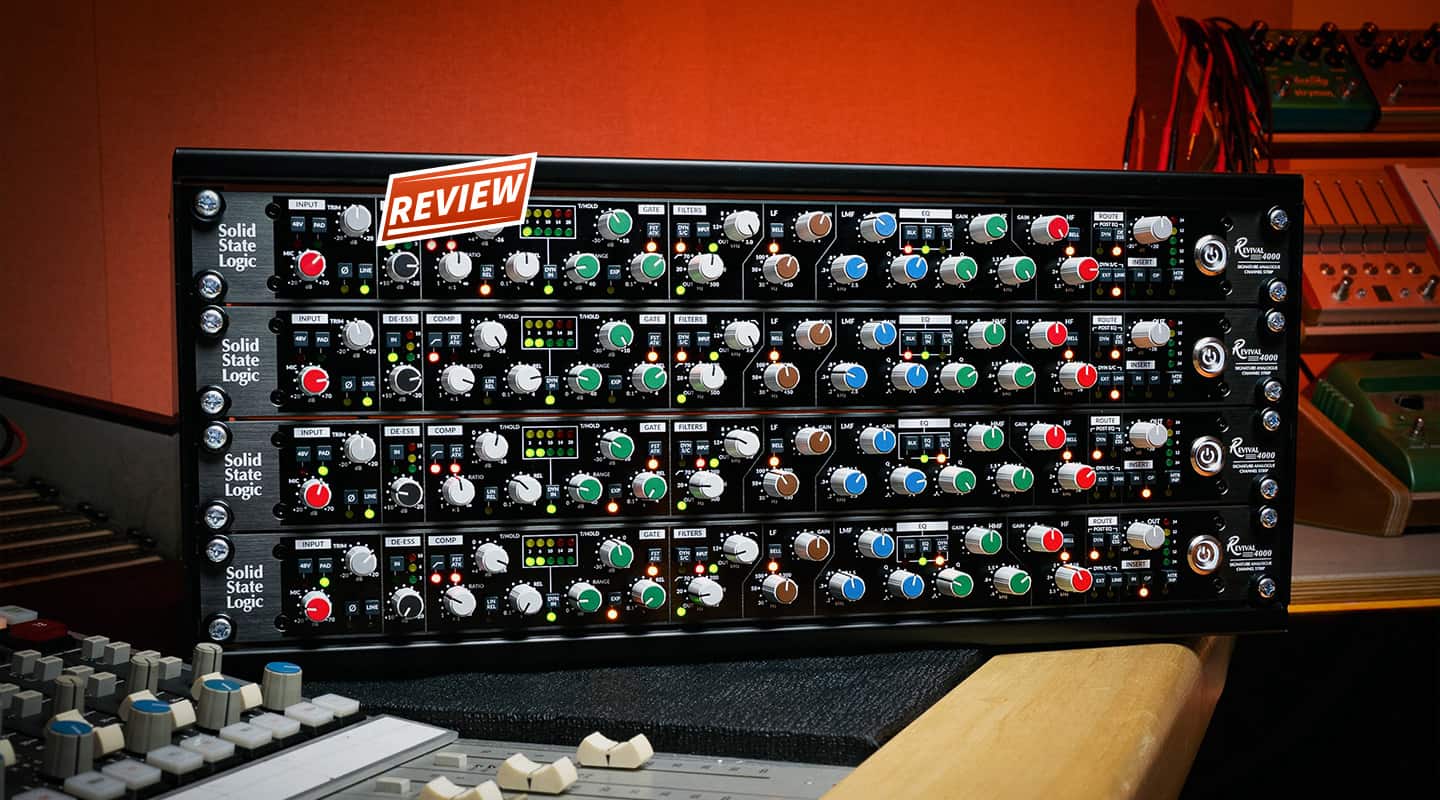
Review: SSL Revival 4000
A jam-packed, ‘best of’ SSL, all-analogue channel strip.

By Greg Walker
23 October 2025
I went guitar shopping for a friend yesterday and spent some time trying out a bunch of mid-priced acoustics. The shop I went to stocked a multitude of new and second hand models from a wide variety of makers. When there’s so many instruments dangling in the air like low-hanging fruit it can be very hard to know where to start. I found the best way forward was to ignore both the brands and the price tags and just do what we’re always encouraging AT readers to do in these columns – use my ears. Half an hour of picking, strumming and listening later I had picked out two contenders. Both well voiced and rich sounding instruments from familiar brands. Both brand new and both 100% made in China.
WAYS & MEANS
There is a great deal of snobbery in the audio world, and those who have the good fortune to own early Neve, Neumann and Urei equipment, for example, are often quick to insist on the necessity of such gear in order to make great records. Most picked up these treasures for a song during the ’80s when such gear was being sold off by radio and TV stations, and they preach the audio gospel according to German precision and American rock ’n’ roll prestige, emanating from the golden ’50s, ’60s and ’70s. Those coming late to the party without the NBA basketball player contract or generational wealth required to buy in at the top table these days must make do with less illustrious options, such as used second-tier brands, clones or variations on the classic gear re-issues.
In a close parallel with Japanese manufacturing in the ’70s and ’80s, Chinese -manufactured audio equipment today has basically caught up with the west. If the quality control is in order, China delivers most, if not all, that the US and Europe can offer in terms of build quality, reliability and sonic performance, and, I would argue, that no company reflects this shift better at the moment than Solid State Logic. Originally a very British concern that rode a raft of iconic, industry-defining mixing consoles to the pinnacle of the pro audio world in the ’80s and ’90s, today SSL is a global brand that services all areas of the market, from pro studios to broadcasting to home recording, with a strong manufacturing presence in China. SSL’s products continue to be some of the most cleverly designed, versatile and best sounding out there, and the Revival 4000 Channel Strip reviewed here is no exception. In fact, it may be the best thing they’ve ever released! Or at the very least, the most impressive since those aforementioned glory days. It represents a real achievement in combining genuine sonic pedigree and classic design with modern manufacturing practice. If you own an original 4000 series SSL console you can turn your nose up and read no further. For the rest of us, this latest offering from SSL demands a look and a listen.
REVIVING A CLASSIC
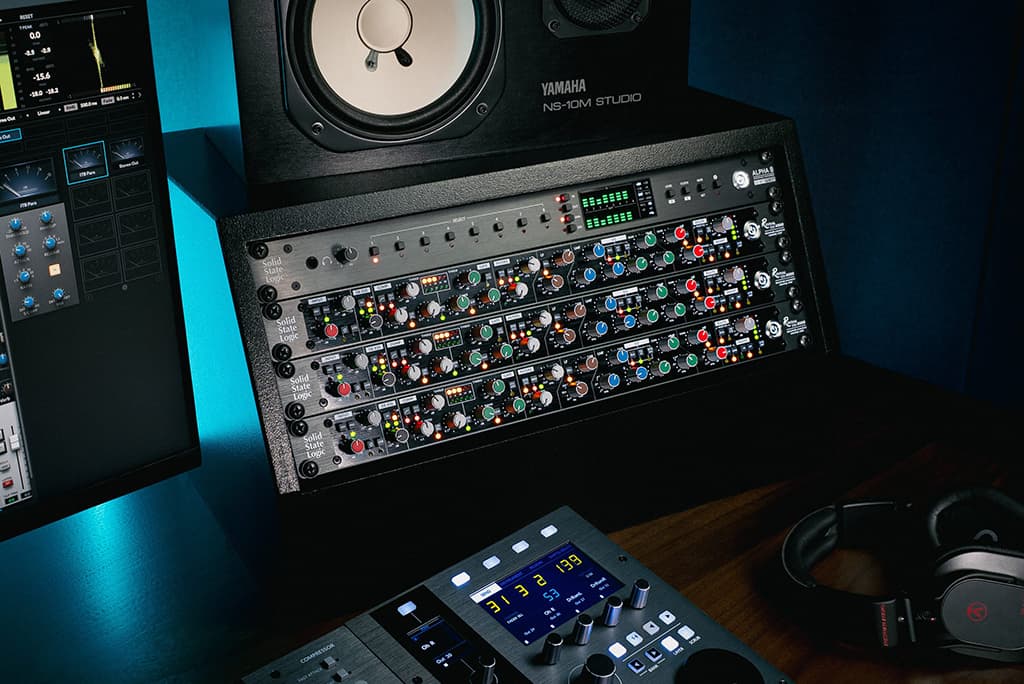
So what exactly is the SSL Revival 4000? It’s a 1U-sized channel strip, and that often implies a tracking device that has some dynamic and tonal processing you can tickle on the way in. There’s a very nice sounding Jensen transformer-coupled mic preamp on the far left hand side of the unit that certainly takes care of the tracking side of things well. It comes equipped with switches for an attenuating pad, phantom power, phase reverse and mic/line input operation. It also has separate input gain and trim controls so it can be set conservatively or pushed into pleasing harmonic distortion. When you look at everything that follows on from the preamp you start to get a sense of what the Revival 4000 might actually be capable of. SSL has fully maximised the space available in the 1U format to include a de-esser, compressor, gate, two filters, four-band EQ and a routing and insert matrix. The only obvious omission is the lack of a DI and jack input but with a unit this feature-rich somethings got to go. Is a lot of this maximally populated front panel due to surface mount technology within? Yes. Is that a big deal? No, SSL is a master of this stuff and has been cramming console channel strips with incredible feature sets for over 40 years to great effect. As much as the unit is a great front end for tracking (more on that later), what it’s really asking you to do is to use it as a mixing channel and get your hands on all those knobs and buttons and get busy tweaking sounds.
NEED TO KNOW
SSL Revival 4000
Analogue Channel Strip
OLD MEETS NEW
As the name suggests, much of the Revival 4000’s circuitry is derived from or directly imported from the legendary 4000 series consoles. The mic preamp is closely based on the E Series design (think ’80s-era Phil Collins or David Bowie’s ‘Let’s Dance’) while the de-esser hails from the short-lived B Series desk. The compressor/gate authentically recreates the Class-A discrete VCA circuit from the E Series but also offers optional soft-knee defeat and logarithmic or linear release curves and a fast attack mode making it more versatile than the original. The equaliser cleverly incorporates options for both the brown knob and black knob revisions giving the user two very elegant and great-sounding tone sculpting circuit paths to choose from. They’re by no means ‘night and day’ but they each have a noticeable flavour. It’s been said many times but I’ll say it again here: these classic SSL EQ designs do something a lot of other analogue and plug-in equalisers can’t. They stay sweet and musical even at aggressive settings (brown ±12dB per octave, black ±18dB per octave) which opens up lots of sonic possibilities and makes them very special creative tools. Ditto for the filters which are lovely sounding and extremely tweakable. The EQ mid bands are fully parametric while the top and bottom bands can be switched between bell and shelving curves. The EQ and filter sections can be independently switched into the side-chain of the compressor and the routing section allows for one or or both of the de-esser and compressor to be placed post EQ. At the far right hand side of the faceplate a selectable external side-chain input is accompanied by a balanced insert switch and insert level control. Last but not least a five-bar LED level meter can be switched between input and output signals. All these features make the unit a tone- and dynamics-shaping powerhouse, while the routing options take the Revival 4000 to the next level in terms of fine tuning the signal processing chains. It really is quite the package and, as we shall see, can be used to dramatically transform sounds in both corrective and creative contexts.
CAN YOU HEAR IT COMING?
My SSL Revival 4000 review unit arrived the night before a big session, so my introduction was as a tracking preamp, keeping the signal processing side of things very minimal. I used it with large diaphragm condensers for vocals, percussion and later with an SM57 on a few different guitar amps and with an AKG pencil condenser as a close mic on a piano as part of a three-mic setup. In every case, the preamp delivered a nicely-balanced tone and, in particular, shone on both the vocal and piano applications. The compressor circuit is quite transparent at gentler settings so I found that very useful at subtly levelling things out in a tracking situation too.
Having ticked off the Revival 4000 as a very capable front end recording tool it was time to take a deep dive into its abilities as a processing device. For this I set it up on a send out and back into my DAW so I could process tracks and record the results directly back into my session.
A quick note is in order here: you really need to keep this unit close by. It is not a device that you will get the best out of by sitting it in a rack way off to the side of your listening position as a) you won’t be able to see what status half your settings are at from a distance, and b) the Revival 4000 is meant to be repeatedly tweaked and mucked about with and you’ll want to be in the listening sweet spot when you do it. Ideally, you would have it at your fingertips because the unit’s controls are small and pretty tightly packed and sonically it really rewards experimentation.
It really is quite the package and can be used to dramatically transform sounds in both corrective and creative contexts
CORRECTIVE & CREATIVE
I had a mix that needed some extra love and a bit of corrective work done on it, so I decided this would be the perfect place to start testing out the Revival 4000’s tool set. First stop was a vocal track that, while sounding pretty good, wasn’t quite sitting properly against the instrumentation. Once I started working the EQ and filters and added in some light dynamics processing, the vocal suddenly bedded in. Adding a small amount of de-essing not only tamed the sibilance but also subtly smoothed out the vocal tone and made the whole vocal feel more effortless and sweet.
I then applied some processing to a finger picked acoustic guitar that, initially, I felt just needed a touch more top-end EQ. After five minutes of tweaking, I discovered a much better sound could be had by a not-so-subtle combination of de-essing, compression and EQ with a little filtering thrown in. By this point, the de-esser really had my attention. It has a very refined way of taming harshness without leaving any muddy footprints on the sound, and it worked an absolute treat on acoustic and electric guitar tones as well as things like harsh cymbals. For a one-knob processor it delivers remarkably sophisticated results.
It’s worthy noting here that the plethora of onboard LED indicators are extremely handy as you work your way deeper into the processing chains. SSL has done a great job of unobtrusively showing you what’s going on where – a must for a unit like this.
I found the Revival 4000 to be one of the most versatile, powerful, great-sounding and flat-out fun outboard devices to have passed through my studio in many a year
SAVED FROM THE BELL
I moved to another track that had a problematic drum sound thanks to an overly-loud ride cymbal bell that was bleeding into both the snare and overhead mics. I had previously tried a bunch of corrective plug-in solutions on it (including multi-band compression, gating etc) with not much success. As with the other tracks I muted all my plug-ins and started again from scratch using just the SSL Revival 4000.
The results were extremely impressive and I was amazed at how much I could transform the sounds using the combination of tools in this unit. I managed to greatly reduce the ‘bell-iness’ of the ride cymbal while simultaneously making the drums sound bigger and more exciting with the judicious use of compression and EQ.
On the snare track the gate really came into its own and I was able to dial in everything from super tight snare isolation to pumping snare plus drum spill without harshness, and everything in between. I printed a bunch of different options to be either substituted for the original snare track or run in parallel with it. I also found that pushing the preamp input and the compressor allowed me to generate some great distortion tones. This is definitely a processor that is happy being overloaded – always a bonus!
Further tests on electric guitars and keyboards yielded more extremely favourable results and I finished my review with that familiar feeling we reviewers dread – I didn’t know I needed this unit before it arrived in my studio but now I’m not sure I can let it leave!
TRUST THE PROCESS
The Revival 4000’s processing elements are all extremely effective when taken individually but it’s when they are combined that the magic really starts to kick in. Reining in an electric guitar’s top and bottom ranges with the filters while pushing the body of the sound around 600Hz and giving it little attitude boost at 1.5kHz (not forgetting to audition both the black and brown EQ flavours) as well as hitting the compressor circuit quite hard either pre or post EQ and smoothing out any unwanted harshness with the de-esser, and you’ve got yourself a very different animal to the one you started with. Want to make a guitar sound smoother and more aggressive; drums sound fatter but with more low end clarity? The SSL can do it… and the list goes on. Subtle finessing of the de-esser and gate can illuminate aspects of a source in unexpected ways, while the tweakability of the compressor circuit and the various side-chain options means there’s a veritable smorgasbord of ways to present your sounds dynamically as well as tonally.
REVIVAL MEETING
I found the Revival 4000 to be one of the most versatile, powerful, great-sounding and flat-out fun outboard devices to have passed through my studio in many a year. If you can afford the asking price, the SSL Revival 4000 is a tool that’ll both rescue you and set you free. With this unit in your rack (close at hand, of course) you’ll be exploring creative analogue processing in ways you simply can’t with even the most exotic plug-in chains. If this is how made-in-China gear can sound in 2025 then I think we could all do with a little more of it in our lives. And yes I’ll be sending my mate to check out those two Chinese guitars. They sound great!






RESPONSES