



Recording Haim with Rostam Batmanglij
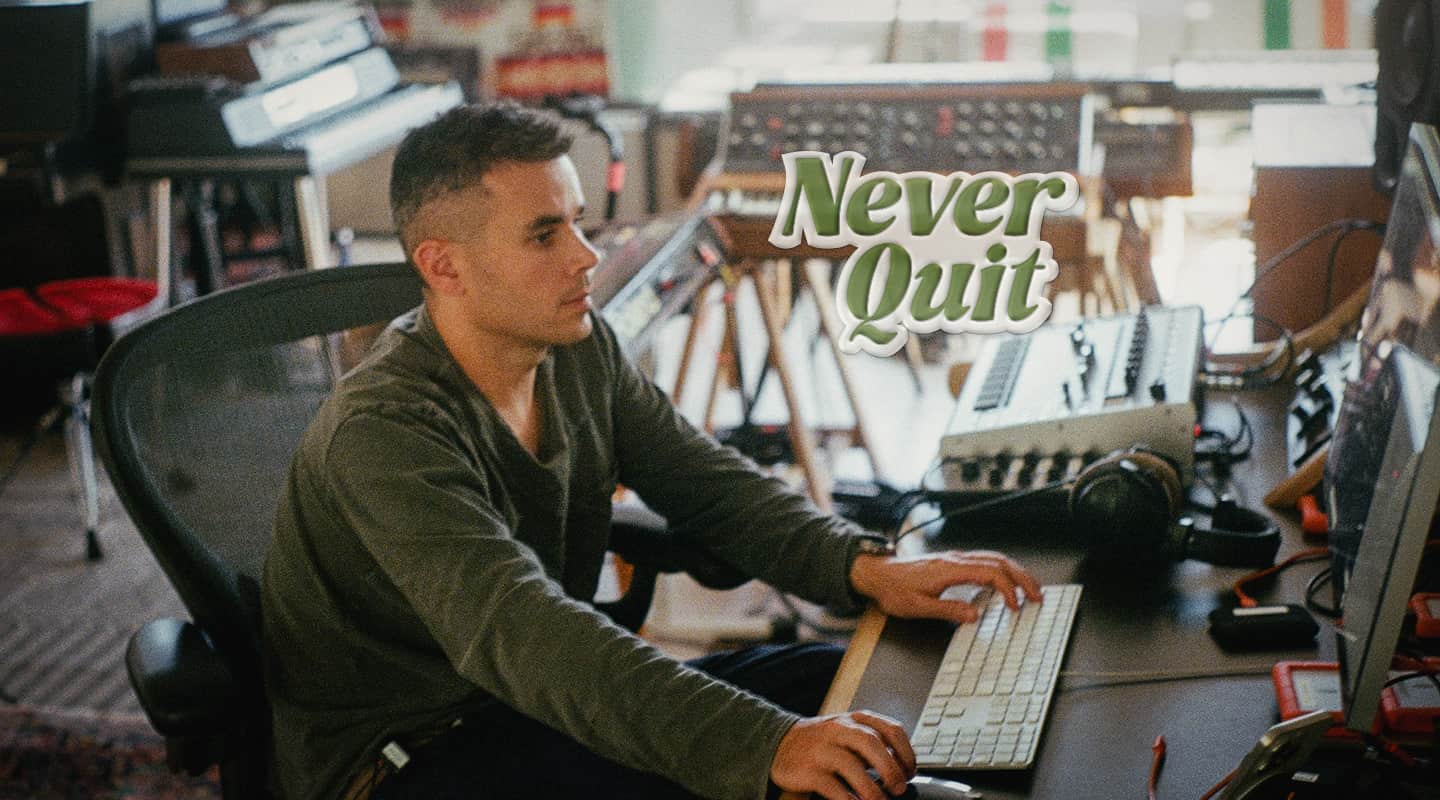
Rostam Batmanglij took on a bigger workload in the production and recording of Haim’s latest, I Quit.

By Paul Tingen
27 November 2025
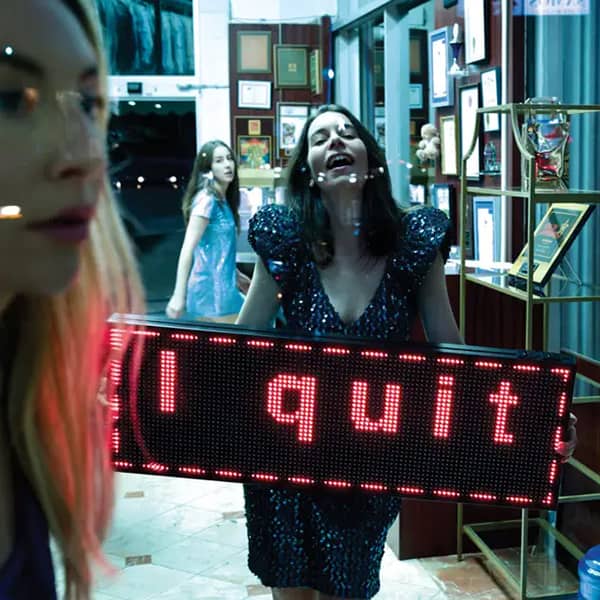
Artist: Haim
Album: I Quit
Cover Shot: Bowen Moreno
Critical reaction to Haim’s fourth album I Quit has been positive, albeit contradictory. The headline of one review read, “The messiest break-up album of all times,” while another judged it the band’s “most uninhibited album yet,” with one of the band’s three sisters quoted as saying that “it’s filled with so much joy.” So, maybe… the most joyful breakup album of all time?
However it may be, a change of direction was certainly on the cards for Haim with I Quit. The breakup in question was between singer Danielle Haim and Ariel Rechtshaid, who had been a central figure in the creation of the band’s music. Rechtshaid was one of the producers on the band’s debut album Days Are Gone (2013), and a principal co-writer and co-producer on Something To Tell You (2017) and Women In Music Pt III (2020).
With Rechtshaid no longer involved, artist, songwriter and producer Rostam Batmanglij stepped into the breach alone.
From his studio in LA, Batmanglij elaborated on the beginning of I Quit. “It started with Danielle telling me she wanted to write with me in my studio, together with her sisters. She had the idea of all of us playing together and recording the resulting jam sessions. The way the Red Hot Chili Peppers play off each other was a touchstone. Playing together was one way in which we worked on this record, but we wrote in different permutations. It’s rare for me that things boil down to one methodology for writing and recording. It’s always pretty diverse.”
BACK TO BASE
During the making of I Quit, with Batmanglij’s studio as ‘home base’, the producer recalls that “all three sisters were present throughout the process. Some days there would be different permutations – different combinations of the four of us, with various divisions of labor. Because Danielle and I were the two producers on the project, we were present day in, day out. Danielle is normally the lead singer, but one thing I wanted for this record was for each of the three sisters to have their own moment with lead vocals.”
The “different permutations” in which songs came into being included all or some of the Haim sisters and Batmanglij jamming and writing together on guitars or piano, sometimes using a pre-programmed beat. In some cases the quartet worked with pre-existing recordings.
“I don’t like to call things demos,” elaborates Batmanglij, “because with modern recording technology there’s no such thing as a demo anymore. There were a few songs that the Haim sisters had started without me, using GarageBand, that we would develop. You could call those demos, but even in that scenario we’d load those recordings into Pro Tools and used some of them. Danielle had recorded some things into her iPhone and Airdropped them to me, and I’d put them into Pro Tools as well. In this day and age, demos and recording is all blended together and the entire writing and recording process moves fluidly from inception to completion.”
“The song ‘Gone’ is an example of Danielle and I both playing guitar at the same time, and creating a four-chord sequence. Once we had that tracked, all of us built the song around that. Towards the end of the process, the Haim sisters wanted to add a sample of George Michael’s 1990 hit ‘Freedom! 90’. I warned that it might be expensive, but I’m glad we did it. I used the Music Rebalance module in iZotope RX11 to extract the backing vocals from the CD-quality recording. You can hear some artifacts, like hiss and top-end digital trash, but I like them. The sample adds a flavour and a dimension of that punk rock spirit of sampling a song that’s very famous. Both punk rock and hiphop have that attitude.”
INNER RELATIONSHIPS
The process to record the lead single of the album, ‘Relationships’, was different for several reasons. It does not only feature Buddy Ross as a third co-producer, but also several additional writers: Rechtshaid, Tobias Jesso Jr, and Buddy Ross. “That song dates back to 2017,” said Batmanglij, “and it’s an example of collaborators outside the four of us. There were a bunch of different versions. The earliest version I heard was something Danielle had made on her laptop in GarageBand. There was also an iPhone voice memo of Danielle with Tobias, just piano/vocal. And after that Danielle had worked with Buddy Ross on a version that was recorded in Pro Tools.
“By the time it came to me, the songwriting and chord structure were pretty much there, but Danielle felt something wasn’t quite right. What I liked about the process of working on that song was the challenge of it being almost like a puzzle, and certain pieces were missing. None of the existing versions had a second verse, so writing that was the first order of business. We created our own version of the song, and then wrote more of the song with Buddy Ross and later also Tobias Jesso.
“Buddy brought his own Pro Tools version, which I loaded into mine, and what stood out for me about his version was that the programmed drums had the right feel. Danielle played along to them, and the final version is a mix of Buddy’s programmed drums and Danielle’s played drums. I may have put my own spin on some of the piano chords. Halfway through the song, at the bridge, the drums go into a different, straight Michael Jackson-style groove, which was something I had in mind. We experimented with harmonic elements in the bridge, but in the end it breaks down to just vocals and drums.
“I doubled the piano part with a Roland Juno 60, and both have a chorus effect. They meld together in a way that means they stay out of the way of the vocals and the drums. I also used the Juno to create these filtered synth swells when the chord progression changes to 2-5-1 for the back half of the song. I pretty much always record the Juno with chorus setting II engaged.
“There’s also a background vocal part on ‘Relationships’ for which I used my E-Mu Emulator II. I received it with a cardboard box full of floppy disks! The challenge with that song was to make the chorus lift. Adding something celestial, like a breathy pad sampling Danielle’s vocal was the key. Danielle’s also singing these breathy aahs, and the combination of those two elements, the Emulator and Danielle singing the ah’s lifts that chorus. It was one of the puzzle pieces.”
demos and recording is all blended together and the entire writing and recording process moves fluidly from inception to completion
HEADPHONES ON & OFF
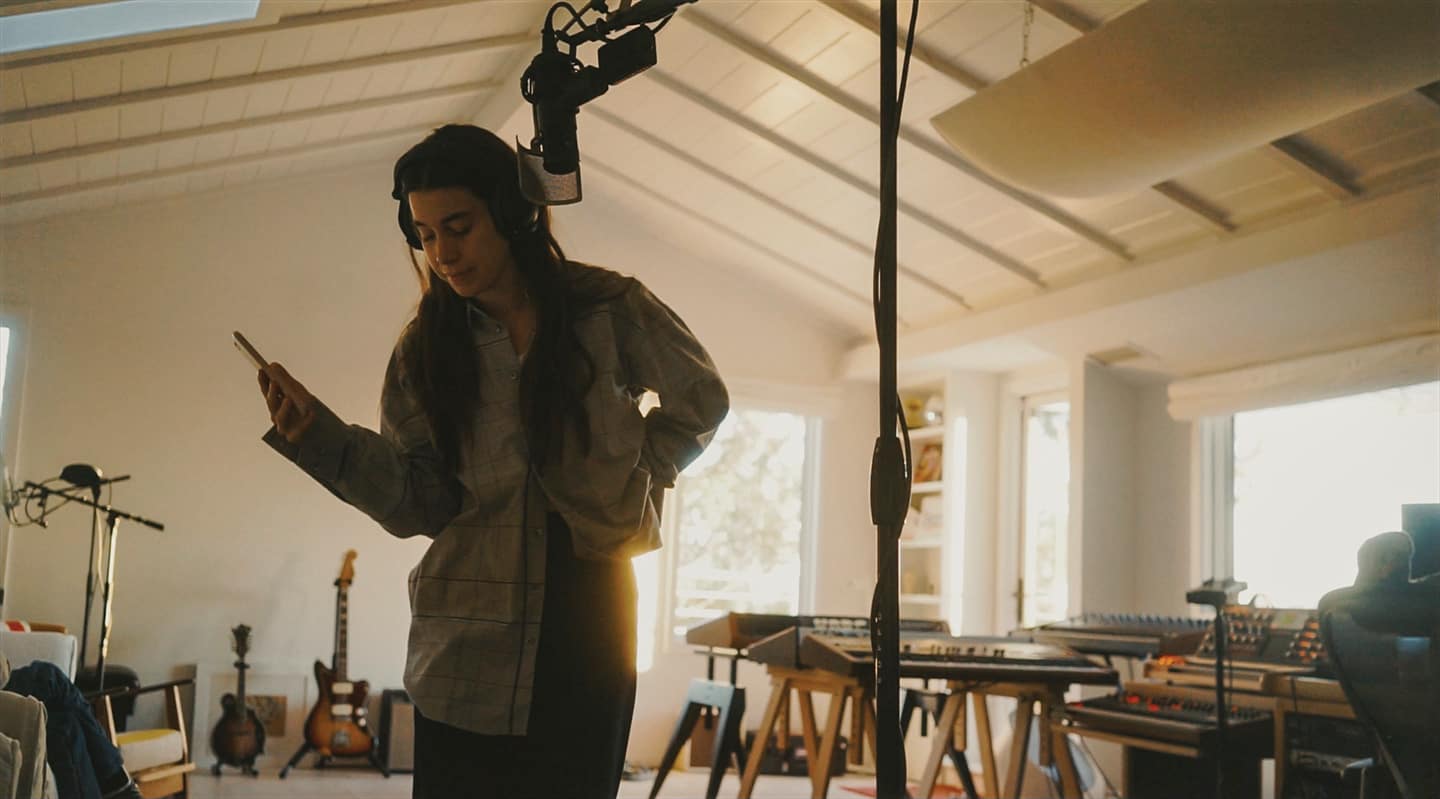
Although Batmanglij has an assistant, his studio is set up so he can track alone. Part of this involves doing writing sessions with his Dynaudio BM5 MkI or ATC SCM45A Pro monitors, instead of using headsets. “It’s pretty stupid to write with headphones on! But recording is a mix of with and without headphones. If you have bleed, it’s pretty incredible what you can do today in terms of removing background noise. With vocals it’s a trade-off, because the best-sounding vocal is usually recorded with a condenser and the singer wearing headphones. But there’s something about the spirit that’s captured with a handheld dynamic mic that you can’t capture otherwise. For the song ‘Down to be Wrong’, we had an entire vocal comped that was recorded with a condenser, but in the end we opted for the handheld mic recording, because it has a spirit that could not be recreate or duplicated.
“On this album, we recorded the vocals with either my vintage Neumann U47 or my Electro-Voice RE20. The vocal on ‘Now It’s Time’ was also recorded with a handheld RE20. If you boost the top end, you can get a pretty clear-sounding, almost condenser-like sound. We did use the iZotope RX11 to take out background noise. I record most things with a Neve 1073LB mic pre, and a vintage Urei 1176 compressor. I have a vintage Neve 1073, but for vocals I prefer the modern lunchbox version. I record most acoustic instruments in my studio with a combination of a condenser and a RCA KU-3A ribbon. I have two KU-3As, and they always go through an Electrodyne 501 pre and a Distressor.
“For acoustic guitar I use the Neumann U47 as my condenser, or sometimes the U67, or my AKG 414, which I think sounds great on acoustics. The condenser will go into the 1073 LB pre and 1176. On my Steinway K52 upright it’ll be a Neumann U67 or U87 going into my vintage 1073 and then the Tube-Tech CL-1B. What I love about that piano is that it sounds exactly midway between an upright and a grand piano. It doesn’t take up as much space in the studio, or in the mix, as a grand piano would.
“For bass and electric guitars I like the Tonecraft 363 Tube Direct Box. You definitely hear it change tone the more you drive into it. I’ve used this on almost all electric guitars I have recorded. The main work horses in my studio are a 1963 Fender Stratocaster and a 1966 Jazz Master. I’ll usually add a chorus plug-in in the box, to add an extra dimension of width, and/or often a plug-in called Speakerphone by the company Audio Ease on the guitars. Everything goes into Pro Tools via my UA Apollo 16.
“I also have a Fender Champ amp, that I love. On the song ‘Spinning’, I sent my Korg Trident synth through a Boss CE1 chorus ensemble guitar pedal, and then into two different tube amps. I mic’d each tube amp separately to create a wide stereo signal. I was trying to capture that very late ’70s sound. In some cases I will also run stuff through my Fender Champ and then mic it after it’s been recorded. So there definitely are amps involved, at the end of the process usually, and sometimes earlier. The mics I use on the amp are the Electro-Voice RE20 and an Shure SM7.
As for keyboards that were used on the album, in addition to my Roland Juno 60 and the Trident, there were an early ’70s MiniMoog, plus the Solaris, made by Mark Bowen. It has the best pad sound ever. I also use soft synths, usually as a placeholder, until they get replaced. Though on ‘Love You Right’, the Tal-U-No-X plug-in, which is an emulation of the Juno, stayed in. It’s just two notes, and I liked the soft-synth more, because it has no hiss, unlike my hardware Juno.”
For the song ‘Down to be Wrong’, we had an entire vocal comped that was recorded with a condenser, but in the end we opted for the handheld mic recording
DRUMS FOUNDATION
Finally, Batmanglij came to the drums. He remarked, “My ideal situation for drums is that all bets are off as to whether the drums are real or programmed. I like it when drums live in that middle ground between real and programmed. On this Haim album, for the most part, the foundation are real drums. To program drums, I’ve created a collection of samples for several Native Instruments Kontakt drum kits that I made that have all been recorded to tape. A lot of my drum programming involves very real-sounding drum samples.
“I use Kontakt, and play the drum parts on a keyboard, because I don’t like dragging and dropping samples. I find that to be uninteresting. I’ve done it before, and I’ll certainly do it again, but I’m more interested in arriving at grooves in ways that are simply not possible when dragging and dropping samples. Playing is part of it, and also, if I’m going to have a clap on a backbeat, I’d rather hear it alternating between two different clap sounds for the two and the four, than hearing the same clap. Drums can live on the grid and not sound stiff. In the Kontakt patches that I’ve made, every element is deep sampled with three different velocities and three different samples for each velocity. So there’s nine possible sounds that could happen with each hit.
“Some people have asked me how I record real drums, as if there was one way that it always went down, but it’s always different. Having said that, it’s usually two ribbon overheads, two condenser overheads, each pair about three feet away from each other to capture the room, and a kick mic. Reluctantly, I’ll have a mic on the snare, but I don’t love snare microphones. Over the last five years I’ve used U47s or C414s for the condensers, and the ribbons are the RCA KU-3A mics which are at the heart of my drums sound, and are going into the Electrodyne pre and the Distressors on pretty much every recording, and via my Cranesong HEDD 192 into Pro Tools. I’ll also often use the SPL Transient Designer on the way in, and then an SPL Transient Designer plug-in in the box. The SPL allows a lot of control over hi-hats, cymbals and snares. Usually it comes down to tightening the decay, and then doing it again. Sometimes I’ll chain multiple SPLs in the box. On the way in, I’m often using the SPL to blow up the sound.”
ON TAPE
Batmanglij clearly has a love of analogue gear. “In some cases we re-recorded the drums at Valentine Recording Studios using their 24-track tape recorder and echo chamber. When we did that, I brought my own mics, particularly my KU-3As, and my SPL outboard unit. In most cases, we beat the drum recordings at my studio, but sometimes the original recordings had a magic that was untouchable. In those cases I almost always bounced the drums to my Ampex ATR-102 two-track tape recorder, or my Nakamichi 1000 cassette recorder. Probably 95% of drums hit tape at some point.
“Cassette players had a bad reputation because they were supposedly lo-fi, but I think there was a point when the pursuit of fidelity caused music not to sound very pleasant. I usually don’t like the way cymbals and hi-hats sound on modern records. On most records that I hear with real drums, the cymbals and hi-hats are painful. A condenser microphone recording a drumstick hitting a cymbal is inherently going to be a little bit painful to your ears. So you have to subvert the fidelity. I love the way that tape changes transients. When David Fridman’s first mix of ‘Even The Bad Times’ came back, I said ‘let’s run the hi-hats through the Nakamichi, and send them back to Dave.’ As soon as we did that, I liked the way that the mix sounded.
“David mixed almost the whole album, but I mixed two songs. When mixing, I’ll sometimes use an UnderToneAudio UnFairchild, and I bounced out some vocals to that to make them sound more finished, for lack of a better word. And on ‘Even the Bad Times’, I remember using my API 550Bs outboard to simultaneously pull upper mids out and boost top end on the hi-hats, so that they would have their modernity intact, but also not be harsh. I learned this from an interview with Philippe Zdar. I’ll use outboard gear, but most of my mixing happens in the box.”
NO TIME TO QUIT
With I Quit well-received by the critics, the recipient of a Grammy Nomination for Best Rock Album, and ‘Relationships’ mentioned as one of the songs for Tobias Jesse Jr’s Grammy nomination for Songwriter of the Year, Non-Classical, the album has been very successful. However, in terms of chart positions, the fourth Haim album has lagged behind its three predecessors. Batmanglij took a long-term view.
“I think that albums now take 10 years, at least, for their impact to be understood. If it is instantaneous, it’s probably going to burn bright and then burn out. It seems like today you have to put music into the world and let it bloom gradually, and let it reach who it’s going to reach.”
With Batmanglij releasing a third solo album, American Stories, and going on tour, in 2026, it’ll be interesting to see where he, and Haim, will be at in 10 years’ time.







RESPONSES