








Review: Hotone Pulze Mini
Guitarists: this tiny modelling amp may just have an indispensable place in your everyday life.

By Preshan John
28 July 2025
I get it. Many guitarists will turn their nose up at a palm-sized, battery-powered amplifier with Bluetooth and built-in modelling. But to me, it’s an opportunity to bring the fun of guitar into everyday life.
Let me explain: I’m married, have an adorable and energetic toddler, and I work full-time. Life’s great. However, when it comes to my passion for making music, this current life stage doesn’t leave much room for long sessions in the studio – something I used to do a lot more.
As a result, I find myself looking for ways to weave music into everyday routines. I set up the keyboard in the dining room the other day. I’ve also attempted to child-proof my bedroom studio so I can jam while my daughter hangs out with me.
So, you could say I’m primed to appreciate a product like the Hotone Pulze Mini that’s designed to make the joy of playing guitar – regardless of time, location, or life stage – a little more within reach.
MINI & MIGHTY
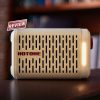
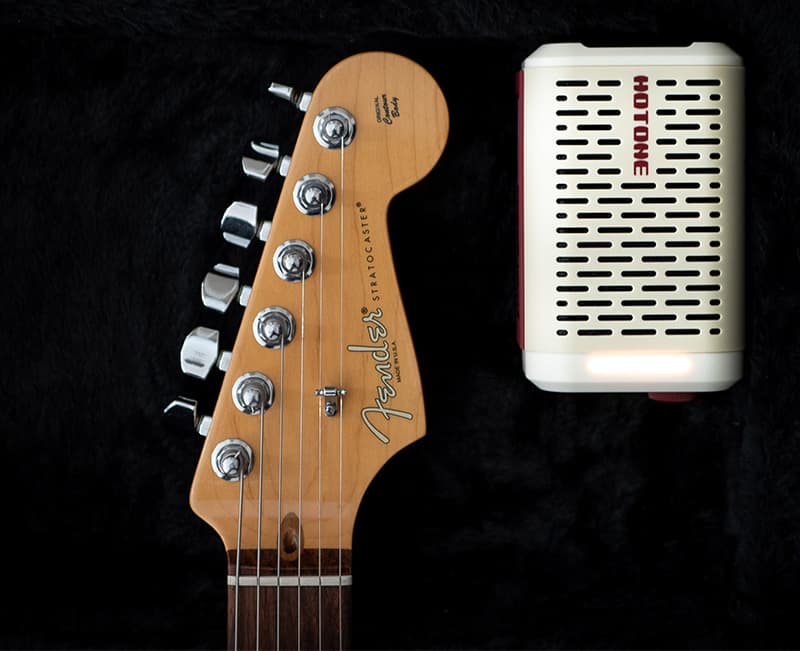
Pulze Mini is the smaller sibling of Hotone’s Pulze portable modelling amplifier. And by ‘smaller’ I’m talking 12cm wide, 6cm deep, and 8cm tall. Portability is high on the design brief for this type of product – and that comes at a cost (which we’ll talk about shortly), but it’s self-evident that a tiny amp like Pulze Mini is less about mind-blowing sonics and more about basic accessibility for practising at home or taking on holiday.
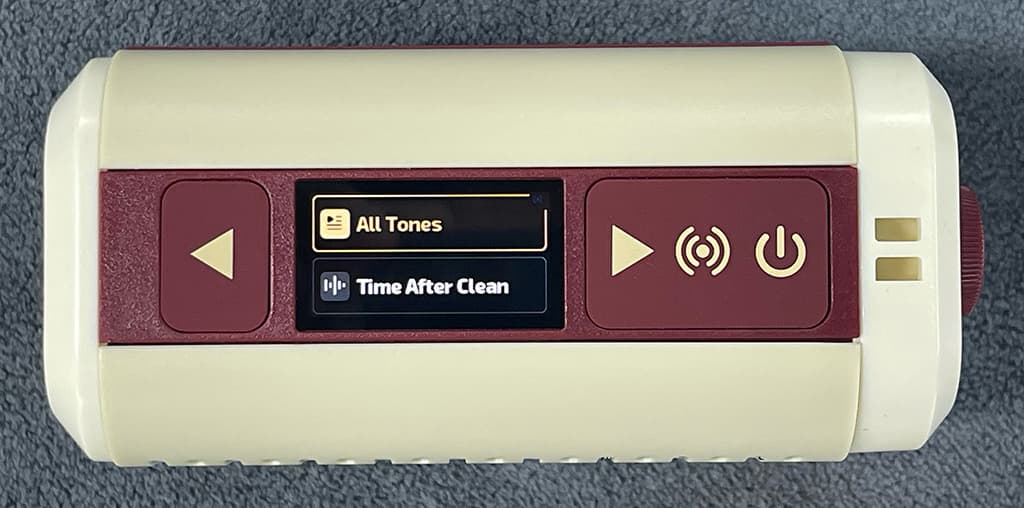
Pulze Mini’s 6.25mm TS guitar input jack is positioned near the bottom of the unit’s side. This helps keep the centre of gravity low so it stays upright on a tabletop. A comprehensive array of patches can be navigated via the full-colour screen which looks fantastic and is easy to read. Cycle through the patches one at a time using the left or right buttons, or press left/right simultaneously to scroll through patch groups called Songlists, such as Hi Gain, Drive, Clean, Jazz/Fusion, Alt/Special, Funk/Soul, Blues/Roots, etc. Hotone even includes patches for Bass (probably not your first choice on a tiny speaker) and Acoustic Guitar (with a range of acoustic sim options).
Built-in Bluetooth functionality allows wireless connection to a smartphone or laptop for audio playback, much like with any Bluetooth speaker. The stepped knob on the side panel controls levels of Main Output, BT Output and Inst Output. Pushing the knob changes what it controls. Push and hold the knob to access the (quite accurate) tuner.
Pulze Mini’s vintage aesthetic is augmented by the cream and maroon colourway and slitted grille perforations. The plastic body feels solid in the hand as do the knobs and buttons. A nice touch is the glowing LED strip light which changes colour and reacts to changes in parameters and levels.
Battery life is commendable. I could easily get over four hours of play time with the volume cranked up, and even more (Hotone states up to 5.5 hours) at medium volume. Using the 3.5mm headphones output extends it to 11.5 hours. A USB-C port makes charging straightforward. Pressing the power button once while the unit is on presents a readout of the remaining battery life on screen.
The USB-C connection can also turn Pulze Mini into a 2×2 audio interface when used with a computer. My Mac discovered the unit immediately and I could record in stereo straight into a DAW or QuickTime in a matter of seconds. It can also be used as a speaker for audio playback from the computer. A separate USB Output level control on the unit would be handy as there doesn’t seem to be a way of changing it currently.
NEED TO KNOW

MADE FOR GUITARISTS
Importantly, Pulze Mini features the same CDCM HD & F.I.R.E. modelling engine as in several other Hotone products. The playing experience is impressively responsive and rivals much dearer modelling products on the market. Audio is processed at 24-bit/ 48k.
Then there’s the swathe of amps, cabs and effects built in – around 50 varieties of both amps and cabs, and over 100 effects. Not to mention the processing power to run all of this. This breadth of sonic scope is what makes Pulze Mini a much more creative tool than a three-switch ‘Clean/Overdrive/Hi-Gain’ kind of amp.
It wasn’t long after toying with the various patches on Pulze Mini that I wanted to start tweaking more granularly. It’s worth noting this cannot be done on the unit itself – all adjustments to individual patches are made through the Pulze Editor app, a 250MB download for iOS or Android via the Hotone website.
The user interface is uncluttered and straightforward. Up to seven effects modules can be stacked in a signal chain and sequenced as you please. I appreciate the ability to create user Songlists which let you aggregate patches into custom groups for easy access. Play Mode offers fine control over the seven modules in the signal chain while Songlist Mode is for switching between patches in a Songlist with an icon display of each module rather than all the control options. Once a Songlist is created and saved, it, of course, shows up on the unit’s LCD for easy access to your favourite patches without a smartphone. Pulze Editor also lets you export patches as files and access or share patches with the Hotone Community via the cloud.
A drum machine in the app is a fun extra that’s perfect for practising. Hotone has included a variety of genres and beats, many of which are a bit cheesy, but there’s a number of metronome options to fall back on.
Given much of Pulze Mini’s functionality is only realised through the app, it’s vitally important the user experience is on point. Pulze Editor is a very well implemented app. It connects quickly, performs smoothly, doesn’t bog you down in menus and unnecessary steps, and ultimately unlocks the full potential of Pulze Mini in a neat user interface.
If you want better control of patch selection on the Pulze Mini, Hotone has you covered with its affordable Pulze Control dual-footswitch MIDI controller that connects via Bluetooth.
thanks to the quality of Hotone’s modelling and built-in scope of tonal possibility, purists may have more fun than they want to admit
MATTER OF INCHES
For a two-inch speaker, Pulze Mini is anything but wimpy. In fact, I found it plenty loud enough when playing around the house and generally had the Main Output set to around 75%. It comfortably held its own even when jamming in a room with others on acoustic guitar and light percussion.
That said, remember: Pulze Mini is built to be super-portable, so don’t expect miracles out of the two-inch driver. Naturally, there are trade-offs in detail, clarity and separation – some subtleties are lost.
The headphone or USB outputs are a way of transcending this constraint and experiencing the full depth and quality of the CDCM HD & F.I.R.E. engine. However, Pulze Mini’s midrange-focused driver suits most guitar tones to a tee, and you won’t bemoan the size of the speaker in a hotel room or camping tent when it’s the very reason why you’re able to play guitar ‘in the wild’.
FINGER ON THE PULZE
With the Pulze Mini as my domestic companion for a few weeks, it’s hard to argue with its value proposition. Just plug in a guitar and start playing. No setup, no power cable, nothing to connect except the guitar itself. The sheer accessibility of the thing will make you play your instrument more, and thanks to the quality of Hotone’s modelling and built-in scope of tonal possibility, purists may have more fun than they want to admit.
Obviously, the Hotone Pulze Mini doesn’t aim to replace a gigging amp or a high-end modeller. What it does is lower the barrier to plugging in and playing anywhere, anytime, and it does that really well. If you’re time poor but still want to keep your fingers moving and ideas flowing, Pulze Mini could be your new best friend. It’s not a 50W tube amp, but it’s not a toy either — and that’s precisely the beauty of it.






RESPONSES