

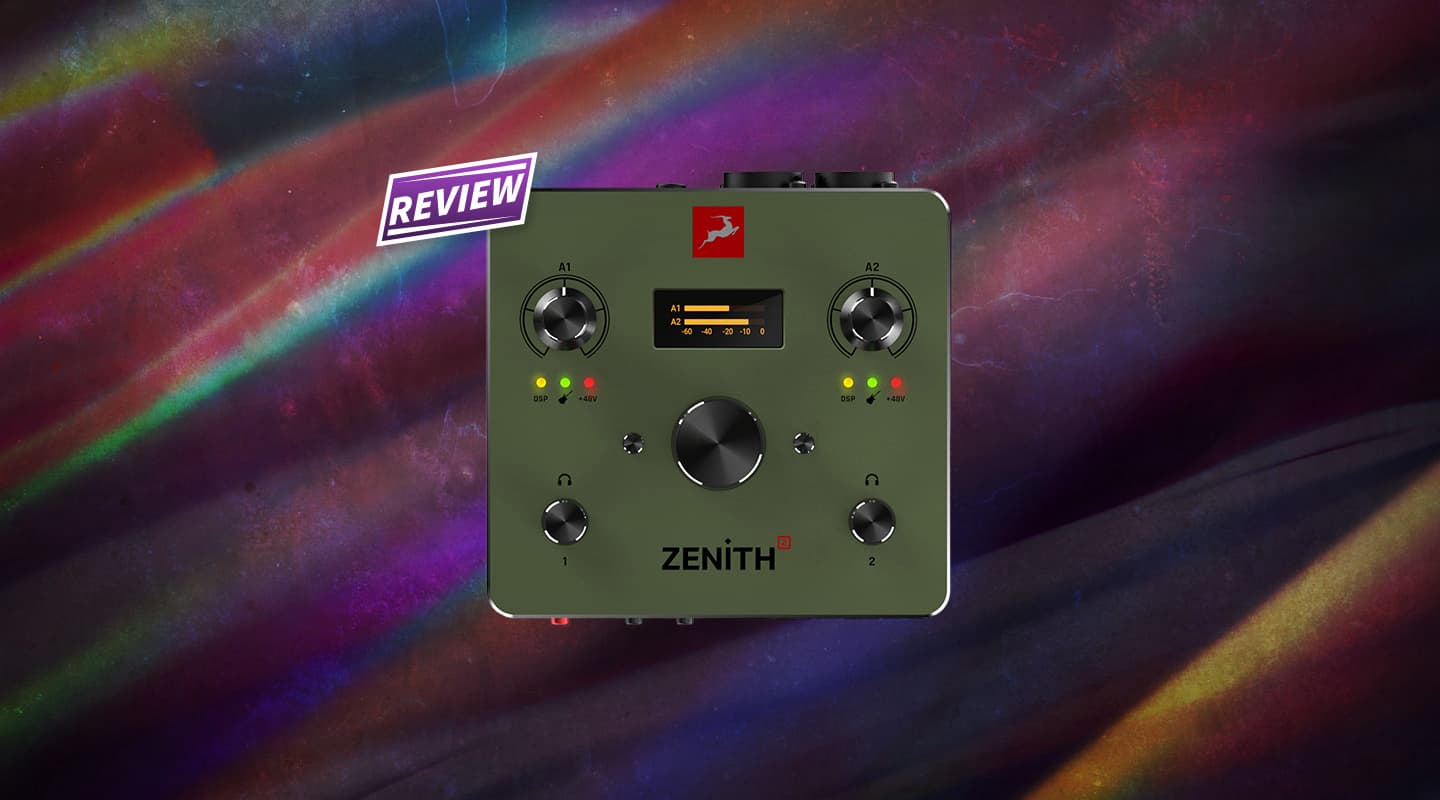
Review: Antelope Audio Zenith 2
Antelope Audio springs into the crowded two-channel interface market with primo preamps and useful front-end DSP.

By Brad Watts
21 July 2026
It’s a tangled market in the ‘price conscious’ audio interface arena. Anywhere between A$150-600 you’ll find literally dozens of options. Whether you’re after simple monitoring, a podcasting interface, streaming I/O, or a stereo field recording system, you can spend a lot of time wading through product specs and the old ‘bang-for-buck’ equation. If you’re after high quality A/D conversion and upper echelon mic preamps, you’re inevitably going to find yourself at the $600 end of the market. You’ll be weighing up the likes of Audient, Focusrite, SSL, Universal Audio; all of which offer professional specifications and a confusing array of proprietary DSP options.
Entering the fray is Antelope Audio. Known for its high-end professional converters and interfaces, the company has taken the plunge and distilled its technology into a portable two I/O USB-powered audio interface covering sample-rates from 44.1k through to 192k at 32-bit integer. It’s the Zenith 2. What’s on offer?
NUTS & BOLTS
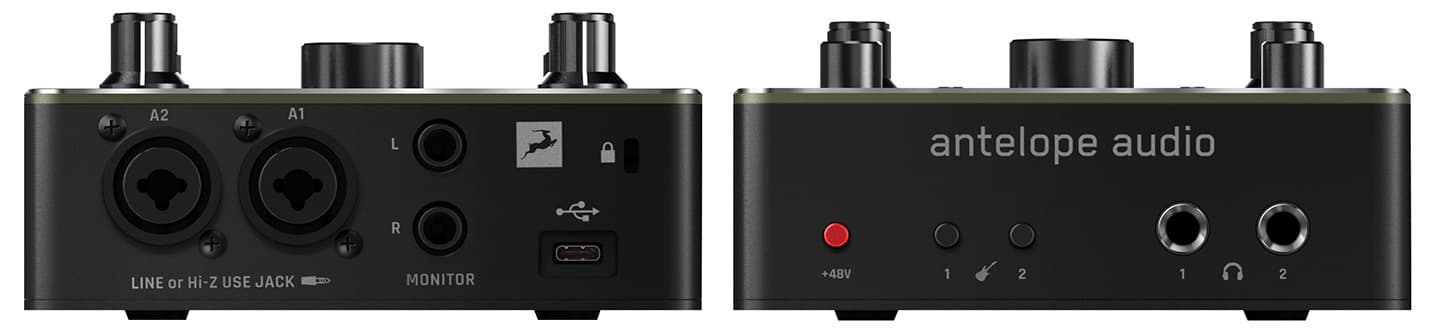
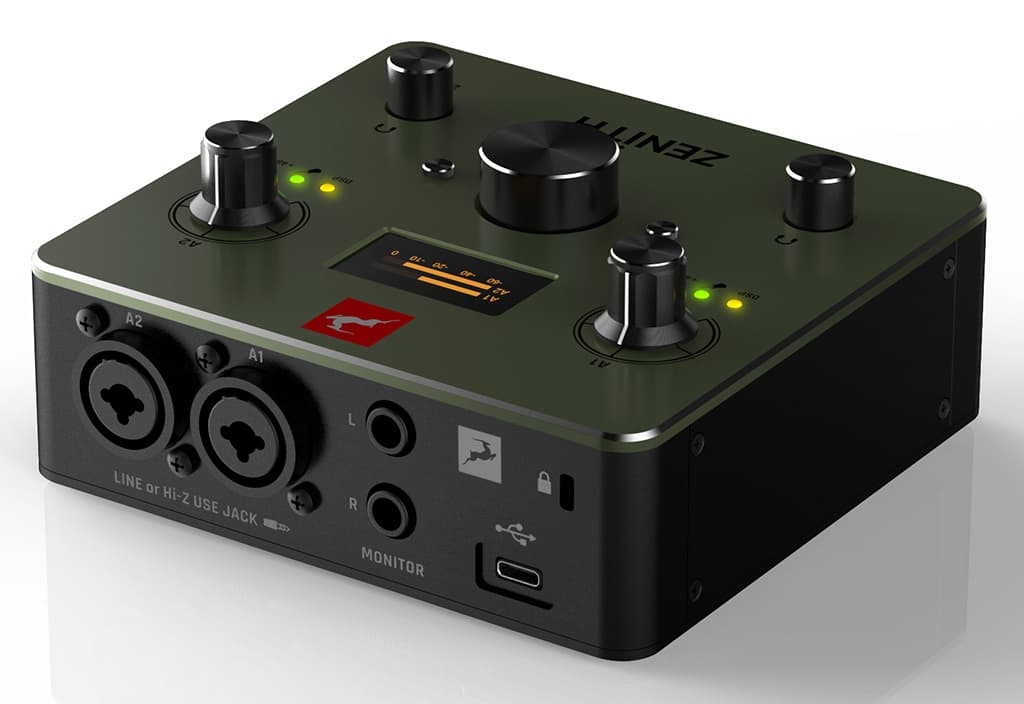
Firstly, I’ll make no bones about it, the Zenith 2 looks remarkably like a guitar effect pedal. It’s a militarily square box you could pick up with one hand and hurl into a backpack at a moment’s notice. Construction is 2.5mm thick steel and aluminium throughout, and feels like it would stand a bit of rough treatment. To the rear are two combo XLR/TRS inputs and left/right monitor outputs on 6.25mm TRS jacks. As mentioned, the unit is USB powered, so the only rear port remaining is a USB-C connector. Antelope advises, and I can squarely confirm, the Zenith 2 is best connected directly to your recording machine rather than via USB hubs and extenders. While I could ‘see’ the unit via the software and macOS when connected via a hub, it simply didn’t function connected this way. Direct is best. Antelope supplies a USB-C cable and an adapter for USB1-style ports.
The front of the Zenith 2 provides two headphone outputs, each with its own software mix parameters, and three push-buttons. The first button instigates 48V phantom power to both mic preamp inputs, and the second two buttons instigate high impedance input for instruments via the TRS inputs. In all honesty, if anything breaks or fails on this unit it’ll be these push-buttons. The build feels cheaper, and the protruding plastic could potentially be damaged or snapped if you do get careless hurling the unit into a backpack. Perhaps make sure they’re pushed in when in transit.
To the right hand side on the Zenith 2 are some evergreen five-pin MIDI plugs. In and Out for connection to traditional MIDI devices. This is one aspect many other manufacturers eschew, no doubt because of the now almost-ubiquitous MIDI-over-USB found on most modern keyboards and controllers. But if you’re in need of ‘real’ MIDI ports, the Zenith 2 provides.
Top-side you’ll find two dedicated rotary encoders for each headphone output level, and two pots for the mic preamp/instrument input gain levels. Below each of these are LEDs indicating if the input is set to Instrument or Mic input, with a third LED indicating if the unit’s onboard DSP is activated, which I’ll cover shortly. Centrally mounted is an OLED display and a larger rotary encoder with pushbutton functionality. The encoder primarily looks after monitoring output level and secondarily for adjustment of device parameters. Two push-buttons either side of the encoder aid delving into the Zenith 2’s menu system, which is relatively intuitive.
NEED TO KNOW
Antelope Audio Zenith 2
2×2 USB-Powered Audio Interface
UNDER THE BONNET
As mentioned, Antelope has incorporated DSP into the Zenith 2 hardware. This processing is available at the input stage and consequently will be ‘printed’ to files when you record. On offer are some overall preset processing chains for vocal recording, some ’studio’-centric processors such as a de-esser, LA-2A style opto-compression, high-pass filter and some high-frequency ‘air’ style EQ. For instrument processing there’s a handful of guitar-based effects: a noise gate, compressor, fuzz, overdrive and distortion emulating the usual suspects, and an amp simulator with 10 options as to amplifier emulation. All DSP can be selected and adjusted via the unit’s front panel or via the software. It’s a basic selection of processing, but serviceable nonetheless – the LA-2A compression being my pick of the bunch.
The control software is both macOS and Windows compatible, and covers a vast range of operating systems on each side of the Mac/Windows divide. Equally, the Zenith 2 will connect and operate with Android and iOS, so the potential for an extremely compact recording system is viable. If you’re streaming audio from within your host operating system there’s an additional loopback function so you can record whatever audio is happening on your host machine directly. An extremely useful touch.
PLAN Z
The Zenith 2’s pedigree is beyond reproach. Antelope has literally taken its high-end pro-grade mic preamps and conversion, a lick of its pro DSP, and crammed it into a tiny form factor. Reproduction is clear, concise, and startlingly professional. Specs tell a lot of the story: a dynamic range of 123dB (A-weighted) on input and a THD of -98dB. On output you’re looking at a dynamic range of 122dB (A-weighed) and THD+N -108dB. The resulting performance is nothing short of impressive for an interface in this price bracket. What I find a little odd is at this price I’d have hoped for at least an ADAT optical input [you’ll need to look at the next Antelope model up, Zen Quadro, for that ADAT input – Ed.]
As for the microphone preamps, they do sound very nice. Clean and uncoloured (unless, of course, you instigate any of the hardware DSP). Oddly, the quoted gain for the mic pres (75dB) is a bit misleading. They’re actually around 55dB with an additional 20dB of digital boost, which is accessible via the unit’s control software and the unit’s front panel controls. Speaking of which, while the software and control panel are adequate, I couldn’t help feeling the antelope Launcher and Zenith 2 control panel to be a little clunky. Not nearly as finessed as what other manufacturers manage to conjure. That said; it does the job.
HIT THE ZENITH?
Whether the Zenith 2 is the right interface for you will come down to a few factors. Firstly, if the audio path and quality spec is what you’re after then you’d be hard pressed to find anything similar at this price. Secondly, are you after something utilitarian; USB bus-powered and easily carried to the next recording space? Then forgetting about additional hardware DSP, do you need an interface that will function alongside multiple devices and operating systems: iOS/Android and macOS/Windows? Ticking all three boxes will leave the Zenith 2 as your top pick.




RESPONSES