

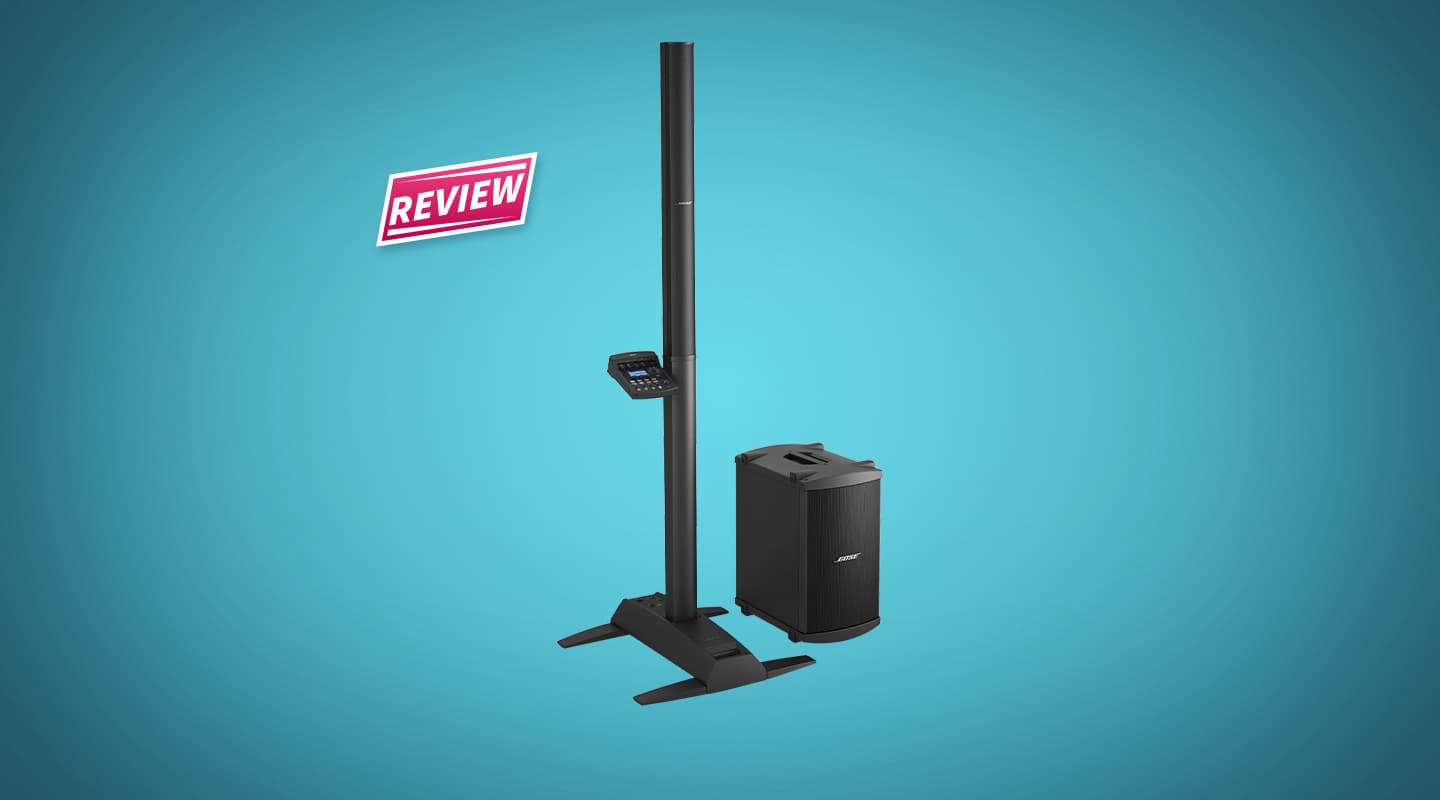
Review: Bose L1 Model 1S, B2 Bass & T1 Tonematch
Bose has added more design ingenuity to its ingenious column speakers.

By Mark Davie
22 April 2013
Bose has always revelled in the power of psychoacoustics to squeeze a little something extra out of its designs. While other speaker box manufacturers tend to provide speakers loosely based around the idea of setting up a left/right configuration, or something like it — leaving it to the engineer to create any spatial separation within their mix — Bose has had different ideas. The Bose 901 hi-fi units fired eight drivers into the wall, and only one directly towards the listener, using room reflections to advantage rather than trying to avoid them. And its satellite systems were always designed to sound much bigger than they look.
In the PA world though, Bose, while still innovative, was seemingly towing the same PA line as everyone else. While the 802 eschewed crossovers and tweeters for eight similar drivers, it was still designed to sit left/right, LCR, or similar. Then Roommatch came out, which allowed installers to not rely on DSP, but rather, pick their line array modules based on how each box’s performance characteristics matched the space it was going into. But again, still designed to operate in one of the de facto setups.
But perhaps the most interesting device to come out of Bose’s boffinry is the L1 system. Various iterations have been around for a few years now, but Bose just updated the line with the release of the L1 Model 1S and B2 Bass module, so we thought it would be a good time to revisit the technology.
COCKTAIL CLOAKING DEVICE
The issue, as Bose saw it, was that by shoehorning the output of multiple musicians into one or two sides of a PA, then the potential for them to mask each other is much greater. It’s commonly referred to as the Cocktail Party Effect. (Well, the opposite really, the Cocktail Party Problem.) See, we humans are pretty good at eavesdropping at parties, so long as the person(s) of interest are spaced around the room and not standing on top of each other. As soon as multiple sources come from the same spot, you’re ability to distinguish between whether they’re talking about your mate Richard or being a tad inhospitable decreases dramatically.
The idea behind the Bose L1 is to return sound reinforcement to the days before triple system amplification (backline, monitors and front of house) became the norm, and go back to individual instrument amplification. The benefits being that each instrument has its own PA, which helps not only the audience localise the sound and enhance intelligibility, but also allows the musician to control their own sound, knowing that the sound they’re producing is what the audience is hearing too. The Bose L1 systems are designed as a cure-all for instrument amplification, foldback and PA in a single package.
STICKING WITH IT
This, of course, requires a markedly different kind of speaker system to what we’re used to. The system, instead of being a speaker on a stick, is a stick speaker. The roughly 2m-tall L1 Model 1S unit splits in two, with the top being a vertical array of 12 speakers, and the bottom half an extension that slots into the base, which also doubles as an amplifier.
The Bose L1 works as a cylindrical wave source. Losing only half its intensity with each doubling of distance, as opposed to a spherical source (think: typical 12+horn-style speaker) which retains only one-fourth of its intensity with every doubling of distance. It also has a horizontal dispersion of 180 degrees. The result is a naturally wide spread that can fill a room with ease, and less level loss from the front of the room to the back. It means the performer can tailor their own sound and EQ, without it sounding completely different in the cheap seats.
It’s actually quite remarkable how well the system works. It’s by far, one of the most even-sounding small systems I’ve heard. You can be standing 25m away, need to adjust the EQ or level and walk right up to the unit without it tearing your head off.
I only had a single system to test out, so I wasn’t able to put into practise Bose’s idea of having an L1 for every performer. But to get the idea behind using it as both monitoring and FOH simultaneously, we used a couple of volatile instruments, namely an acoustic guitar and a vocal mic. If anything was going to set it off, it would be one of these parked directly in front of the array. But, with plenty of level for a 100-person sing-a-long and definitely space for more, there wasn’t even a squawk from the PA with the performer sitting 1.5m in front of it. Adding a backing vocalist to the mix didn’t phase it at all either, but that was starting to move away from the one artist, one stick formula. The B2 Bass was more than adequate to keep up with the column speaker, and does its job admirably.
BREAKING IT DOWN
The two halves of the main PA — the power stand, and column — break down into roughly 11kg lots with their padded carry bags, while the B2 bass module is a 20kg box, and comes with a slip-on cover. The whole design is incredibly well thought-out. While original versions of the L1 had a base support system more akin to a portable basketball ring (one of those plastic-bottomed contraptions you fill with water), the newest models have a sleek base unit with operable legs. The legs are the sort you’d imagine folding out from a Bond amphibious vehicle — all four are connected, so tugging on one will unfold the lot in unison. It’s these little refinements that have really turned the series into a gigging musician’s dream. There’s even an incorporated loop and hook to tuck the Tonematch mixer’s Ethernet cable out of the way.
Which brings us to… the T1 Tonematch. It’s a little mini-mixer you can purchase with the L1. It hooks up and talks to the base via Ethernet, including drawing power from it. It’s got three combo mic/DI inputs with direct preamp outs on ¼-inch jacks, as a stereo line input, and two mono outputs — master and aux — on ¼-inch jacks for any extra hookups you may need.
The Tonematch has small rubber knobs for trim and channel volume, buttons for mute, FX mute and channel edit, a master knob, phantom button, a small screen big enough to show all the metering at once, as well as a large dial for most everything else. Bose has really packed a lot into this microphone stand/L1 column-mountable package, including Bose’s Tonematch presets. With Tonematch, performers can pick their instrument, say vocals, then choose between whether they’re using a handheld or headworn mic, want a bright sound, or any other number of options. Once the general preset is nailed down, the EQ function gives a basic low/mid/high EQ with set frequency and Q. For more detailed adjustment, users can twiddle the parametric EQ. There’s also an onboard tuner and dynamics, modulation and delay effects for each channel, as well as global reverb mixed to taste on each channel. Users can also set up multiple scenes if, say, the system is alternating between an acoustic duo, to speech, and then a DJ during an event.
Bose is intentionally obscure about providing specs for the system. As such, there’s no dB SPL ratings, frequency response plots, or even cross-sections of the mysterious 12-speaker line array column that manages to spit out 180-degree coverage. But it sounds great, and Bose has developed the package so it’s not only a joy to use, but simple and effective to pack up at the end of the night. While it functions perfectly well as a PA, if you really want to buy into the Bose ethos, you’ll have to convince your playing partners to buy one too.






RESPONSES