






Review: Two Notes Torpedo Reload II
Two Notes’ latest salvo is the Torpedo Reload II, a powerful analogue load box that aims to bridge the gap between stage, studio, and sanity.

17 April 2025
Review: Brad Watts
Like most guitarists, I’ve slowly learned that more doesn’t always mean better. After years of recording guitar amps, I realised that hauling around a 100W head and a 4×12 cab was more hassle than it was worth. These days, I get convincing results with a 5W amp, a 10-inch speaker, and a couple of well-placed mics.
Out went my Laney 100W AOR head and 4×10 cab. Foolishly, my mid-’80s Super Champ also bit the dust—to fund an Atari 1040STE, no less. Ah well. You live and learn. Eventually, I ended up with a dodgy ’70s Champ that had more issues than Woman’s Weekly, but at least I was on the right path. A small amp mic’d well can sound massive, and you won’t be upsetting the neighbours.
These days I stick with a modern Vibro Champ reissue, a 1W Valvetone head, and a handful of speaker cabs—plus the usual pedal pile. That’s the extent of my valve amp world. I can crank these little suckers up, and that’s where it ends. Still, I’ve always missed the high-wattage tone—especially the Laney—when pushed into that sweet spot.
Over the years, we’ve seen all kinds of ways to tame loud amps: isolation booths, speaker attenuators (which often sap the tone), even voltage regulators (which risk damage). More recently, a smarter option has emerged: the reactive load box.
Enter Two Notes Audio Engineering. Since 2008, they’ve focused on delivering controllable amp volume without sacrificing tone. Their original product, the Torpedo VB-101, combined a reactive load with cabinet impulse responses. Since then, they’ve refined the formula, culminating in the new Torpedo Reload II—a serious piece of gear for studio and stage.
ALL HANDS TOPSIDE
The Reload II is bristling with analogue routing and patching options that put its competitors to shame. Unlike the UA OX, which leans heavily on internal DSP and emulations, Two Notes has opted for a strictly analogue approach. No Wi-Fi, no Bluetooth, no USB—just real knobs, switches, and sockets. For those who want a digital playground, a free copy of Genome software is included, offering amp sims, IR loading, and effects within your DAW.
Importantly, Genome Reload II Edition can be integrated through the unit’s effects loop—so you’re not restricted to adding effects post-recording. It’s a clever design choice: spend the money on high-quality analogue components, and let the user decide where and when to add digital sparkle.
FORE & AFT
The Reload II is housed in a 2RU chassis, supplied with angled wooden side panels for amp-top positioning. It also includes steel rack ears for studio setups.
From left to right: a rugged power switch (US orientation), amp input level control with LED metering, and impedance indicators (4, 8, or 16Ω, selectable via a rear-mounted switch to prevent accidental bumps).
On the right are two sets of input channel controls. Each can be fed from the amp input or a line-level source. A large detented ‘CAB’ knob controls the level to your speaker cabinet. A secondary detented pot sets the level of the balanced XLR output—ideal for feeding your interface, preamp, or FOH desk. Just dial the CAB knob to zero and you’ve got a silent DI straight to your DAW. Ground lift switches are provided for each XLR out.
Tone shaping is handled by three controls per channel: ‘Depth’ (up to +8dB at 75Hz), ‘Presence’ (+8dB at 4kHz), and the ‘Mojo’ switch—designed to add “high-power feel at low volume.” I found the EQ useful for fine-tuning, though Mojo wasn’t always my cup of tea. Could be the amps I used already had plenty of mojo to begin with.
NEED TO KNOW

STERN SECTION
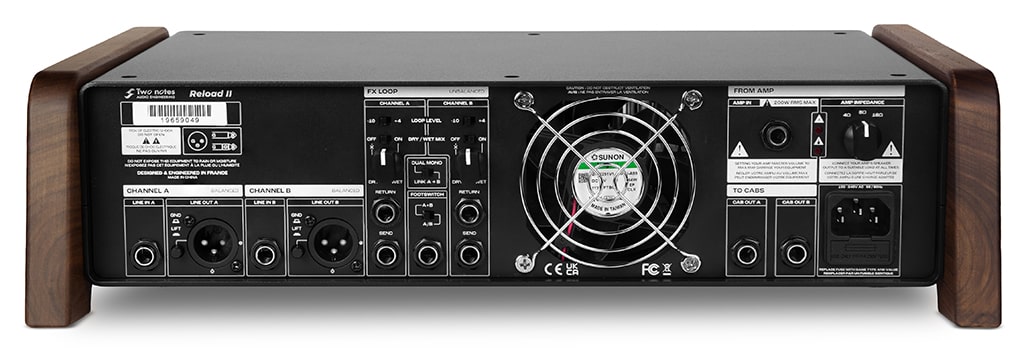
Round the back, you’ll find dual cabinet outs, dual TRS line inputs, the amp input, and XLR outs for each channel. Power is via a standard IEC—no dreaded wall warts here.
Curiously, there’s only one amp input, despite the dual-channel layout. A second amp input would have made sense, especially for A/B switching live or in the studio. Still, external switchers can fill the gap.
A standout feature is the versatile effects loop section. Each channel gets its own loop with TRS jacks, configurable for -10dB or +4dB levels, wet/dry mix control, and series/parallel/dual-mono modes. There’s even footswitch control for toggling loops. These loops also serve as send/returns for integrating Genome software—a slick touch that bridges analogue and digital workflows.
TAKE AIM
With all these routing options, the Reload II is immensely configurable. Live, you could run a single cab and effects, dual cabs with stereo processing, wet/dry setups—even wet/dry/wet if your rig is elaborate enough.
In the studio, you can bypass mics entirely, DI your amp, blend mic and DI signals, re-amp, or go full-tilt into Genome for IR cabs and amp sims. The Reload II is less a load box and more a tonal command centre.

TWO NOTES DESTROYER
Two Notes claims the Reload II outputs 215W into a single 4Ω cab, or 150W with dual 4Ω cabs. Into 8Ω, you’ll get 120W; into 16Ω, about 50W. Class-D amplification seems likely, although not officially confirmed.
The load box section handles up to 200W from your amp, making it suitable for bass duties as well. It also features an internal fan and heat-sensing auto-mute protection.
There’s also a “Celestion Approved Load Response”, which uses an averaged Celestion impedance curve—not modelled on a specific driver, but on Celestion’s greatest hits. It’s a smart branding move, and the Celestions I tested (Greenback, Vintage 30, and a Ten 30) all sounded fantastic. My vintage Elacs and crusty old Fender speakers didn’t fare quite as well.
HELLO SAILOR
Is the Torpedo Reload II the last word in load box tech? Possibly. Nothing else I’ve seen offers this level of routing flexibility and real-world practicality. With no DSP to complicate live use, it’s a dream patch bay for stage setups—and in the studio, it unlocks re-amping, cab IRs, amp sims, effects integration and more.
It even made me fall back in love with my old ValveTone 1W. It’s not cheap, but once you hear what it can do, the price tag feels entirely justified.






RESPONSES