








Review: Arturia KeyLab 88 Mk3
A new full-weighted hammer action keybed and 3.5-inch colour display lead the list of new Mk3 features.

9 July 2025
I’m now convinced that there isn’t a controller keyboard for all occasions. Let me explain:
For a while now, controller keyboard manufacturers have sold us the idea that a keyboard and a laptop will go anywhere your inspiration takes you. And sure, with bus-powered keyboards there’s truth in that: bash out your next magnum opus from your sofa bed, on the beach, while hot air ballooning, on a train, during a marlin fishing trip… But there’s a difference between what’s possible and what’s optimal. What’s optimal is creating a space where you’re at your most productive and inspired. For you, that might be around a campfire, but for me that’s in my studio with my head between a pair of studio monitors. While there, I’m mostly best served by a small-format controller keyboard (say, 49 keys) so I can stay in the sweetspot and for the keyboard not to dominate my workspace. But there are times when I could really do with something with more keys (say, 61). I have such a keyboard but it’s off to one side. Which is sub-optimal.
Then there’s the 88-note keyboard. I don’t have one of those, but I now wish I did. Until now, I’ve considered the 88-note controller keyboard (especially with hammer action) as an unnecessary flex. It kinda says, ‘I’m classically trained and simply can’t work with any fewer than all 88 notes of the pianoforte… in fact, since performing on a Bösendorfer Imperial, I’m reluctant to work with fewer than 97 keys… but I suppose 88 will have to do.”
COMPARE & CONTRAST
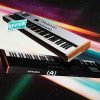
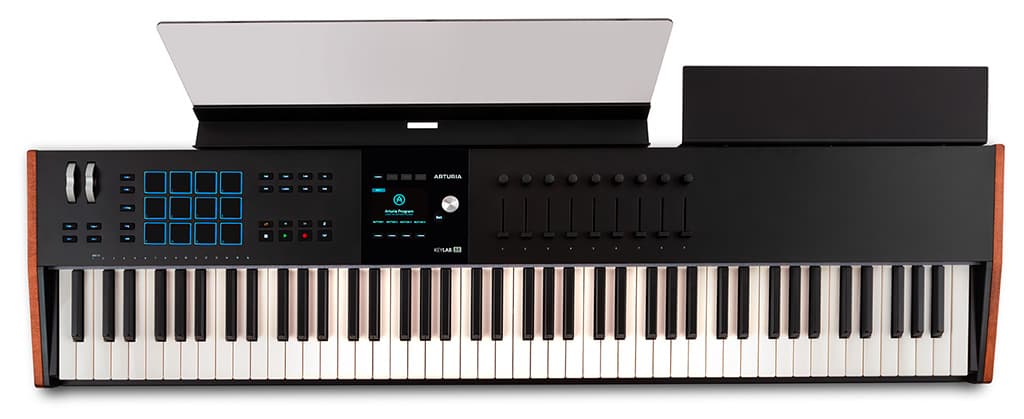
KeyLab 88 Mk3 is Arturia’s latest 88-key controller, featuring a fully-weighted hammer action keybed There are some key new features on the Mk3 that make it a worthy iteration. Let’s run through them:
Keybed: The Fatar TP/110 keybed is a step up. It certainly feels more luxurious to me. One minor point: I’ll occasionally accidentally activate aftertouch if I’m playing hard.
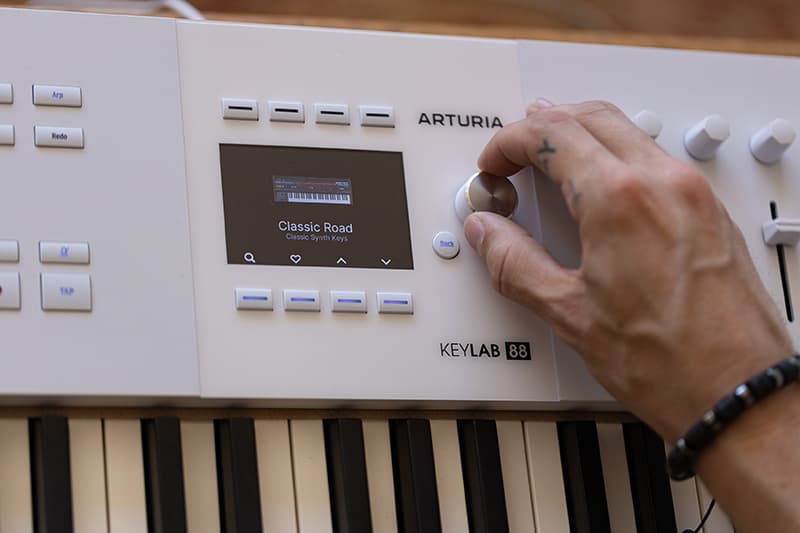
Display: The Mk3 has a full-colour screen with eight contextual buttons, making navigation and parameter control more intuitive than the Mk2’s monochrome display. Being able to do a keyboard split and seeing both Analog Lab instruments displayed on the 3.5-inch 480x320px screen is reassuring. Having the buttons immediately to hand to edit the relevant settings is a time saver and keeps you in the zone.
Controls: The rotary knobs and faders are now touch sensitive, so you don’t need to tweak them to know where they’re set, and they feel smooth and precise.
Creative Features: The Mk3 includes Arpeggiator and Scale modes (set your mode and play any key without hitting a bung note), which are nice additions.
Pads: 12 instead of 16.
Connectivity: USB-C for connection and bus power – convenient. That said, if you’re a keyboard tech for a live show I’m not sure the tiny USB-C connector (which represents something like the entire nervous system and bloodflow of the setup) will fill you with confidence. Maybe a screw-lock version would be a good idea to prevent a show-stopping knock? You can plug in an alternative DC power source as backup but that won’t assist with maintaining a data connection if the USB-C connector dislodges.
Design: Mk3 looks schmick with its timber end cheeks, and solid construction. Weighs in at a reasassuringly hefty 8kg.
Pedal Inputs: The Mk3 has fewer pedal inputs than the Mk2. Double check this if it’s likely to be a deal breaker for your needs.
Analog CV: No analogue CV inputs and outputs, unlike the Mk2. Might upset the odd cardie-wearing modular warrior.
NEED TO KNOW
Arturia KeyLab 88 Mk3
Controller Keyboard
88 LUXURY
I’ve had a ball with the KeyLab 88 Mk3. I forgot just how luxurious the extra keys are, especially in a live situation. In a 50/50 keyboard split you’re getting so much more range. And, yes, as a ‘classically trained pianist’ I appreciate the action of the keybed. It’s wonderful. When I have to return this review unit I’ll go back to kidding myself that I spend most of my time playing pads and Rhodes, so the weighted hammer action doesn’t matter. But it does.
The colour display makes life easier and allows me to spend more of my time with my head over the keyboard and less time with my head over my laptop. Speaking of which, the extra real estate afforded by the 88-key manual allows for space for your lappy to sit on the keyboard. In fact, Arturia gives you a little extendo-shelf to help it stay put. I love this touch. Love it.
LAB WRAPPED
I maintain that if you work with Analog Lab as your main sound source in a live context then KeyLab is a no-brainer. Nothing integrates better, as you’d hope. The pots and sliders all perfectly match corresponding software controls in Analog Lab. While the display serves as a next-level compass for navigating through patches.
Of course, Arturia isn’t pitching KeyLab only at those married to Analog Lab. As a general purpose DAW controller, Arturia provides some excellent MIDI maps to work with the main programs (NB: KeyLab ships with Ableton Live Lite along with some other goodies). There’s no question that KeyLab is a very capable all-purpose controller but chances are if you’ve gone all-in with Native Instruments, for example, then you’re likely to lean that way in your choice of controller keyboard (worth noting, though, KeyLab is fully NKS compatible).
Arturia now has another way of hosting Analog Lab sounds (Astrolab), which isn’t designed to double as a studio controller keyboard – it’s more specialised. So, in this regard, for Analog Lab peeps it’s simply a matter of which version of KeyLab you spring for – with the 88 Mk3 being the top of the pile. Especially for ‘classically trained pianists’… you know who you are.






RESPONSES