


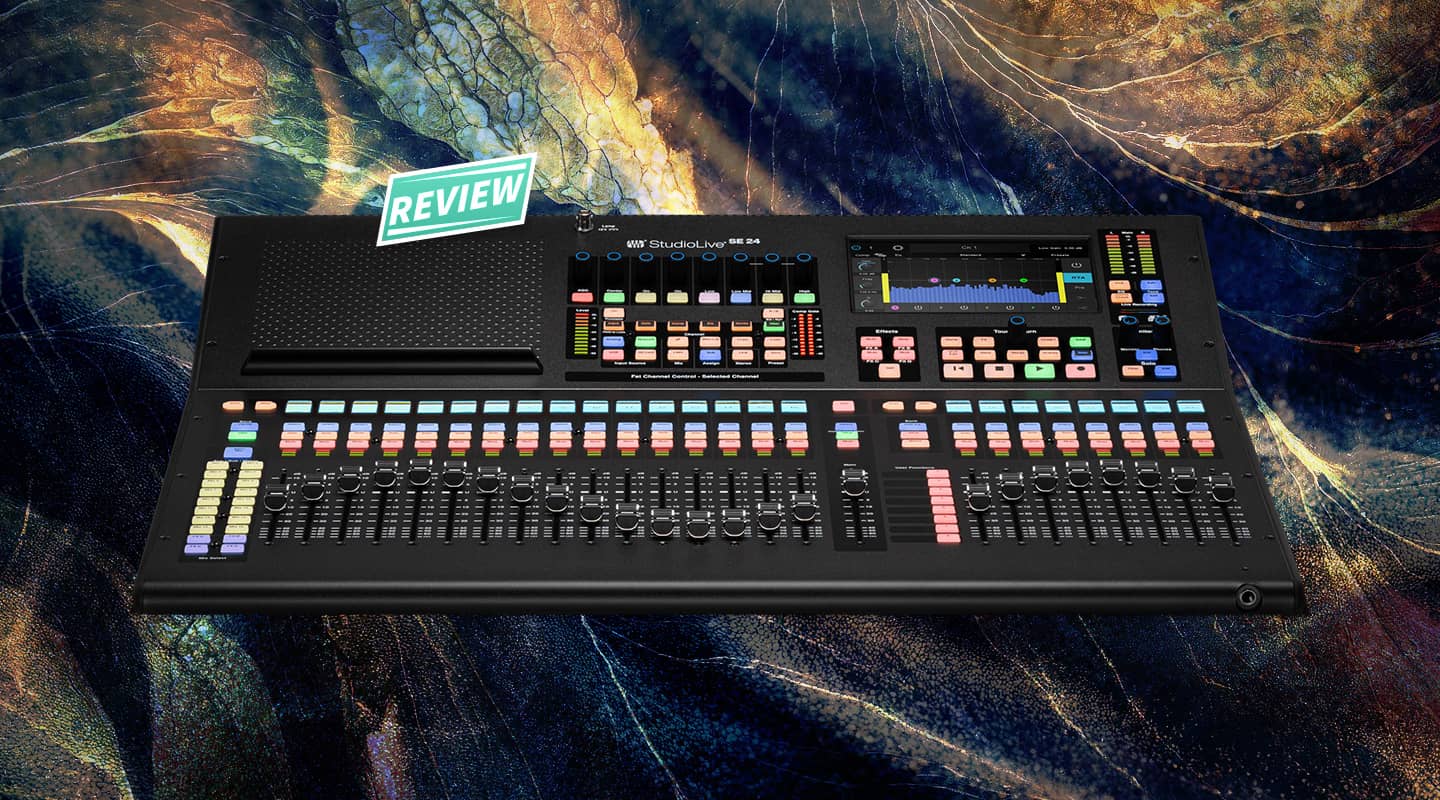
Review: PreSonus StudioLive Series III SE 24
A studio-friendly and feature-rich digital console that expands PreSonus’ live and networking credentials.

By Mark Woods
19 February 2026
The latest version of the PreSonus StudioLive digital mixer updates the series with more power, enhanced integration and expanded networking. The Series III SE 24 is in the middle of the range with 25 faders, also available in 17-fader SE 16 and 33-fader SE 32 versions.
The StudioLive Series III SE 24 is a 40-input mixer designed for both studio and live work. PreSonus mixers are generally seen as more Studio than Live – I think because they got into the home/project studio/streaming scenes early. Their FireWire and AudioBox USB interfaces, XMAX preamps and bundled Capture software made high quality recordings for modest outlays and quickly won customers, many whom have remained loyal.
You see the Live side of StudioLive’s in venues, mainly as FOH mixers but I’ve noticed the rack versions are becoming popular for touring bands’ on-stage IEM control. Some acts use them because they’re among the cheapest 24-input systems, others because they’ve made their recordings on PreSonus gear. The Series III SE 24 would make a good touring FOH mixer with its high channel count, ergonomic physical layout, and Capture software for live recording/playback/virtual soundchecks.
PRESONUS LAND
The Series III SE 24 now also includes Studio One Professional DAW. Combined with 64×64 USB multitrack recording/playback/streaming ability this makes the SE 24 a 64-channel audio interface and DAW controller. The onboard SD card will record up 34 tracks with an external recording device. Remote control software Universal Control is multi-platform, multi-device and provides for wired or wireless control over the mixer. Add a pair of low-cost but capable PreSonus Eris monitor speakers and you won’t need to leave PreSonus Land until the project is done.
The Fat Channel has always been a unique feature of PreSonus mixers and it’s gained weight for the Series III SE range. Now included is the full Fat Channel Collection of eight exotic Comps and seven EQs on every channel. Output processing loses the Gain and the Gate but includes delay and more EQ bands. 16 Mix busses that can be used as Groups, Auxes or Matrix outs is generous for studio or live applications.
Connectivity is improved with the 64-channel AVB now being Milan-certified — previous models used standard AVB networking. The Milan standard ensures low-latency interoperability with all Series III hardware (mixers, racks, stageboxes, EarMix 16M) and other Milan AVB equipment, regardless of manufacturer.
Personal monitoring can be achieved with QMix-UC. It works with iPhone, iPad and Android, allowing up to 14 devices to remotely control the aux mixes. Alternatively, the EarMix 16M – a physical mixer that controls 16 mono inputs, assignable via Milan AVB – offers more comprehensive controls and convenience compared to a phone app. EQ and Comps are available on each channel and the outputs. Physical connections are stereo TRS Outs, probably for wedges, and an Aux In socket for monitoring, or a maybe a click track. The headphones are driven by a powerful 150mW/60Ω low distortion amp.
NEED TO KNOW
PreSonus StudioLive Series III SE 24
Digital Mixer
LET’S CONNECT
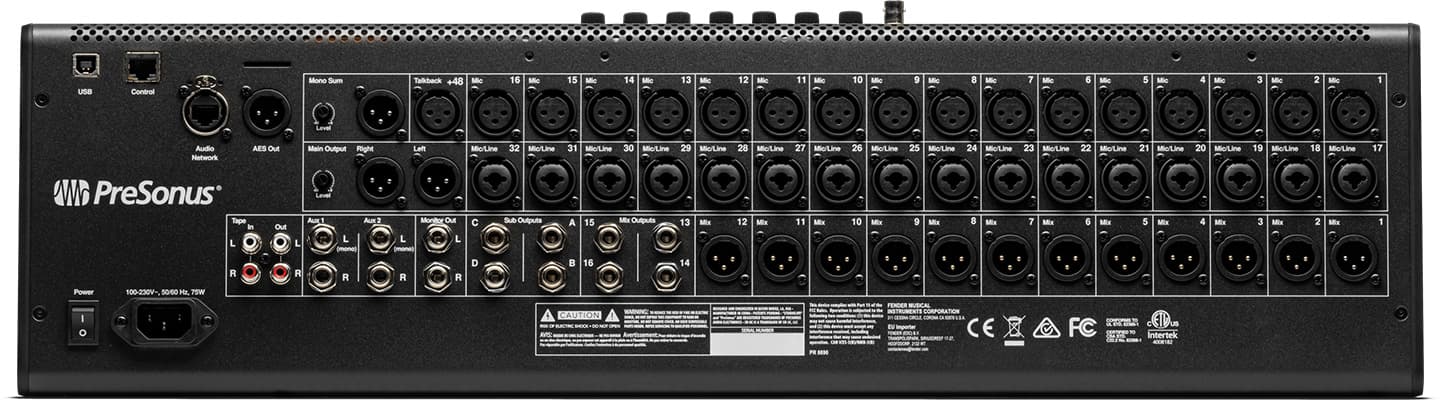
The SE 24 has lot to offer as a medium-sized FOH mixer, and even more as a foldback desk. Firstly, the back panel is full of sockets, starting with a generous 32 XLR inputs (16 combi Ins) and 16 analogue Outs. Main Stereo Out, mono Sum Out, four Sub Outs, two stereo Aux Outs, Monitor Out, RCA Tape In & Out, and a talkback mic. That’s a lot of analogue connections. Plus, there’s digital AES and a whole world of connection possibilities through the RJ45 Network socket, including stageboxes, Milan AVB gear and personal monitors.
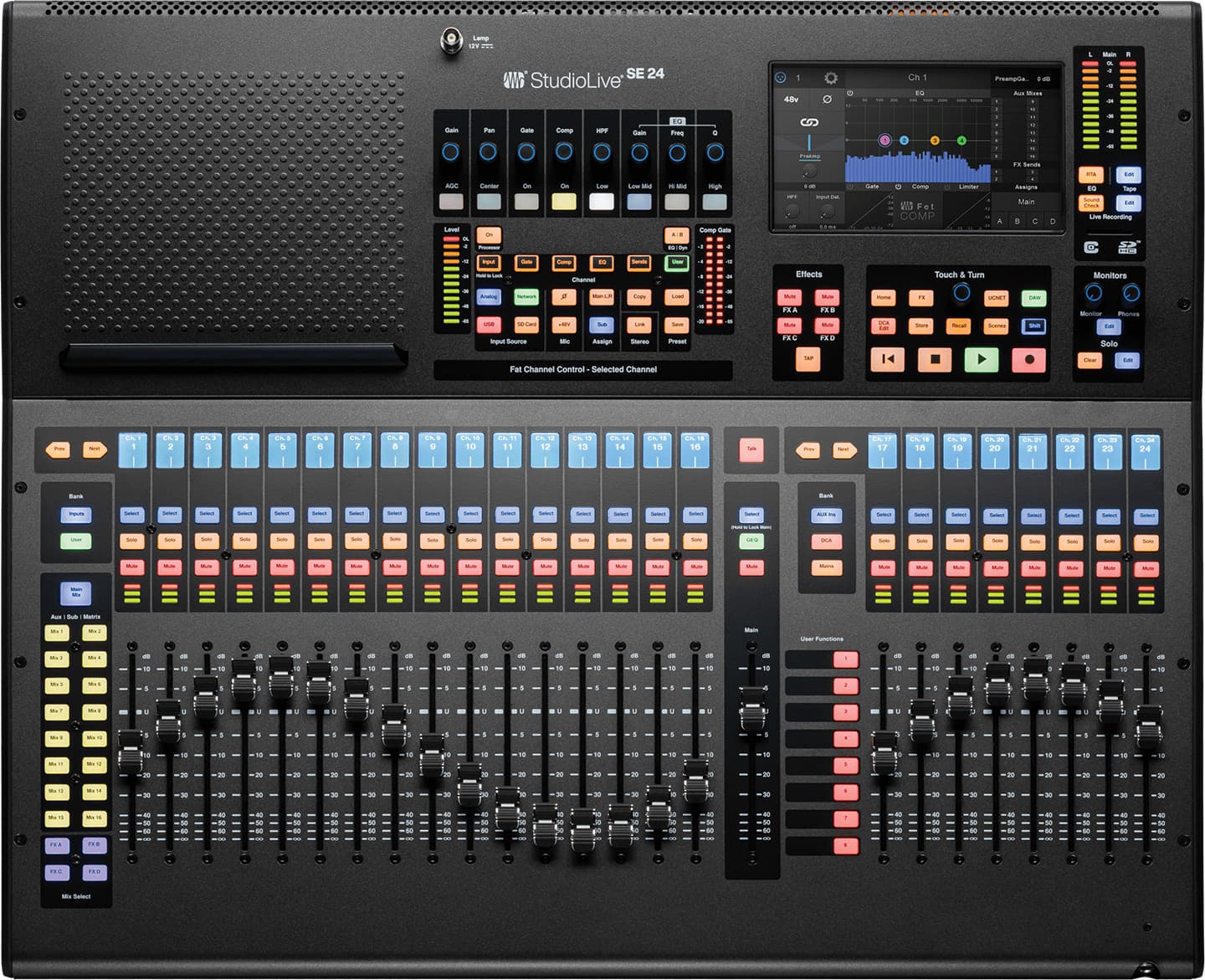
Around the front, the SE 24 console sits low, the fader section is angled for easy access, the control section angled further for easy reach. There are 16 faders in a bank on the left and eight faders on the right. 16 Mix and four FX buttons flip the faders for levels. The 16-fader section cycles through the 32 input channels and returns, the eight-fader section cycles between channels, returns, 24 DCA and 16 Auxes. The buttons are big, bright, colour-coded, labelled and illuminated. The new touch-sensitive faders snap to attention. The Fat Channel Control panel sits in the middle of the control section and oversees the selected channel. The new 7-inch touch screen is flatter and now frameless. It sits beside the Fat Channel and acts mainly as a visual of what you’re doing with the physical controls – you can select on the screen but not gesture.
The Fat Channel has the common controls for the Gain/EQ/Dynamic processors, what makes it fat is the other controls it places conveniently at hand, including direct access to controls that might otherwise be hidden in a menu, like Input Source select, channel assign and more. Phase reverse and 48V on physical buttons feels pleasantly nostalgic. Level, Comp and Gate functions are illustrated on three proper 12-segment ladder meters in the Fat Channel section.
BEHIND THE DESK
In use, the SE 24 is a convenient size and the physical layout enables a smooth workflow for both Studio and Live applications. Ergonomic improvements include new fader caps and rotary encoders. Lots of channels and connections enable large recording projects, or it could replace an analogue mixer in a small-to-medium sized venue, especially if they wanted to record or stream at the same time. Standing behind it offers a commanding operating position, and the physical buttons sometimes make it feel like an analogue mixer.
Sound quality has always been a StudioLive strength. The XMAX preamps are transparent, and the overall response is linear – more so than a couple of my new small digital mixers that seemed somewhat mid-forward in a direct comparison with the SE 24. The high frequencies are not exaggerated or spiky, and the overall sound is smooth and full.
The standard channel EQ works. It’s predictable but limited to four bands including the HPF. Outputs get six bands. Same for the Comps/Gates – easy to use and you get what you expect. The Fat Channel Collection EQ and Comp plugins are more interesting and worth auditioning if you’re looking to add some character to a source. Little audible glitches can sometimes be heard when adjusting parameters, not too loud but unexpected.
The FX have been updated for the new Series III SE range with more detailed parameters. Four FX slots handle your selection from four reverbs, three delays, a chorus and a flanger. The reverbs have a deep and dark quality I like. They all sound kinda similar but there are lots of controls and shaping options. The delays are accurate, not like the old days, but using the HPF, LPF and feedback filters gives you all the classic echo sounds if you want them. The Effects have a fast-access section under the screen with four Mute buttons and a larger Tap button.
The Series III SE range adds what feels like finishing touches to a proven and familiar system. Following the recent acquisition by FMIC (Fender Musical Instruments Corporation), the next version may have a Fender badge on it. Maybe not. It will have newer, faster processors and higher sampling rates; the tech keeps evolving. For now, the PreSonus StudioLive Series III SE versions offer good value, professional quality with lots of functionality for studio, live or streaming applications.




RESPONSES