




Bob McCarthy Interview
When it comes to the role of System Tech, Meyer Sound’s Director of System Optimisation, Bob McCarthy, wrote the book.

8 December 2025
Bob McCarthy wrote the book on sound design and system optimisation. Quite literally. It’s in its third edition. A meaty tome that remains the audio bible for those serious about live sound.
AT’s Chris Holder caught up with Bob while he was in Australia supporting the Metallica tour – with his Meyer Sound ‘Director of System Optimisation’ hat on – as well as running well-subscribed, system-agnostic workshops.
Chris started by asking Bob to jump into the wayback machine to describe what things were like when he started in the late ’70s and early ’80s.
Bob McCarthy: It’s been a remarkable journey. When I look back at the ‘stone knives and bearskins’ we had when I started my first tour back in 1978. The system-tuning part comprised a cassette tape player and a graphic EQ for the whole system. That was the entirety of it. You might set the relative levels of the four-way crossover, but the tuning toolset we now take for granted was extremely limited. There was nothing that could alter time other than physically moving a box forward or back. Of course, everything was ground-stacked back then. Sound design as a concept was largely a case of ‘How many of these can we fit before it becomes a tipping hazard?’ and pointing them in the general direction of the audience. We didn’t have audio measurement tools. We didn’t have audio prediction tools. You had your experience, and I started like everyone else with zero experience and began logging it over time.
A couple of years later we started to see the early RTA analysers appear. I’d been exposed to one with the Grateful Dead – they had one as early as 1976 while I was still a university student studying sound. Then the IVIE IE-30 measurement tool for front-of-house arrived. That started people thinking they could quantify acoustic performance, but with varying degrees of success – room acoustics strongly affected what it saw. The brain, as we later learned, is able to incorporate the room acoustics along with the direct sound, but it strongly favours the direct sound. So a measurement system that can favour direct and early sound over late room reverberation is, in the long run, the superior technology for creating a tuning tool that delivers reliable, transportable results from venue to venue and across scales.
ARISE SIR SYSTEM TECH
AudioTechnology: When did the term ‘system engineer’ first emerge?
Bob McCarthy: For me, 1984 was the pivotal year. I was part of a very small team bringing the FFT analyser to front-of-house. Only a handful of groups were doing it, and it really changed everything because we now had something that could quantify not only frequency response but also coherence – a measure of clarity, the direct-to-reverberant ratio – and it could see timing. What people had been calling ‘system equalisation’ started to expand into what we now call system optimisation. They used to say, ‘Just EQ the system.’ We said, ‘No, we’re not just EQing the system.’ We were using the measurement gear to adjust splay angles scientifically, adjust the aim, adjust relative levels of downfills. We were moving a mic around and analysing coverage zones.
People were often sceptical of the analyser: ‘Let me hear the system EQ in and EQ out.’ I’d reply, ‘That’s not the point. I’ve already found three polarity reversals in your array. I’ve rearranged the aiming. I’ve adjusted levels between sections. I’ve time-aligned everything. You can’t just switch the filters out and claim that’s what I did.’ That was the moment the role of system engineer started to emerge for me. You weren’t just getting the gear out and setting it up for the front-of-house mixer. You were actively involved while the show was running because now we could watch frequency response in real time. With an RTA, when the show started it just got louder or quieter. With the FFT analyser we could see stability, clarity, and we could see it in multiple locations. The learning curve was enormous; the feedback loop of knowledge about system deployment was rising exponentially.

Meyer Sound’s Director of System Optimisation, Bob McCarthy.

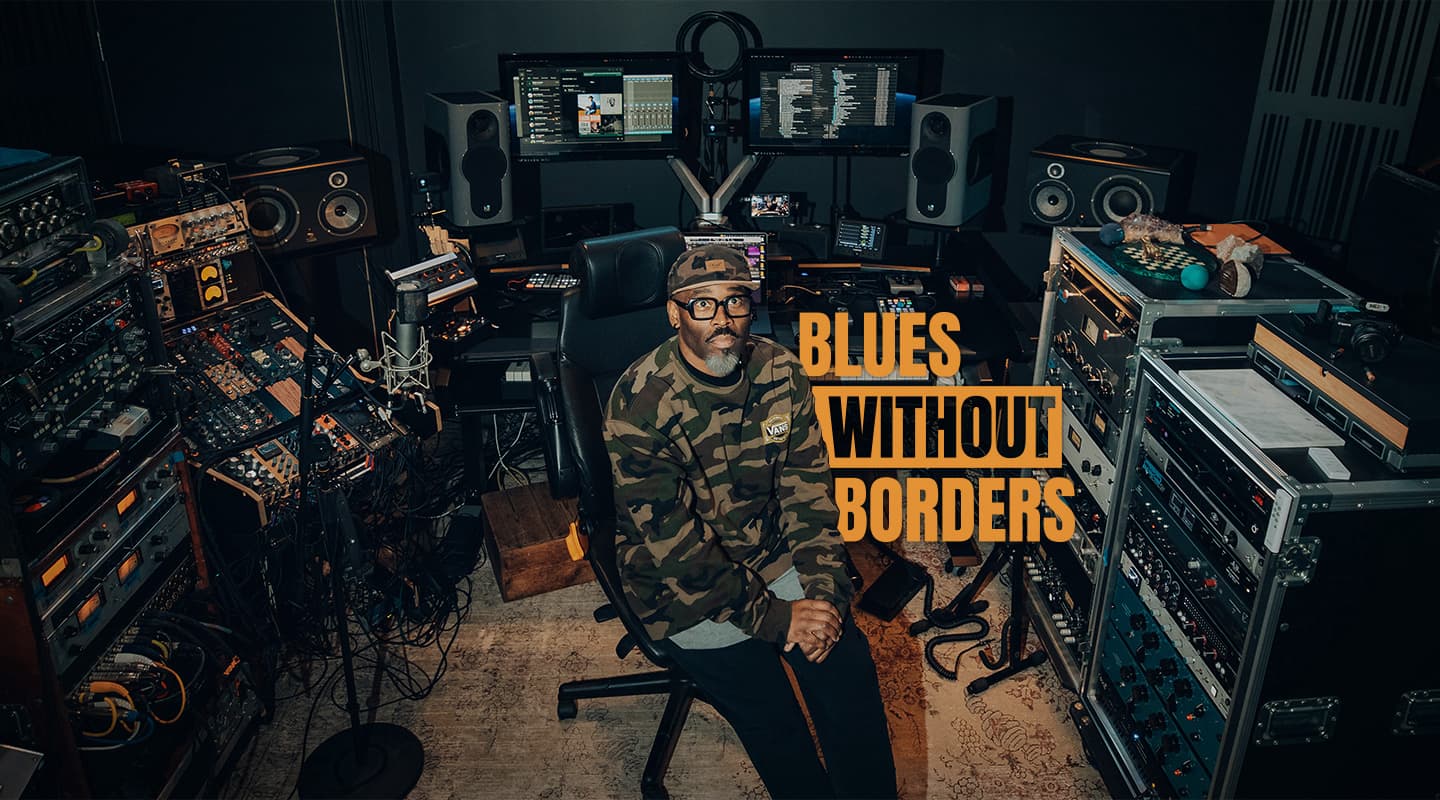
Bob McCarthy in his element – training the next generation of system techs.
TRAPS OF OLD-SCHOOL AUDIO
AT: The period you’re talking about – late eighties, early nineties – was pre-line-source. Systems weren’t any smaller; there were huge tours with hundreds of trapazoid boxes and, I guess, not easy to measure?
Bob McCarthy: Absolutely. In the big rock ’n’ roll touring world they weren’t ready to embrace this technology early on. They asked, ‘Is this analyser going to make the system louder?’ My answer was, ‘No, it’s not really about louder. I can give you uniformity – taper levels side-to-side, front-to-back.’ Rock ’n’ roll was sceptical. The people who embraced it immediately were in musical theatre, where every seat had to be perfect every night.
So on big tours there was still very little subsectioning and individual tuning. The ‘system engineer’ in 1978 – whether tuning by ear or by instruments – was basically just making the FOH mixer happy. When you break that mindset and say, ‘I’m going to make what you have at the mix position match upstairs, downstairs, and in places you’ll never reach,’ that’s when it becomes a job requiring real skill, not just people skills and mind-reading. You have to know the physics of aiming and balancing without degrading the mix position – which was always the big concern.
AT: The wireless remote control for the system processor was a big deal on that count.
Bob McCarthy: Exactly. Early on I was placing mics but still reading data in one location – that took time, and we didn’t have wireless measurement mics yet. Being able to walk around with remote control of the processor was gigantic. At Meyer we had the Compass Go software that let you walk with a tablet and make adjustments. Suddenly there was no excuse for not verifying top-to-bottom, side-to-side coverage separately.
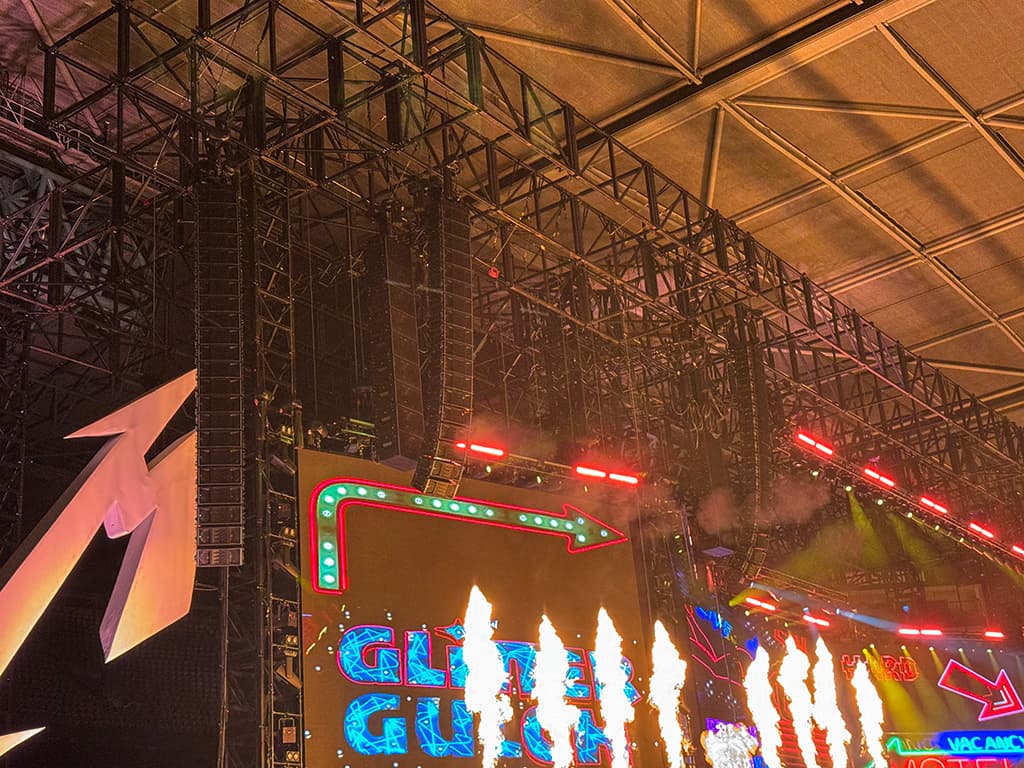
Bob McCarthy spends some of his time following Metallica around the world, supporting their system design and tuning for shows such as what’s pictured here in Melbourne. It’s an usual arrangement as the band actually owns the rig, which comprises a huge stock of Meyer Sound Panther.
PROF BOB IN THE HOUSE
AT: You were one of the first to espouse the idea that with enough data and measurement there should be no guesswork in loudspeaker deployment. That met some resistance initially. What do you put that down to, and how did you overcome it?
Bob McCarthy: There was definite resistance. I remember one crew went to the trouble of finding a white lab coat, putting it on me and taking photos: ‘Ha ha, Mr Science – we’re real-world, you’re science-world.’ A big part of the problem was the RTA. I’m tough on the RTA because it was blind to so many things – phase, timing, direct-to-reverb ratio. It left huge problems undiagnosed and made people sour on measurement in general: ‘I tried measurement, it’s rubbish.’ We had to keep saying, ‘We’re not an RTA. We’re not time-blind. We can see phase, coherence, everything.’ Some mixers worried I could see their mix and would counter their moves. I’d say, ‘No, you’re just data to me. I’m not touching your mix.’
AT: The emergence and dominance of line-source arrays in large-scale touring, with their more dependable, predictable dispersion and coverage has been a huge watershed. That must have been perfect new technology for someone whose mantra was ‘coverage first’.
Bob McCarthy: There’s a key step in between. When I was doing advanced FFT measurement, prediction was still a protractor on a physical blueprint. Then proper prediction software arrived that could duplicate what we saw in the FFT: phase, level, everything. You could predict in the office and verify in the field. That raised the game enormously because we now walked into tuning knowing exactly what to expect at every location.
When line-source technology arrived, it was clearly superior for long throws, but new tuning techniques had to be developed. With point-source arrays I could solo individual boxes and adjust freely, especially in the highs. Line arrays are a highly interactive organism that changes its coupling gradually over frequency. It took time for me and others to figure out: ‘Wait, how do we tune this thing now?’
AT: You would have been helped enormously by increasingly powerful DSP along the way?
Bob McCarthy: Absolutely, and by different filter topologies. The parametric filter, which was the best tool for point-source is not the primary tool for sculpting sectionalised line arrays. Shelving-type filters or ‘Mesa’ filters became the tool. When I tune Meyer Sound Panther arrays today, parametrics are barely used; almost everything is gentle sculpting with U-shaping filters.
Nowadays, the best system engineers I meet absolutely love what they do. They’re not waiting for the FOH chair
JUST A PHASE?
AT: Maintaining phase coherence has always been an article of faith for you. How have line-source arrays, better tools and Mesa filters changed what you can achieve with phase?
Bob McCarthy: Think of it medically: what symptoms are you treating and what’s the right medicine? Point-source interactions look like parametric-filter-shaped amplitude and phase responses, so parametric EQ is still the correct treatment. Line-source interactions don’t look like that; they produce a different shape that responds beautifully to U-shaping filters with very gentle phase shift. You can sculpt amplitude with minimal phase disturbance – that’s the perfect antidote.
AT: Your approach remains: coverage first, ensure phase coherence, do all the mechanical work before you even touch EQ. Do you still have to preach that gospel hard these days?
Bob McCarthy: Among the people I work with, the basic optimisation goals we established decades ago are no longer controversial. We’ve come through a very Wild West era. The level of control and predictive capability we have now makes uniformity obvious – you can literally see and hear it. Those gigantic walls of Clair S4s (not picking on any brand – we all heard hundreds of great shows through them) were pure chaos: 40 speakers arriving at different times. Uniformity was mathematically impossible. It was brute force: everyone gets level, but nobody gets the same show. Now you can look at a tiny curated line of boxes and know exactly which one is covering you and which is covering the person 30 metres away. The system is subsectioned into repeatable, reliable parts.
AT: DSP has become extraordinarily powerful. Do you still see a tug-of-war between mechanical optimisation and software/DSP optimisation? Some brands now do flat hangs and let DSP do everything. Is that the future as DSP gets better?
Bob McCarthy: We’ve researched everything thoroughly. Curving the array mechanically and using phase for finishing touches gives higher SPL and better power efficiency than running it straight and asking phase-steering to do all the work. Phase-steering is never lossless – physics forbids it. We’re very conscious of dynamic-range preservation, so we take as much as we can mechanically and finish with DSP. That’s the approach we’re happy with at the moment. Meyer Sound does have purely phase-steered products in the catalogue and in R&D, but for maximum output, mechanical-first remains king.
NO LONGER WAITING
AT: Finally, the role of the system engineer in 2025. Does it attract a different type of person today – a different brain profile?
Bob McCarthy: When I started, the ‘system guy’ was usually someone who wanted to be the mixer, paying their dues until their big break. Their job wasn’t that different from babysitting the mixer and twiddling a graphic. Nowadays, the best system engineers I meet absolutely love what they do. They’re not waiting for the FOH chair. As [Metallica’s FOH engineer] Greg Price calls us, they’re the ‘propeller heads’, and they get genuine joy from nailing implementation, finding that little bit extra coverage on the side, cracking a new puzzle every venue. To me it was always: I learned something today – either I got my arse kicked or I had a triumph. The arse-kicking usually taught me more. I see so many young engineers with exactly that ethos: ‘I’m here, but I can do this better.’ It’s a joy to watch.
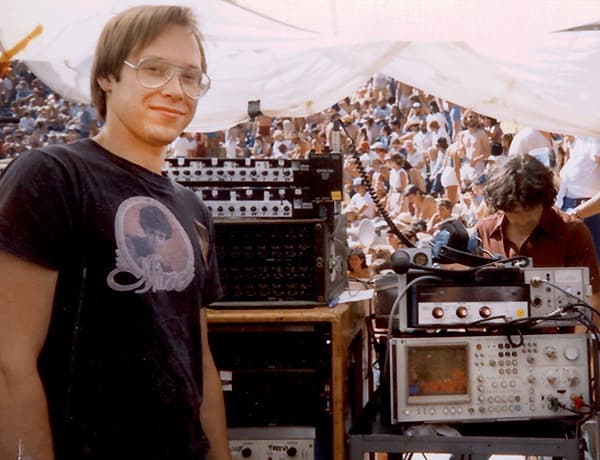
Bob McCarthy back in the day, just as the distinctive role of the system engineer was being defined.





RESPONSES