

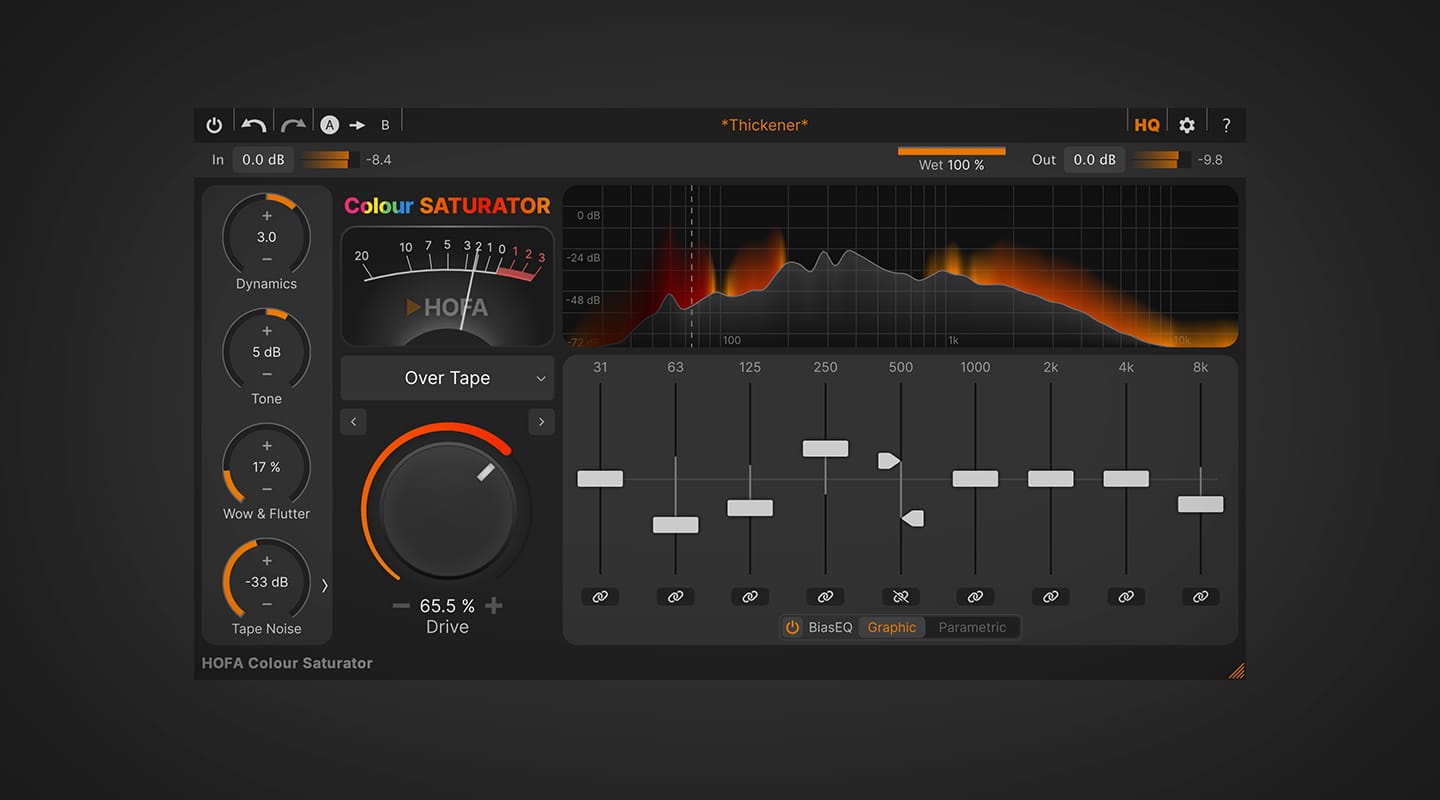

Smooth harmonics, powerful punch, analogue warmth and even brutal destruction – saturation and distortion are essential in professional music production. Designed for this very purpose, the HOFA Colour Saturator has become a real game changer.
Modern neural modelling algorithms enable absolutely authentic saturation like you’ve never heard before. And with the specially developed BiasEQ, you have completely new creative possibilities.
Input section
Dynamics to limit or intensify the dynamics of your signal
Tone, a tilt EQ to control the frequency balance of your sound
Wow & flutter for the typical retro tape effects
Noise, crackle, and hum for infamous LoFi artefacts
Algorithms & drive
Above the central drive control, you can choose between different algorithms, such as Tape, Tube, Desk, Solid State and Hybrid.
We have applied various methods to accomplish this. Among other things, sophisticated neural modeling algorithms are used for maximum realism, as well as CPU-saving variants.
Creative shaping
The groundbreaking BiasEQ is available for all algorithms.
After saturation, you can make final sound adjustments with hi and low cut.
Of course, parallel saturation can be easily achieved with the dry/wet mixer.
Incredibly detailed saturation models
We have created detailed, high-resolution models of our favourite hardware devices in the HOFA-Studios.
Mic PreAmps: 4 iconic microphone preamps of various designs
Tape: 3 analogue tape machines with their characteristic harmonics
Git / Bass Amp: 7 legendary tube amps from crunchy to heavy
Pedals: 6 popular, perfectly modelled stompboxes
Pedal + Amp: 5 combinations of guitar pedals and amps for ultimate distortion
Other: 4 renowned studio classics with intriguing harmonics
Legacy: 5 CPU-efficient algorithms from the SYSTEM Saturator
The BiasEQ has nine bands and a fully parametric mode. This allows you to intensify or reduce the degree of distortion for individual spectra of your sound. For example, you can saturate the mids of a bass sound while removing the low and high ends from the distortion.
By default, each frequency boost is counterbalanced by a reduction of the same frequency after the distortion. If you don’t want this effect, you can unlink each band and make even more precise adjustments.
For particularly precise or extreme modifications, a fully parametric expert mode is also available.
Whatever saturation your output signal needs, BiasEQ lets you create something special with just a few knobs.









RESPONSES