

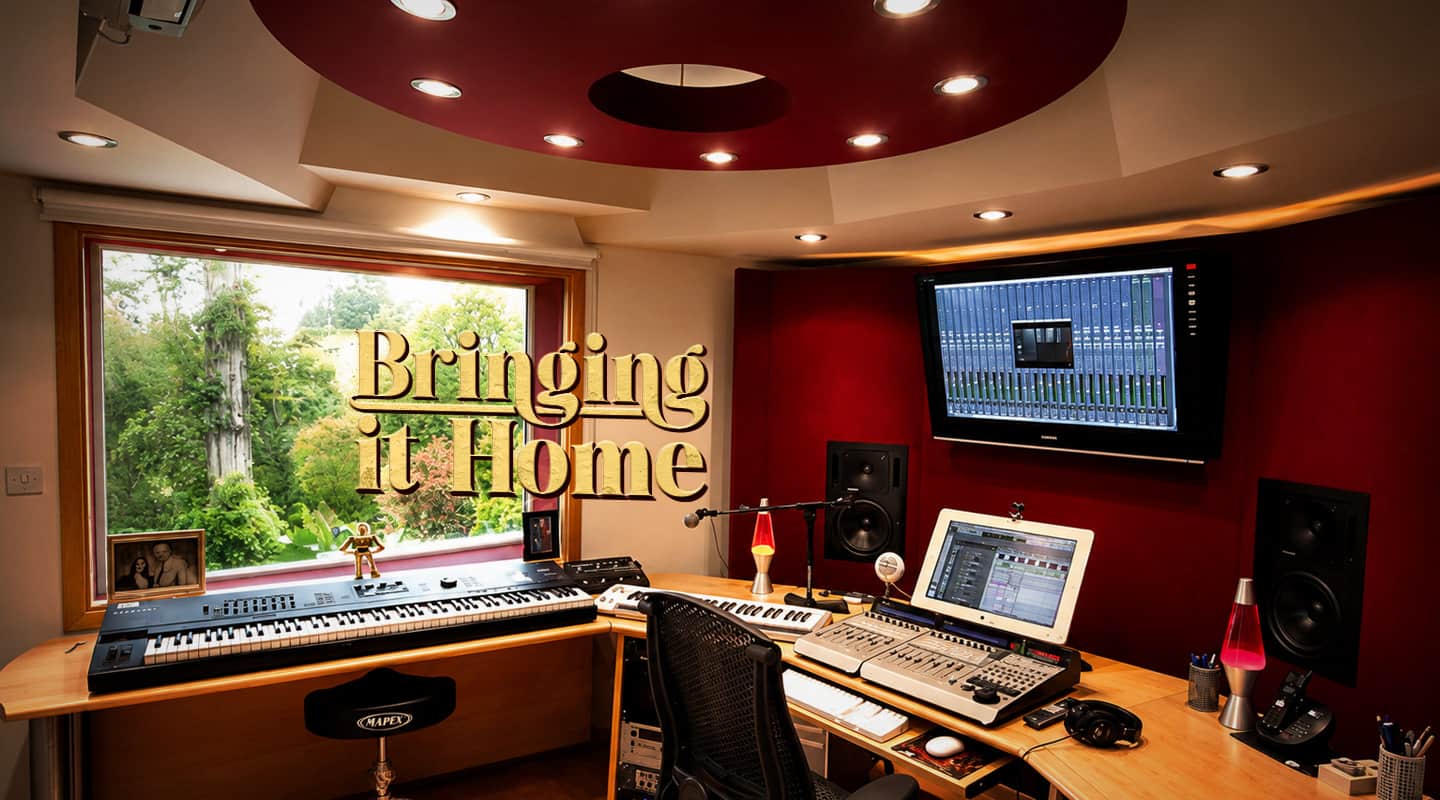
E-Studio: Redefining the Home Studio
The E-Studio: the home as production hub, classroom and mission control. Walter Storyk Design Group’s Sergio Molho talks us through it.

17 June 2026
Text: Sergio Molho
There was a period, not so long ago, when most home workspaces were defined by compromise. A spare bedroom became an office because it had a door. A dining table became a classroom because it was available. A corner of the living room became a content studio because there was no better option.
That phase was understandable, but it also set the bar too low. It encouraged the idea that working, teaching, recording, editing, presenting and collaborating from home should feel temporary, improvised and slightly unresolved. Today, that no longer reflects reality.
For many people, the home is now expected to support a much broader range of functions, and to support them at a much higher level. One room may need to operate as a content creation and production studio, a distance learning and teaching space, an advanced remote working environment, an entertainment and media centre, and in some cases even a performance space. That shift demands a different design response. It is no longer enough to place professional audiovisual tools inside a domestic room and hope the room will adapt around them. The room itself has to be enhanced for the task.
This is the idea behind the E-Studio.
E-STUDIO DNA
An E-Studio is a residential space enhanced for full-time use at a professional level. It is designed to support a variety of educational, creative and business needs within the home, without sacrificing comfort, aesthetic quality or long-term usability. In that sense, it is not simply a home office, nor is it only a compact studio. It is a more evolved type of room – one capable of supporting the increasingly blurred boundaries between work, learning, communication, production and personal life.
The most useful way to understand an E-Studio is through the four ideas that define what makes it ‘enhanced’: Efficient, Effective, Evocative and Evolved. Those principles matter because they move the conversation beyond equipment and towards performance.
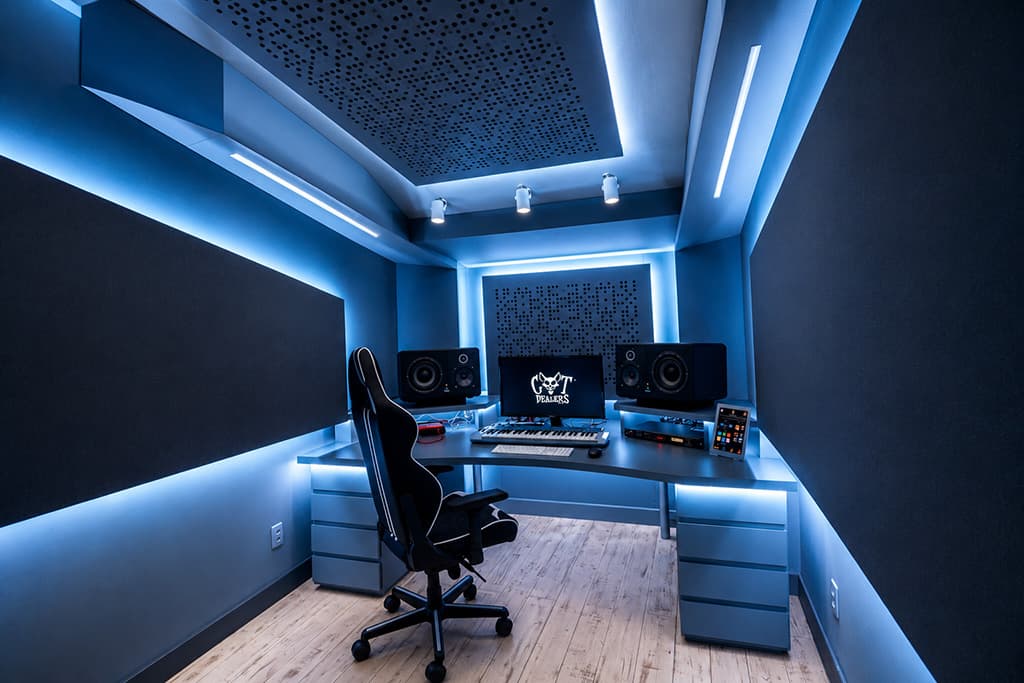
Cat Dealers
EFFICIENT: A ROOM READY TO WORK
Efficiency begins with immediate usability. Everything the end user needs should be within reach and in the right place, allowing the space to support maximum effectiveness from the moment it is occupied. Room layout and furniture ergonomics need to be carefully resolved so that technology is easy to access, with the room remaining comfortable over long periods of use.
In practical terms, this means thinking beyond furniture selection or desktop organisation. The position of the desk, the relationship between the chair and the camera, the height and angle of displays, the placement of speakers, the reach to controls, and the way cables and peripherals are integrated, all influence whether a room feels frictionless or fatiguing. A genuinely efficient room does not ask the user to constantly reposition, compensate or adapt. It allows them to focus on the task at hand, whether that is a conference call, an online class, a recording session or an edit review.
The most useful way to understand an E-Studio is through the four ideas that define what makes it ‘enhanced’: Efficient, Effective, Evocative and Evolved
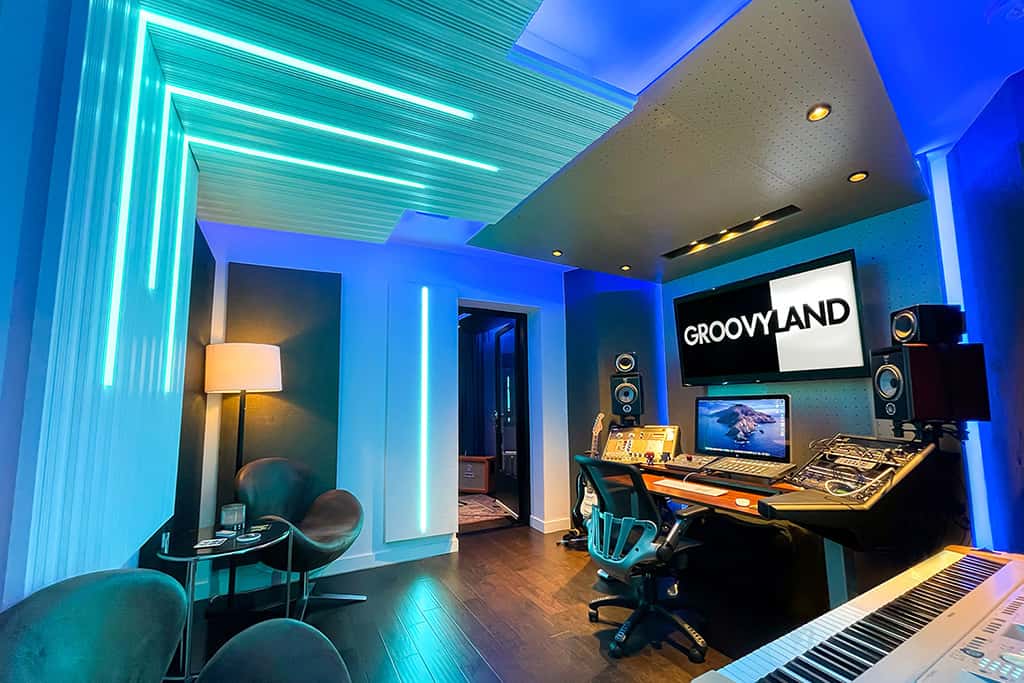
Groovyland Studios
EFFECTIVE: INTEGRATED (NOT ACCUMULATED) TECH
Effectiveness is where the distinction between a room with devices and a room with design becomes most visible. The technology in an E-Studio should not simply be present; it should be purposefully integrated to support a variety of professional, educational and creative uses. This includes dedicated workstations that accommodate both mobile and stationary working methods, full AV integration for conferencing, remote collaboration and production, and a personalised, intuitive control system that makes the room easy to command.
The phrase ‘mission control’ is especially useful here. The best examples do not just look organised. They operate with clarity and confidence. They allow the user to move from one mode of work to another without losing momentum. A room might need to support a video call in the morning, critical listening in the afternoon and a livestream or teaching session later in the day. If every transition requires a workaround, the room is not yet effective.
One of the most common mistakes people make when building or upgrading a home studio is focusing on equipment before understanding the room itself. People often invest heavily in microphones, speakers or displays before considering room layout, ergonomics or acoustics. In practice, the performance of the room will almost always define the performance of the technology inside it.
EVOCATIVE: FEELS AS GOOD AS IT PERFORMS
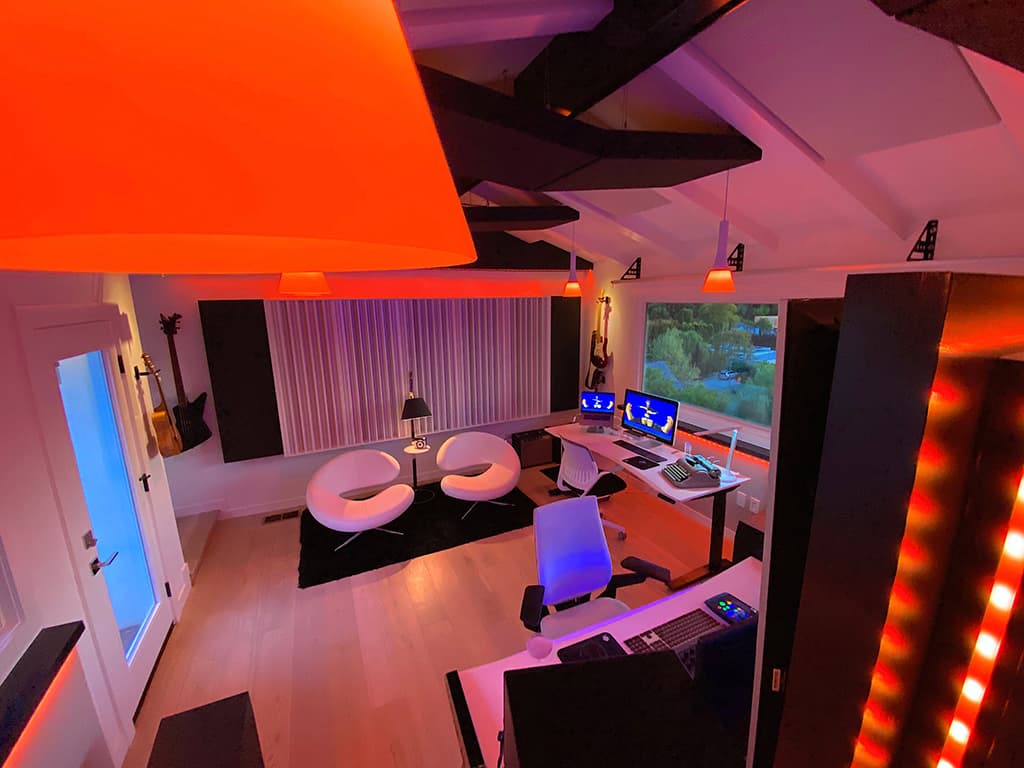
This is one of the most overlooked aspects of high-performance residential spaces. If a room is intended to be a long-term destination for professional, educational and creative activity, its look, feel, lighting and sound must match its technological ambition. That does not mean styling for its own sake, it means recognising that atmosphere has a direct relationship to performance.
A technically competent room can still feel visually fatiguing, acoustically uncomfortable or emotionally flat. An evocative E-Studio is one where technical interior design, smart lighting, acoustics and modularity work together to create an environment that is both precise and personal. It should support different moods, different uses and different times of day, while remaining aesthetically coherent and pleasant to inhabit.
This is especially important in residential settings, where the room must do serious work without feeling disconnected from the home around it. A successful E-Studio should feel like somewhere you want to spend time, not simply somewhere you have to work. Good lighting, considered materials and visual calm can support focus, communication and creative flow, while a visually chaotic or acoustically harsh room can quickly become tiring to use.
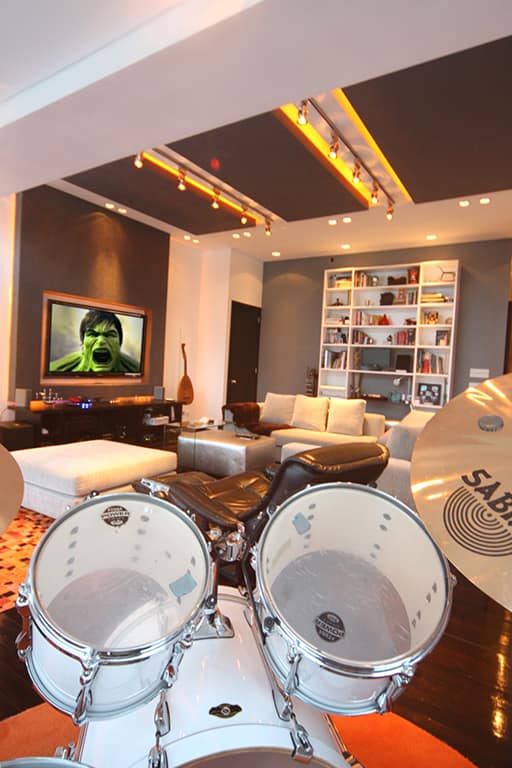
Casa Ezeiza
ScooterMusic
ACOUSTICS: PERFORMANCE BECOMES TANGIBLE
One of the most persistent misconceptions in residential studio design is the tendency to reduce all acoustic concerns to the word ‘soundproofing’. In reality, a high-performing room must usually address two different questions: how sound behaves inside the room, and how sound travels into or out of it.
Internal acoustics affect speech intelligibility, tonal balance, monitoring reliability, listening fatigue and the overall sense of clarity. Isolation affects privacy, focus, neighbour impact and outside noise. A successful residential room begins by identifying which of these problems matters most or the way the space will actually be used.
In many home or project studio settings, the first priority is not necessarily extreme isolation. It is often the creation of a room that supports controlled listening, clear communication and long-term comfort. For many E-Studio users, speech clarity tends to matter first because the room is expected to support conferencing, teaching, presentations and collaborative work for long periods throughout the day.
In many E-Studio projects, the first priority is not extreme isolation but controlled listening, clear communication and long-term comfort. For users working across conferencing, teaching, presentations and collaboration, speech clarity often matters first. For music creation, monitoring accuracy and low-frequency control may become more important. For editing or content review, the priority may be a balance between precision and comfort over extended sessions.
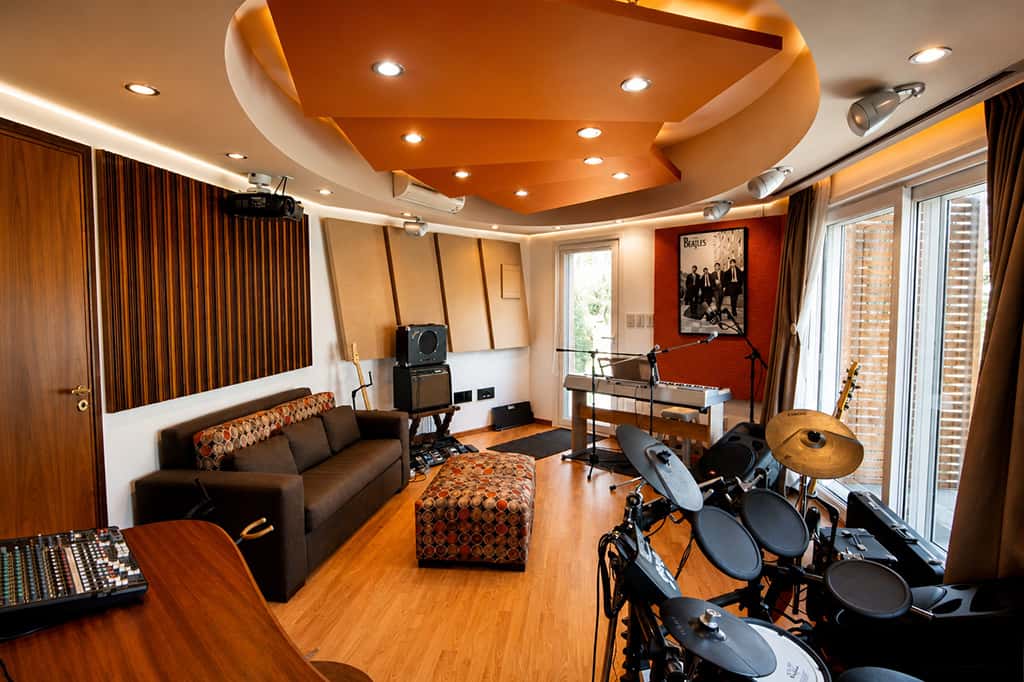
This is why acoustics cannot be added at the end. Speaker location, desk position, screen placement, surface choices, lighting integration and furniture all contribute to how a room sounds and behaves. In smaller residential spaces, acoustic success often comes not from complexity, but from getting the fundamentals right.
The same principle applies to flexibility. An E-Studio is rarely single-purpose, but successful multi-use spaces do not try to be everything at once. They establish a hierarchy of priorities first, then build flexibility around it, so secondary uses can be supported without compromising the room’s main purpose.
One of the most common mistakes people make when building or upgrading a home studio is focusing on equipment before understanding the room itself
San Isidro Residence
EVOLVED: HOME AS LAUNCHPAD
The fourth principle, Evolved, speaks to the broader shift that made the E-Studio necessary in the first place. The global pandemic was, in many ways, the dress rehearsal for many of these ideas, but the changes that followed have proved far more durable than many people initially expected. Hybrid work has not disappeared, remote collaboration has become normal, and learning, presenting, producing and managing from home are now part of everyday professional life for a much wider group of people.
This does not mean every home needs to become a studio in the traditional sense. Rather, it means that more homes will need at least one space capable of supporting higher-quality communication, creation and concentration. The next stage of E-Studio development will not be defined simply by more technology. It will be defined by better integration, greater adaptability and a clearer understanding of how people actually use their rooms over time.
As expectations continue to rise, the difference between an improvised home setup and a properly designed E-Studio will become more apparent. People will expect to sound better on calls, appear more natural on camera, move more easily between work modes, and use the same room for business, education, content and leisure without feeling that the space is constantly being reassembled. In that sense, the future E-Studio is less about creating a separate technical environment and more about embedding professional capability into residential life in a way that feels intuitive and sustainable.
For some people, that may mean a compact but highly-refined room for calls, teaching and focused work. For others, it may mean a more ambitious mission-control layout for media production, content creation or business management. In every case, the principle remains the same – the room should be designed to enable, not simply contain, the activities that matter most.
The real value of the E-Studio lies in that shift in thinking. It acknowledges that residential spaces now need to perform at a higher level, and it offers a framework for making that possible. Not through excess, and not through gadgetry, but through the careful integration of acoustics, ergonomics, AV technology, interior design and human need.
In the end, the question is no longer, ‘Can I work from home?’ It is, ‘Can my home support the full quality of the work, learning and creative life I now ask it to hold?’ The E-Studio is one answer to that question, and an increasingly relevant one.
Sergio Molho is Senior Partner and Co-CEO at WSDG. WSDG is an award-winning international firm specialising in acoustics and AV technology consulting and design. More information is available at www.wsdg.com







RESPONSES