



Hen House Rehearsal Studios Melbourne
Hen House might just be your platform for a future No. 1 and world tour. It was for owner Rob Nassif.

5 June 2025
Rob Nassif believes in rehearsal studios. Sure, he owns a few, so you’d expect him to. But for Rob, a rehearsal studio is more than a place to make a happy racket, a rehearsal studio helped him realise the rationally unattainable – a professional career as a rock ’n’ roll musician. I’ll let Rob tell the story:
Rob Nassif: “Back to 1999, when I was 18, I was the drummer in a band called Gyroscope. We’d been playing for a few years, starting out in bedrooms and garages like everyone else, until the noise complaints forced our hand. That’s when we found R&R Studios, a local rehearsal space in suburban Perth.
“To be honest, it was a dump. A proper grimy rehearsal studio. But it had soul. We rehearsed there, Karnivool had a room upstairs, End of Fashion, The Panics, Little Birdy, Jebediah – they all passed through.
“In January 2002, we wrote a song in half an hour called ‘Doctor Doctor’. We all knew it was special. Eighteen months later, it got high rotation on Triple J and helped us land a record deal. That’s the power of a song. And that’s what I want to remind people when they come to my studios – whether they’re chasing a dream or just jamming for fun. Music is magic. Anything is possible.
“In 2003, Gyroscope signed with Festival Mushroom Records. It was a huge moment. We’d been grinding for five years by that point. After signing, we went back to R&R and said to the owner, ‘We’ve just got a record deal. They’re paying us a $200 per week allowance for a rehearsal space, can we rent a room permanently to write our album?’ He said yes, and that’s where ‘Sound Shattering Sound’ was born. We became great mates with the owner, Mike, and over the years – between touring – I started working there.
“From 2003 to 2010, when I wasn’t on the road, I was behind the counter. That experience gave me real insight into what bands actually want out of a rehearsal studio – what worked, what didn’t. Meanwhile, Gyroscope kept growing. Our third album ‘Breed Obsession’ went to number one on the ARIA charts, and the single ‘Snakeskin’ had a huge AFL sync. Suddenly, at 27, I was drawing a salary from music. I saved every cent from 2007 to 2010 and eventually convinced Mike to sell me the studio. On May 1st, 2010, I became the owner of R&R Studios.”
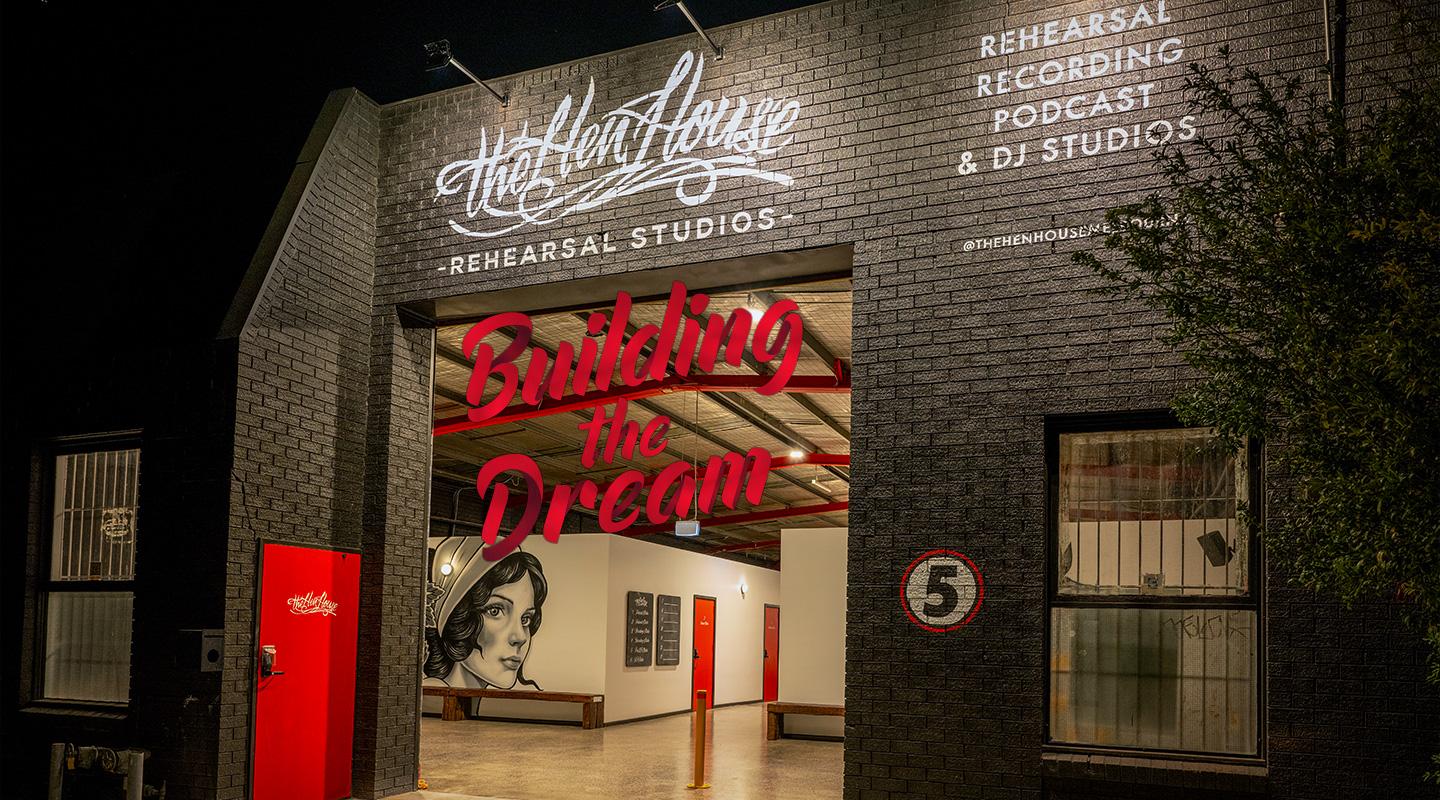
That’s quite the origin story. Rob went on to rebrand R&R Studios as The Hen House and to upgrade and expand operations. Then in 2022 he came sniffing around Melbourne to stake out a Hen House in Australia’s music capital.
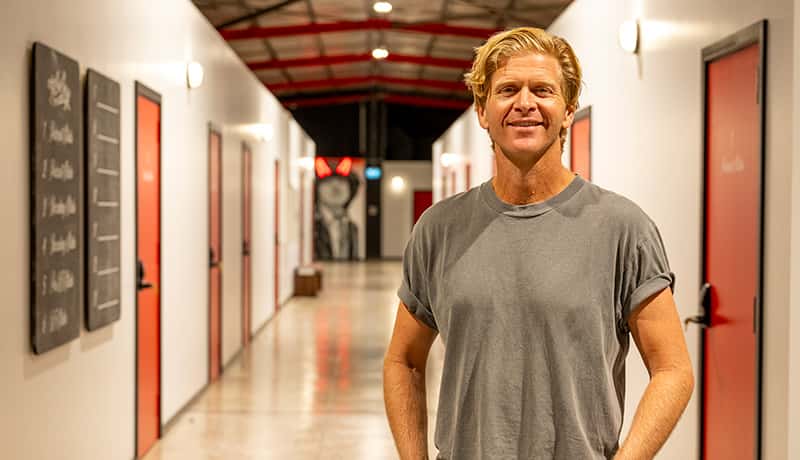
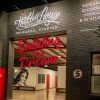
Owner Rob Nassif: “I painted every steel beam red, by hand, on a scissor lift. At the time I was thinking, ‘Is this really worth it?’ But when the high-bay lights hit those beams at night… it’s magic.
Artwork from Calum Preston and Ryan Smith.
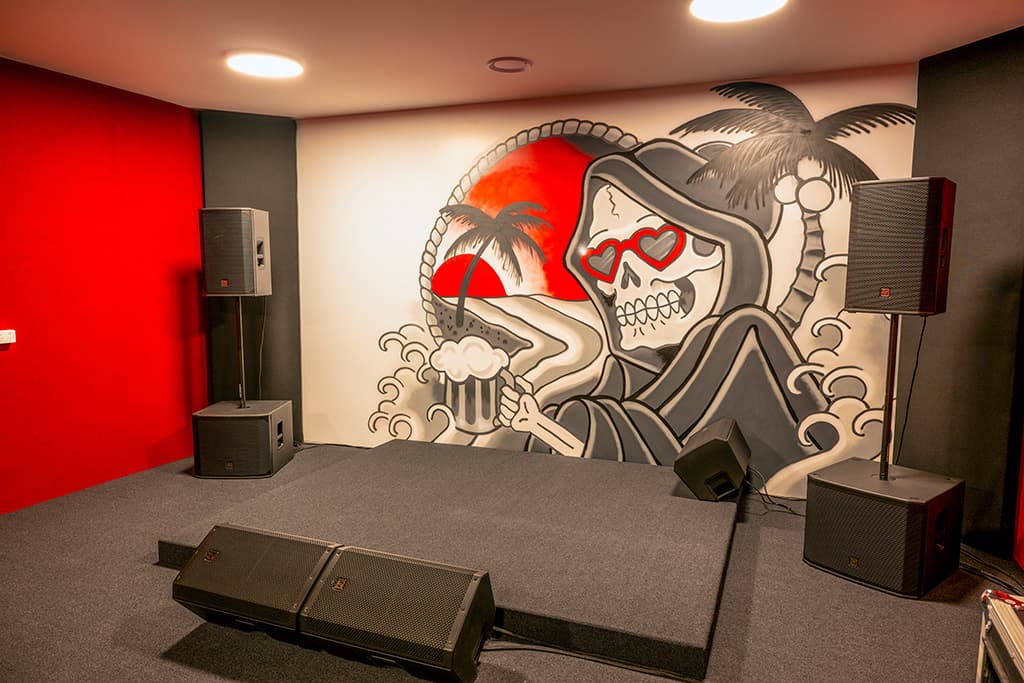
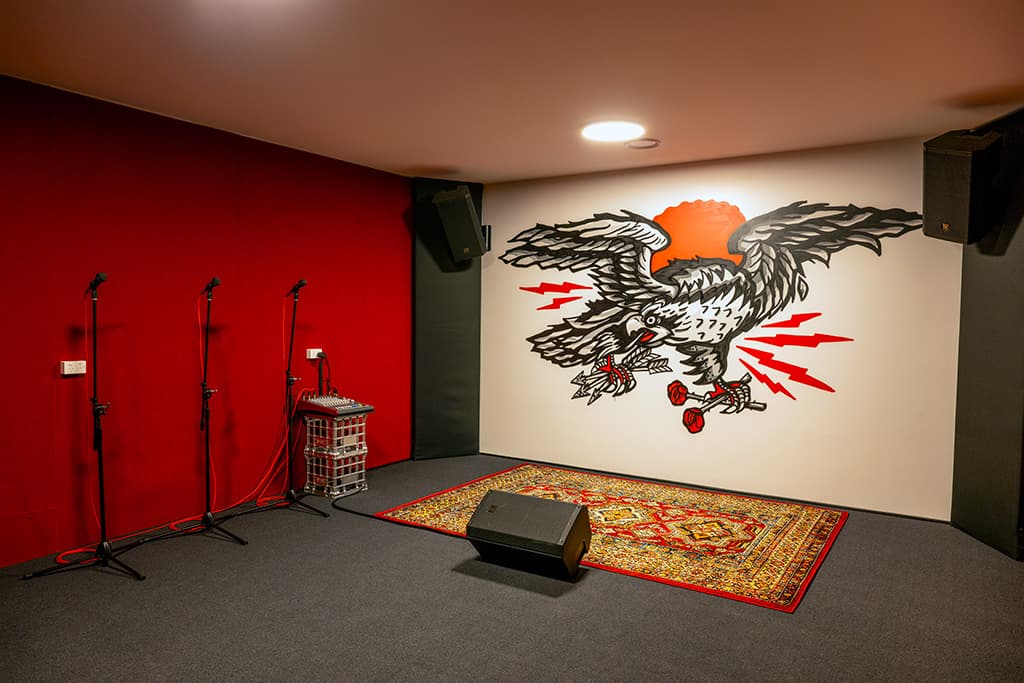
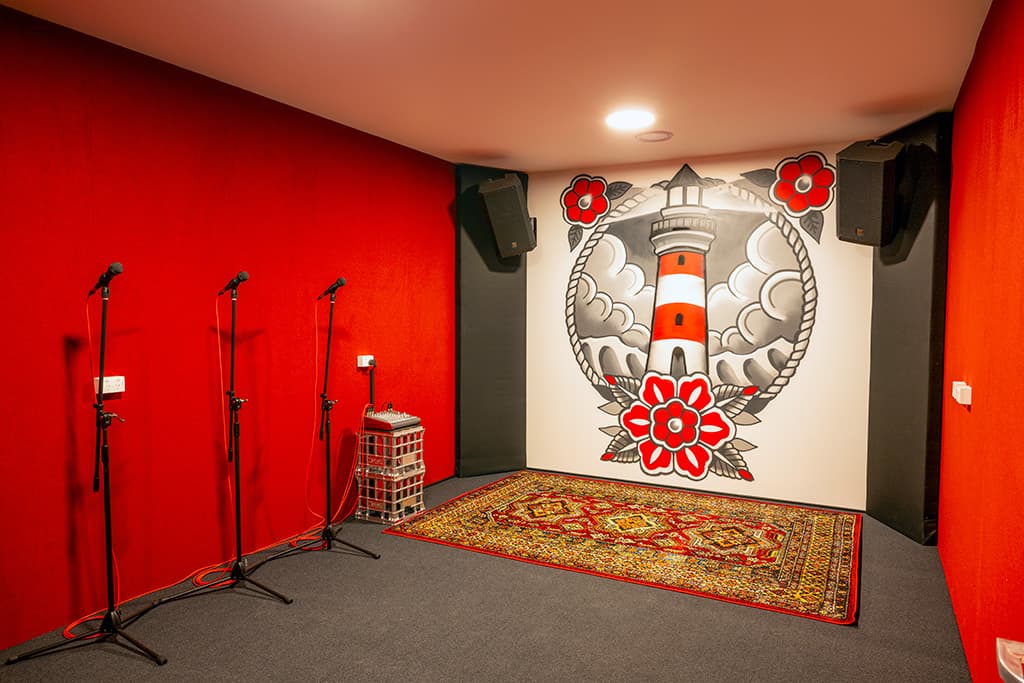
The seven rehearsal rooms lean heavily on Electro-Voice ZLX 12P G2 12-inch powered loudspeakers, Allen & Heath Zed mixers and Rode M2 dynamic mics.
FREE RANGE
It took Rob a couple of years of searching to find the ideal location. But when he did it was love at first sight – a factory site on a street with plenty of music and art already existing and in the musician-friendly suburb of Brunswick.
After months of construction and personal TLC, Rob opened The Hen House Rehearsal Studios Melbourne in May this year.
The site has approval for 18 individual studio spaces, with 13 ready at launch. These include seven rehearsal rooms of different sizes, a recording studio with an iso booth and control space a podcast studio, and two DJ studios.
All the studios have been properly designed and built for acoustic isolation and have been treated within the room to sound great (more on the build elsewhere in this article). The choice of equipment has also been agonised over – with reliability being paramount along with industry recognition.
Electro-Voice ZLX G2 powered loudspeakers carry much of the sonic load. A rehearsal studio is merciless on its PAs, copping a daily thrashing. Rob had some bad experiences in the noughties with well known powered PAs (basically running a on-site repair workshop for his own gear), and knew that his choice of loudspeakers was crucial.
“EV’s ZLX G2 is a change for us but hearing the EVs has been unbelievable,” explains Rob. “The choice comes back to offering a great service to the customers. If they can hear themselves better, that’s just a win. If their vocals sound clearer, if the drummer can hear everything… that’s important – anything to make the experience better.”
“I knew the EV ZLX G2 family of powered speakers were what Hen House needed,” says Chris Webber, Account Development Manager at Jands who’s a long-time friend of Rob’s. “EV’s reliability has been one of the key factors in recommending these speakers to Rob. With over one million ZLX boxes sold worldwide, I had the utmost confidence that these speakers could take a beating and last the distance within a rehearsal studio.”
Six of the seven rehearsal spaces feature a pair of Electro-Voice ZLX 12P G2 12-inch powered loudspeakers mounted to the rear wall. Rob designs the spaces to have the speakers mounted to get them up and out of the way without sacrificing any performance. The largest of the rehearsal rooms gets a primo combination of a pair of Electro-Voice EKX-12 passive full-range loudspeakers with an EKX-15 subwoofers, both powered by Dynacord amplification.
“We’ve ordered 24 of the ZLX G2 cabs and then four of the passive boxes for the largest of the rehearsal rooms. And then a bunch of the smaller EV installation loudspeakers for the foyer. We’ve gone deep with EV.”
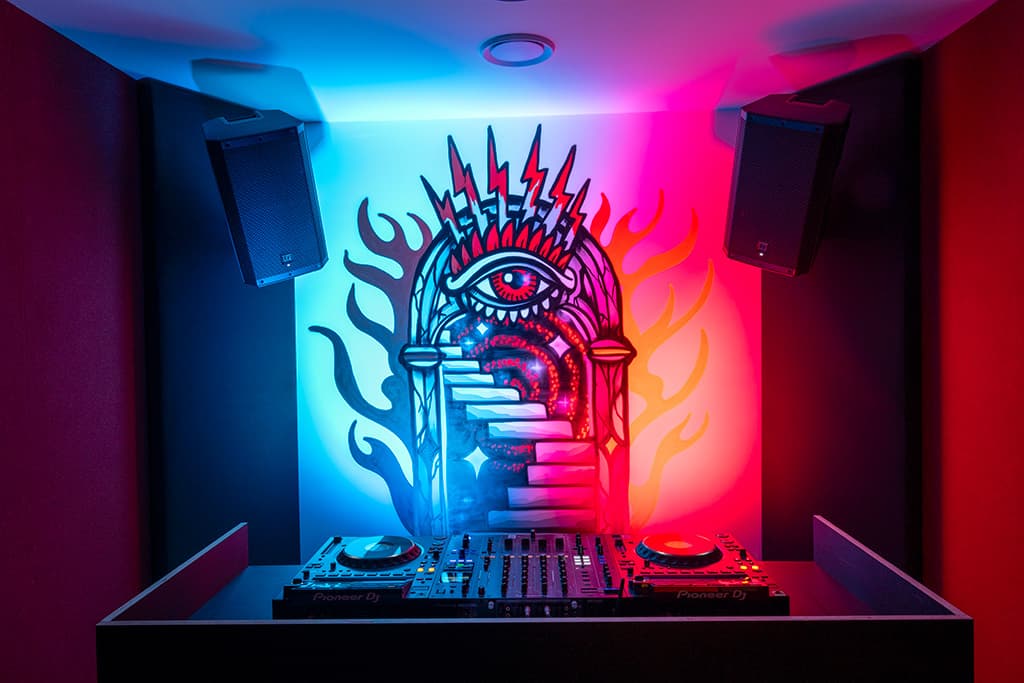
Pioneer CDJ3000 digital decks take pride of place in the DJ studios.
MORE THAN A HUTCH: THE BUILD
“Great soundproofing is crucial,” says Rob Nassif. “And it only comes from building it properly.
“You’ve got to build four walls for every room,” he goes on to explain. “Not just a single wall between two spaces, but two separate wall frames for each room, with a gap in between. It’s brutal. You lose valuable real estate, and you’re paying rent on that air for the next 20 years – but it’s the only way to do it properly.”
Each wall and ceiling is double-layered with 16mm Fyrechek Gyprock— one of the densest materials available per square metre.“It’s all about mass,” Nassif continues. “That density is key. But with that comes weight, and when you’re loading a ton of plasterboard over a big room, you need structural engineering. We had to used LVLs to carry the ceiling loads.”
Inside the walls? High-performance polyester insulation batts, not just for sound attenuation but to prevent unwanted resonance. “If you left those wall cavities empty, you’d get weird hums and resonant frequencies – because one wall vibrates, the other wall vibrates, and the cavity starts singing back at you.”
INSIDE JOB
But acoustic isolation is only half the battle. The rooms also needed to sound great on the inside. That meant high-grade acoustic treatment throughout – Rob opted for Autex compressed polyester panels. “They look great, which helps with vibe, but they also perform. Side walls get 10mm panels to tame the highs, the rear wall has 25mm panels to manage the mids, and we finish one wall with Villaboard – a reflective concrete composite – behind a mural. That hard surface adds a bit of energy back into the space.”
The real challenge, however, is the bass. “Low-end is the biggest battle in every studio,” says Nassif. “We’ve installed proper bass traps to deal with it. Especially in the DJ studio, which is a smaller room with a ton of low frequencies.”
whether they’re chasing a dream or just jamming for fun. Music is magic. Anything is possible
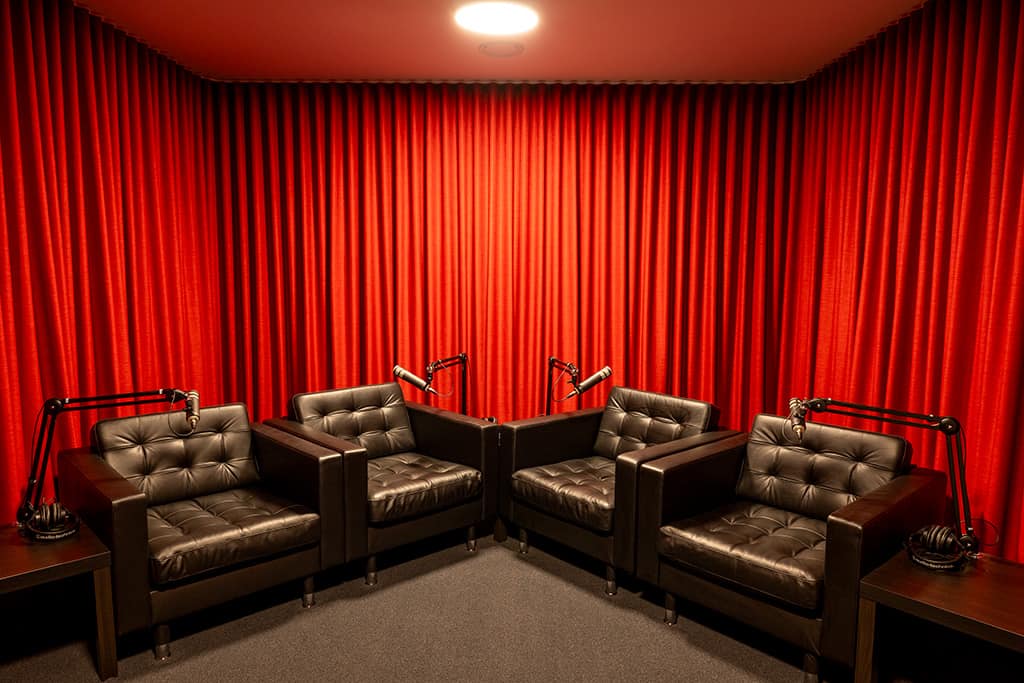
The Podcast Studio features RØDE Microphones mics and hardware, and $5000 worth of pleated drapes. For you? Only $35/hr.
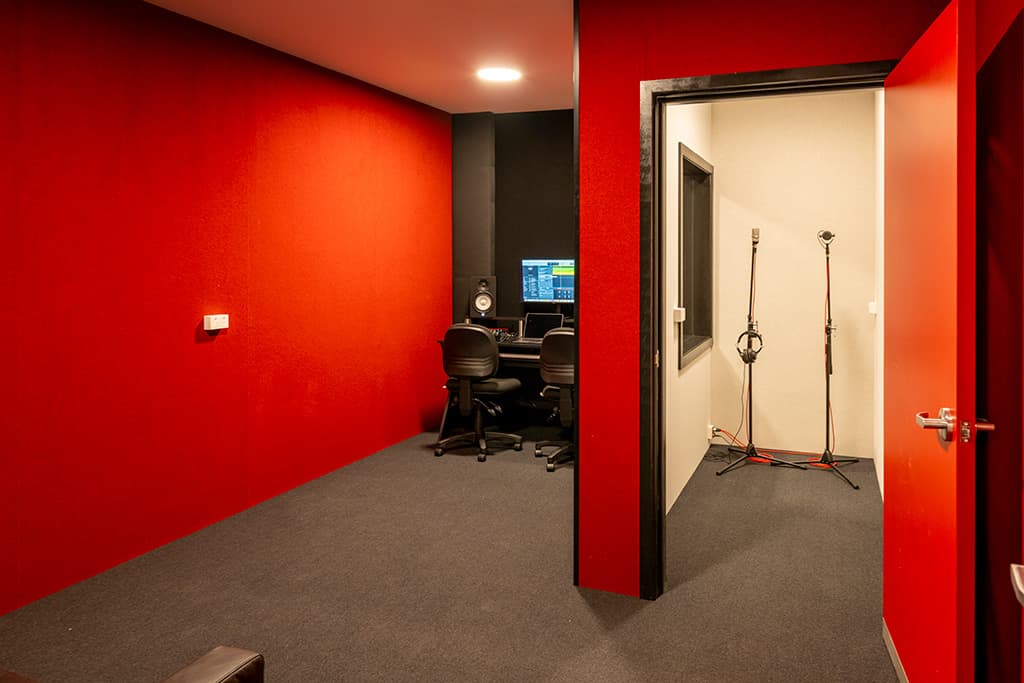
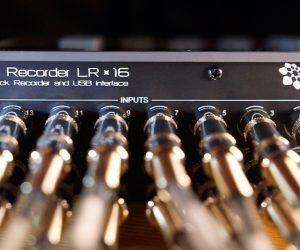
The recording studio has its own iso booth. Gear includes Yamaha monitoring, a Neumann TLM103 and a Shure SM7B microphone, along with a Focusrite audio interface.
THINKING INSIDE THE BOX
Behind the scenes, Rob credits two acoustic consultants: Darren Tardio from Enfield Acoustics (who handled planning) and Chris Fatouros from Exponential Acoustics. “Chris is a genius. He designed the ventilation ‘boxes’ that keep fresh air flowing between rooms without leaking sound.”
Those boxes turned into a massive build challenge. They use a labyrinth design, taking any leaking audio down a ‘tortuous path’ of 4.5 metres of sound absorption. “Chris pre-cut everything like an IKEA kit,” Rob laughs. “But assembling them was hell. He told me it would take an hour or so per box. In reality? More like three and a half – 26 boxes in total.”
Every seam had to be sealed with polyurethane. “We went through carton after carton. The wood was pine – never totally flat – so you had to seal, reseal, test every join.”
Still, Rob knows it was worth it. “No one sees that stuff, but it makes the studio what it is. The irony is that $40,000 wasn’t even in the budget. I said to the building surveyor, ‘Mate, do we really need these ventilation penetrations?’ He said, ‘Absolutely. No building permit without it.’”
Now it’s done. The rooms are acoustically isolated, the bass is tight, the vibe is strong – and the Hen House Melbourne is open for business.
The Hen House Rehearsal Studios Melbourne: thehenhouse.com.au/Melbourne
Jands (Electro-Voice): jands.com.au








RESPONSES