



Green Day’s Stage Sound
Monitor engineer, Danny Badorine, talks us through Green Day’s stage setup and what puts front man Billie Joe Armstrong in his happy place.

14 October 2025
Interview:/ Christopher Holder
Green Day has just got back from touring South America. You may have already be aware of this if, like me, you’ve seen huge Green Day crowds in cities like Rio and Santiago singing Bohemian Rhapsody in glorious unison on your feed.
So my first question to Green Day’s monitor engineer, Danny Badorine: what the heck is all that about?
Turns out that the Queen classic is in the preshow playlist and that South American crowds are notoriously up for it and involved. The audience gusto is also a reliable indication for Danny about just how good a night it’s going to be.
“The Bohemian Rhapsody thing is actually interesting because, okay, we do the line check, we do the changeover, we’re ready for the show. I’m sitting there, and I have the audience mics up, and I’ll usually listen to the audience mics. Audience mics are a measure of what’s going to be a good show, right? It’s either going to be a terrible-sounding venue or hopefully a great outdoor loud crowd. You hear them. They start to sing along, and I’ll look over at my tech, and we’ll go, “Oh, yeah, it’s going to be good tonight,” because they’re so loud. I look down at that fader, and I know it’s pulled down three, four, five dB more than normal, but the crowd is so loud that the energy’s right.”
It might sound odd to kick off a live sound feature story talking about audience mics but for Green Day, they take on huge importance – actually, Danny’s makes a strong case for these mics to be the most important… at least from where he’s sitting at the monitor position.

Green Day’s monitor engineer, Danny Badorine. (Photo: Dylan Rohrer)
MIKING THE CROWD
Beau Alexander was Green Day’s longtime monitor engineer before Danny Badorine. He handed off the role during preparations for the band’s 2024 Saviors Tour, providing Badorine with a pre-built Avid S6L console file and a well-established modus operandi, including 12 audience mics – six stereo pairs across the full width of the audience. Part of the audience mic armoury were Schoeps MiniCMIT shotgun mics – traditionally known as specialist and pricey, boutique mics. Danny picks up the story: “I cut out four of the mics. I now have a stereo pair in the centre and three mono mics each side panned according to their position. I also standardised on Schoeps – the MiniCMITs are so good at picking up the crowd; they provide a very 3D sound in the in-ear monitors.”
So why are the audience mics so crucial? The answer was in Beau Alexander’s ‘onboarding briefing’: “He said, ‘Hey, man, the gig is audience mics.’ I’ve learned the cues; I know the singalong spots. There are other cues, but the guys are pretty easy — Billie’s going to ask for his vocal mic up or the crowd mics up, and that’s about it.”
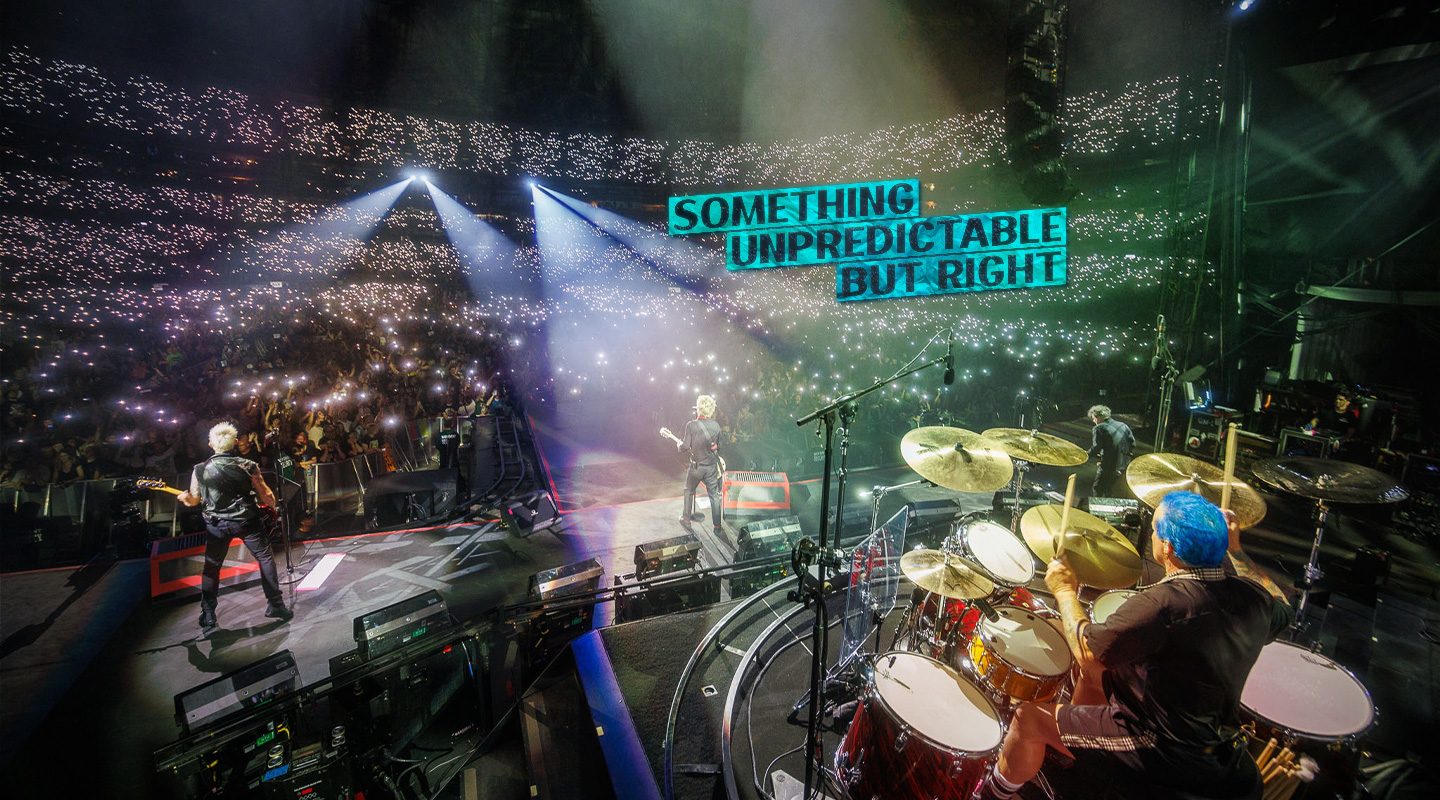
Anyone who’s experienced a Green Day gig will know that lead singer, Billie Joe Armstrong, is the consummate front man and knows how to work a crowd into a frenzy. At times he will playfully taunt the crowd, telling one side that they are louder than the other. As he does, the Schoeps audience mics provide Armstrong with perfectly panoramic image of what the crowd is up to. “It’s pretty cool,” according to Badorine. That said, he’ll admit only a few people get to hear the sonic picture painted by the Schoeps shotguns. “Billie Joe hears it. I hear it. My tech hears it. Nobody else knows the magic of what’s going on. With the Schoeps mics, you can hear the energy move. It’s spatial, it’s three-dimensional.”
The audience mics get their own VCA and Danny’s hand is hovering over it throughout the gig. When the crowd is singing along in full voice and Billie is hearing that at a perfect level there’s a certain magic happening: “Billie will get a smile that comes over him and when I see that smile and see him loving the moment then I know good things are happening – Billie feeds off that energy, the band feeds of Billie’s energy and the audience reap the rewards.”
In the audio world, you have the over-complicators and the under-complicators, and I’m an under-complicator. I want it to be as simple as possible
LOUD GIG, QUIET STAGE
Green Day roots are in the irrepressible mayhem of ’90s post punk. It’s easy to assume the original three-piece lineup spent those early years baptised in feedback and extreme stage volumes. Quite perhaps, but the band moved to in-ear monitors as soon as practicable. As monitor engineer for one of the premier live acts in the world, Danny, naturally has a perspective on this:
“If you want it to sound good out front; if you want to compete with other bands; the stage needs to be as quiet as possible. I heard a band the other day – and I don’t want to name who they are – but they were ripping. It sounded so good on the stage, but they were entirely using wedges, and it was loud. I went out front, and the guy’s mix was really, really good, but you could hear all that stage noise in every microphone, and it’s not clean.
“So sure, Green Day is a punk band, but they’re also a rock band, and they want to be the best-sounding band at every festival they play. If that’s your aspiration, then you’ll do all you can to keep the stage quiet.
“Was their transition to in-ears difficult? I wasn’t there for that, but I bet it was difficult. It’s never easy. In fact, there are a lot of people who just won’t do it, and that’s fine. I get it. I mean, I understand why a drummer might want to vibe off a massive drum fill but at front of house you can hear it roaring down every microphone on that kit, and it’s just a nightmare for the mix. So I get that IEMs don’t necessarily sound as good as a wedge, but at least your mix sounds the same everywhere on stage. So it’s a compromise. But as a band you’ve got to ask yourself: do you want it to sound really, really cool for you, or as good as it can be for the people paying to hear you?
“A noble sacrifice? I suppose it is. For a band who really cares – as Green Day does – it’s all about the fans and their desire to give the best performance possible.
“And Green Day are pioneers. Bands coming through now have it comparatively easy. In-ear monitoring isn’t cost prohibitive and there are other ways to clean up your stage sound that are getting better and better. Modelled guitar amps, for example, which I know people resist – I did for years – but the new gear is so good and so consistent. You don’t have to rip into your hearing. Even electronic drum sets. I’m about to experiment with the new DW kit – and that could well be a tradeoff that bands can now make. I mean, in a little club, you put a drummer in there, and the hi-hats are louder than everything else, and it sounds terrible. So these younger bands can get an in-ear setup and a lot of electronic stuff, and I think they could get their point across even better. The technology is going to give them a lot of advantages.”

Eight Schoeps MiniCMIT shotgun mics comprise a panoramic audience blend, primarily for the IEM mix of front man, Billie Joe Armstrong. Placing the mics is part art, science and experience. (Photo: Alice Baxley)
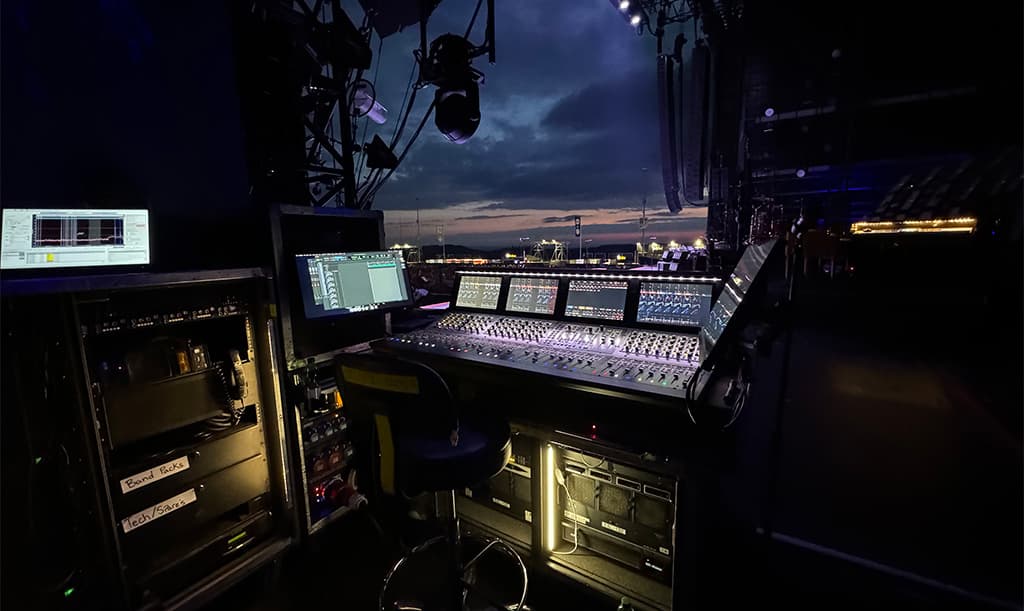
Monitors World: Danny Badorine’s mix position with an Avid S6L as the centrepiece. Danny uses Wisycom wireless for his IEMs, mainly for their wideband RF performance. (Photo: Dylan Rohrer)
AVID S6L TOUR
A little earlier we mentioned that ‘Audience Mic VCA’ on Danny’s Avid S6L. Nosing around his monitor position you’ll see signs (or no signs?) of Danny’s ‘less is more’ approach to his role.
“In the audio world, you have the over-complicators and the under-complicators, and I’m an under-complicator. I want it to be as simple as possible. I think my job is to take whatever is there and convey it to the band as accurately as possible. I’m not trying to alter it a bunch. I’m just trying to get it to them as quickly and accurately as possible. The S6L is really great for that. It’s a very transparent console. The summing bus is really good – really wide. The ability to program in function keys has also made my life easier. For example, there are a couple of times where the piano features and everyone want to hear that section. I’ll structure that piano send such that when I throw the fader to its upper limit of 12dB, it’s right on. That way, I’m not guessing. Then when I need it to return it to unity I’ve programmed an assignable button to return it exactly to 0dB. I may be an under-complicator but I’m still a bit OCD and can’t stand the idea of returning the fader to, say, -0.3dB.
“I’d probably use maybe eight or 10 plugins – all native Avid plugins; I don’t use a Waves Soundgrid – a couple of reverbs, a couple of multi-band compressors for Billie’s voice, which it’s barely touching. That’s it, because this stuff sounds good coming to me and I want it to sound natural and not too produced.”
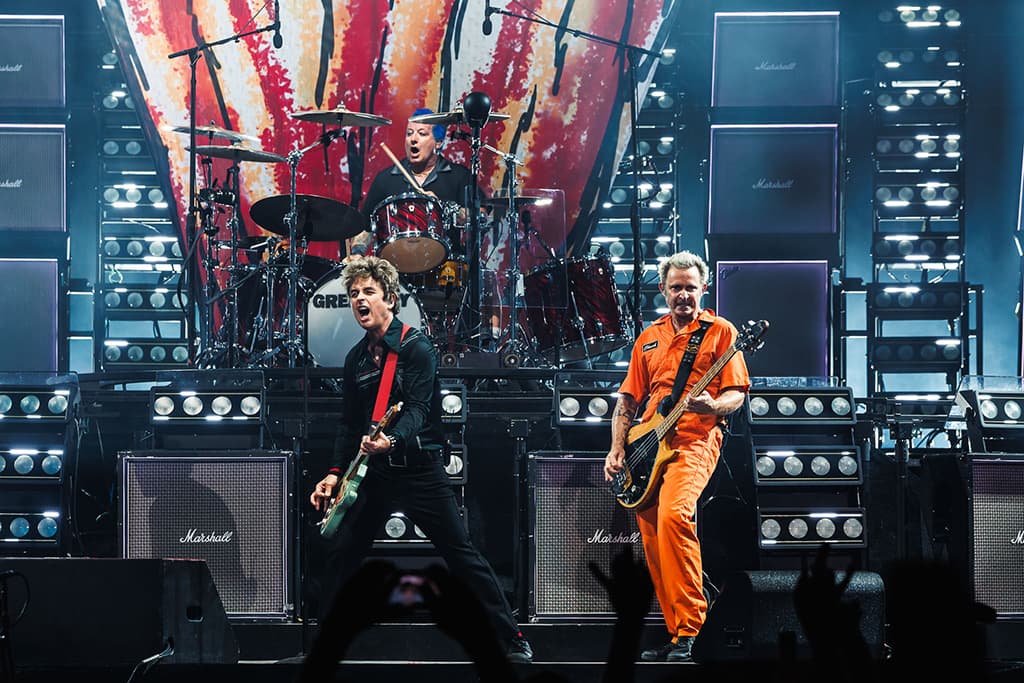
Despite all the guitar cab theatrics, the Green Day stage is quieter than most. Billie Joe Armstrong’s guitar tone comes from an amp driving two Marshall MX412 cabinets with a Josephson E22 on one and a Sennheiser 421 on the other. Jason White’s guitar setup is the same. All the guitar cabs are iso’ed off-stage. Mike Dirnt’s bass guitar is DI’ed straight into an amp (no cab). The drums rely on DPA 4099s on the toms and cymbals, a Telefunken M80 on the snare top, a DPA 2011 on the snare bottom, a Shure Beta 91 inside the kick, a Sennheiser MD421 on the kick out. Danny uses a pair of Schoeps pencil mics as overheads for Tré Cool’s IEM mix.
KEEPING COOL
Easily the most demanding of the band is drummer is Tré Cool. ‘Demanding’ is probably the wrong word; ‘discerning’ might be better. Danny explains:
“Tré has some of the best hearing of anybody I’ve ever worked with. He’s very picky about his drums, and I love it. It’s one of the things that makes him good. He hears everything. It amazes me sometimes. If somebody misses a note, Tré hears it – nothing gets past him. He might ask you to turn a cymbal up a dB and it’s like his whole world’s better. He hears it. It’s not like he’s making it up. He’s not trying to make my job harder.”
It became clear to Danny that he’d have to go ‘above and beyond’ to ensure Tré was drumming with a smile on his face. He devotes a layer on the Avid S6L entirely to the drum mix using doubled input channels with their own processing and EQ:
“I figured out a while ago that the frequency response if in-ears is often compromised. I use master EQ to flatten that out and get it closer to what’s called the Harman curve, which is essentially an earphone curve that better mimics what the ear would recognise as a flat response from a pair of studio monitors, say. So I use output EQ, which is pulling out a lot of low mid-range. With his drums, and with the DPA 4099 clip-on mics, they don’t get a lot of the attack, so I’ll add some top-end to the toms, and a little bit of compression on parts of the kit. Working with doubled channels works well because the guitars need different EQ in his mix – just to get them fitting nicely into his drums-heavy mix.”
Finally, to stay on a Schoeps tip, Danny uses a pair of Schoeps overheads for Tré’s in-ear mix. “It gives him a great image of the kit. Front of house will use individual underhead cymbal mics for the mix but Tré’s happier with the stereo pairing of the Schoeps mics.”
HOME RUN
Danny Badorine has one of the best audio gigs in the world, and he knows it. He gets to work with one of the best bands going around and with a team who are all pushing to do the best they can for the fans – no melodrama or aggression. Each night Danny strives for perfection:
“I try to pitch a perfect game. I don’t want anyone to ask for anything – I just want to serve it all up and anticipate it. If Billie doesn’t ask for anything, then that’s a measure of a good night for me. Even if they do, sure, they’ll want something and they’ll want it immediately, but there’s no edge or snark. Nobody gives you ‘the look’.
“It’s a great gig and a great crew. If something’s not quite right, then they’ll support you. We all just want it to be good.”



RESPONSES